
UNITED NATIONS: The UN General Assembly on Wednesday overwhelmingly adopted a resolution calling for an immediate and unconditional ceasefire in Gaza, a symbolic gesture rejected by the United States and Israel.
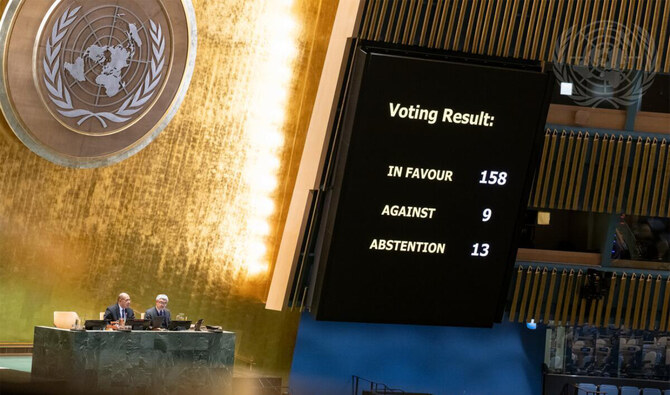
The resolution — adopted by a vote of 158-9, with 13 abstentions — urges “an immediate, unconditional and permanent ceasefire,” and “the immediate and unconditional release of all hostages” — wording similar to a text vetoed by Washington in the Security Council last month.
At that time, Washington used its veto power on the Council — as it has before — to protect its ally Israel, which has been at war with Hamas in the Gaza Strip since the Palestinian militant group’s October 7, 2023 attack on Israel.
It has insisted on the idea of making a ceasefire conditional on the release of all hostages in Gaza, saying otherwise that Hamas has no incentive to free those in captivity.
Palestinian militant group Hamas said on Thursday it welcomed a UN General Assembly vote.
Hamas said in a statement it “welcomes the adoption (on Wednesday) of the UN General Assembly resolution, supported by 158 countries, demanding a ceasefire in Gaza, enabling civilians in the (Gaza) Strip to have immediate access to essential services and humanitarian aid.”
Deputy US Ambassador Robert Wood repeated that position Wednesday, saying it would be “shameful and wrong” to adopt the text.
Ahead of the vote, Israel’s UN envoy Danny Danon said: “The resolutions before the assembly today are beyond logic. (...) The vote today is not a vote for compassion. It is a vote for complicity.”
The General Assembly often finds itself taking up measures that cannot get through the Security Council, which has been largely paralyzed on hot-button issues such as Gaza and Ukraine due to internal politics, and this time is no different.
The resolution, which is non-binding, demands “immediate access” to widespread humanitarian aid for the citizens of Gaza, especially in the besieged north of the territory.
Dozens of representatives of UN member states addressed the Assembly before the vote to offer their support to the Palestinians.
“Gaza doesn’t exist anymore. It is destroyed,” said Slovenia’s UN envoy Samuel Zbogar. “History is the harshest critic of inaction.”
That criticism was echoed by Algeria’s deputy UN ambassador Nacim Gaouaoui, who said: “The price of silence and failure in the face of the Palestinian tragedy is a very heavy price, and it will be heavier tomorrow.”
Hamas’s October 2023 attack on southern Israel resulted in the deaths of 1,208 people, mostly civilians, according to an AFP tally based on official figures. That count includes hostages who died or were killed while being held in Gaza.
Militants abducted 251 hostages, 96 of whom remain in Gaza, including 34 the Israeli military says are dead.
Israel’s retaliatory offensive in Gaza has killed at least 44,805 people, a majority of them civilians, according to data from the Hamas-run health ministry that is considered reliable by the United Nations.
“Gaza today is the bleeding heart of Palestine,” Palestinian UN Ambassador Riyad Mansour said last week during the first day of debate in the Assembly’s special session on the issue.
“The images of our children burning in tents, with no food in their bellies and no hopes and no horizon for the future, and after having endured pain and loss for more than a year, should haunt the conscience of the world and prompt action to end this nightmare,” he said, calling for an end to the “impunity.”
The Gaza resolution calls on UN Secretary-General Antonio Guterres to present “proposals on how the United Nations could help to advance accountability” by using existing mechanisms or creating new ones based on past experience.
The Assembly, for example, created an international mechanism to gather evidence of crimes committed in Syria starting from the outbreak of civil war in 2011.
A second resolution calling on Israel to respect the mandate of the UN agency supporting Palestinian refugees (UNRWA) and allow it to continue its operations was passed Wednesday by a vote of 159-9 with 11 abstentions.
Israel has voted to ban the organization starting January 28, after accusing some UNRWA employees of taking part in Hamas’s devastating attack.