DAMASCUS: After racing from Lebanon to Syria to celebrate the fall of the Assad regime and making arrangements for his family to follow, 42-year-old Anas Idrees knew what was next on his list of priorities.
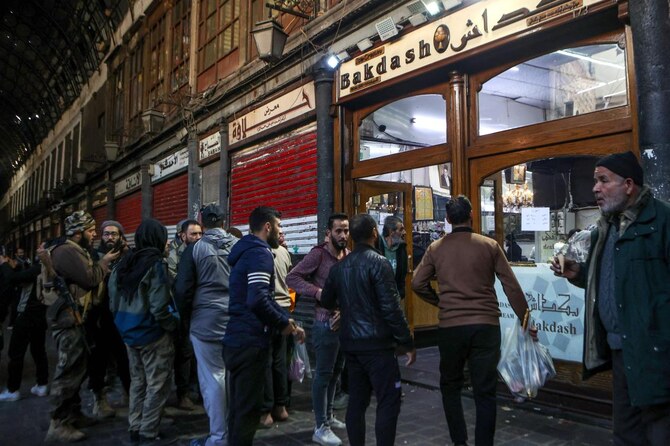
He ventured into the grand Hamidiyeh Souk in old Damascus until he arrived at the renowned Bakdash ice cream parlour, then ordered a large scoop of their signature mastic-infused Arabic gelato.
Idrees had last savoured it 15 years earlier, before the Syrian civil war made him a refugee.
“I swear to God, it tastes different now,” he said after eating a spoonful. “It was good before, but it’s changed because now we are happy inside.”
For more than 100 years and through many wars, Bakdash has served up an Arabic-style of ice cream that is infused with Sahlab, a flour made from orchid roots and pounded by hand with meter-long mallets until it takes on a soft, stretchy texture.
A generous heap costs just $1 per bowl, and is served coated in pistachios.
Bakdash is much-loved across Syria, but many Syrians have been unable to visit their capital city since former Syrian President Bashar Assad cracked down on pro-democracy protests in 2011, igniting a 13-year civil war that divided the country.
In the wake of Assad’s ouster following a lightning rebel advance, tens of thousands of Syrians have converged on Damascus from across the country and outside its borders.
On Monday, hundreds turned up at Bakdash, many of them fighters fresh from the battlefield who slung guns around their backs to tuck into the cool treat that sometimes got caught in long, unkempt beards.
Ahmed Aslaan, a 22-year-old combatant wearing green fatigues, said he had not seen Damascus in more than a decade and enjoying the ice cream was a perk of his newfound freedom.
“Thank God we achieved our goal. Now we can go around all of Syria in our own car,” he said between bites. “We were all stuck in a tiny area before, now we have space.”
Co-owner Samir Bakdash said reopening the day after Assad fell was his way to show his joy at the end of a government that oppressed Syrians for decades and forced him to pay bribes just to keep his shop open.
He insisted the signature recipe had not changed since his great-grandfather came up with it in the 1890s.
But even regular customers said something felt new.
“It tastes different – it’s delicious and has gotten even better,” said Eman Ghazal, a business student in her 20s who has been coming to Bakdash since she was a child.
“It’s not just the ice cream, it’s life in general. It’s as if the walls are smiling and the sun has finally come out.”

Syrians taste freedom at famous Damascus ice cream parlour
https://arab.news/83jkk
Syrians taste freedom at famous Damascus ice cream parlour
- Idrees had last savoured it 15 years earlier, before the Syrian civil war made him a refugee
- For more than 100 years and through many wars, Bakdash has served up an Arabic-style of ice cream that is infused with Sahlab
Washington presses Syria to shift from Chinese telecom systems
- Syria is exploring the possibility of procuring Chinese technology
- It was unclear whether the United States pledged financial or logistical support to Syria to do so
DAMASCUS: The United States has warned Syria against relying on Chinese technology in its telecommunications sector, arguing it conflicts with US interests and threatens US national security, according to three sources familiar with the matter.
The message was conveyed during an unreported meeting between a US State Department team and Syrian Communications Minister Abdulsalam Haykal in San Francisco on Tuesday. Washington has been coordinating closely with Damascus since 2024, when Syria’s now President Ahmed Al-Sharaa ousted longtime leader Bashar Assad, who had a strategic partnership with China.
Syria is exploring the possibility of procuring Chinese technology to support its telecommunications towers and the infrastructure of local Internet service providers, according to a Syrian businessman involved in the procurement talks.
“The US side asked for clarity on the ministry’s plans regarding Chinese telecom equipment,” said another source briefed on the talks.
But Syrian officials said infrastructure development projects were time-critical and that Damascus was seeking greater vendor diversity, the source added.
SYRIAN OFFICIALS CITE US EXPORT CONTROLS AS TELECOMS BARRIER
Syria is open to partnering with US firms but the matter was urgent and export controls and “over-compliance” remained an issue, according to person familiar with the meeting in San Francisco.
A US diplomat familiar with the discussions told Reuters that the US State Department “clearly urged Syrians to use American technology or technology from allied countries in the telecoms sector.”
It was unclear whether the United States pledged financial or logistical support to Syria to do so.
Responding to Reuters questions, a US State Department spokesperson said: “We urge countries to prioritize national security and privacy over lower-priced equipment and services in all critical infrastructure procurement. If it seems too good to be true, it probably is.”
The spokesperson added that Chinese intelligence and security services “can legally compel Chinese citizens and companies to share sensitive data or grant unauthorized access to their customers’ systems” and promises by Chinese companies to protect customers’ privacy were “entirely inconsistent with China’s own laws and well-established practices.”
China has repeatedly rejected allegations of it using technology for spying purposes.
The Syrian Ministry of telecommunications told Reuters any decisions related to equipment and infrastructure are made “in accordance with national technical and security standards, ensuring data protection and service continuity.”
The ministry said it is also prioritizing the diversification of partnerships and technology sources to serve the national interest.
Syria’s telecom infrastructure has relied heavily on Chinese technology due to US sanctions imposed on successive Assad governments over the civil war that grew from a crackdown on anti-government protests in 2011.
Huawei technology accounts for more than 50 percent of the infrastructure of Syriatel and MTN, the country’s only telecom operators, according to a senior source at one of the companies and documents reviewed by Reuters. Huawei did not immediately respond to a request for comment.
Syria is seeking to develop its private telecommunications sector, devastated by 14 years of war, by attracting foreign investment.
In early February, Saudi Arabia’s largest telecom operator, STC, announced it would invest $800 million to “strengthen telecommunications infrastructure and connect Syria regionally and internationally through a fiber-optic network extending over 4,500 kilometers.”
The ministry of telecommunications says that US restrictions “hinder the availability of many American technologies and services in the Syrian market,” emphasizing that it welcomes expanding cooperation with US companies when these restrictions are lifted.
Syria has inadequate telecommunications infrastructure, with network coverage weak outside city centers and connection speeds in many areas barely exceeding a few kilobits per second.


