

Netanyahu assails media as he testifies for first time in his corruption trial

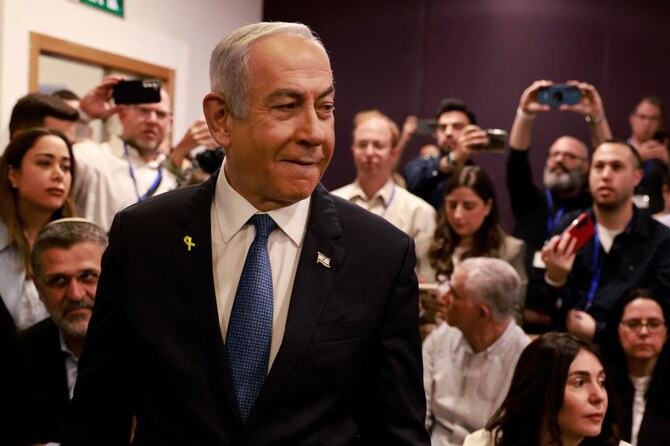
Israeli Prime Minister Benjamin Netanyahu arrives at the district court in Tel Aviv for his hearing on corruption charges on Dec. 10, 2024. (AFP)
Short Url
Updated 10 December 2024
Follow

Netanyahu assails media as he testifies for first time in his corruption trial

  • “I have been waiting for eight years for this moment to tell the truth,” Netanyahu told the three-judge court
  • “But I am also a prime minister … I am leading the country through a seven-front war. And I think the two can be done in parallel”

TEL AVIV: Israeli Prime Minister Benjamin Netanyahu took the witness stand for the first time on Tuesday in his long-running corruption trial, saying he was being hounded for his hawkish security policies.
Netanyahu, 75, is Israel’s first sitting prime minister to be charged with a crime. He is testifying at the same time Israel is engaged in a war in Gaza and facing possible new threats posed by regional turmoil, including in Syria.
Last week judges ruled that Netanyahu, indicted in 2019, must testify three times a week, forcing the longtime Israeli leader to juggle between the courtroom and the war room at Israel’s Defense Ministry, minutes away from the courthouse.
The leader of the right-wing Likud party, Netanyahu assailed the Israeli media for what he called its leftist stance and accused journalists of having hounded him for years because his policies did not align with a push for a Palestinian state.
“I have been waiting for eight years for this moment to tell the truth,” Netanyahu told the three-judge court. “But I am also a prime minister … I am leading the country through a seven-front war. And I think the two can be done in parallel.”
Prosecutors accuse Netanyahu of granting regulatory favors worth around 1.8 billion shekels (about $500 million) to Bezeq Telecom Israel (BEZQ.TA) in return for positive coverage of himself and his wife Sara on a news website controlled by the company’s former chairman.
He is also accused of negotiating a deal with the owner of Israel’s Yedioth Ahronoth newspaper for better coverage in return for legislation to slow the growth of a rival paper.
Netanyahu denies the allegations against him and has pleaded not guilty. He stood rather than sat in the witness box throughout his morning testimony.
“Had I wanted good coverage all I would have had to have done would be to signal toward a two-state solution. ... Had I moved two steps to the left I would have been hailed,” he said.
In lengthy replies, he portrayed himself as a staunch defender of Israel’s security, withstanding pressures from international powers and a hostile domestic media.

TRIAL IN UNDERGROUND COURTROOM
Netanyahu smiled confidently when he entered the Tel Aviv District Court around 10 a.m. (0800 GMT). The trial was moved from Jerusalem for undisclosed security reasons and convened in an underground courtroom.
Before Netanyahu took the stand, his lawyer Amit Hadad laid out for the judges what the defense maintains are fundamental flaws in the investigation. Prosecutors, Hadad said, “weren’t investigating a crime, they were going after a person.”
A few dozen protesters gathered outside the courthouse, some of them supporters and others demanding he do more to negotiate the release of some 100 hostages still held by Hamas in Gaza.
Israel has been waging war in Gaza against the Palestinian militant group for more than a year, during which Netanyahu had been granted a delay for the start of his court appearances. But last Thursday, judges ruled that he must start testifying.
Charged with bribery, fraud and breach of trust, Netanyahu will testify three times a week, the court said, despite the Gaza war and possible new threats posed by wider Middle East turmoil.
Netanyahu was indicted in three cases involving gifts from millionaire friends and for allegedly seeking regulatory favors for media tycoons in return for favorable coverage. He denies any wrongdoing.
In the run-up to his court date, Netanyahu revived familiar pre-war rhetoric against law enforcement, describing investigations against him as a witch hunt. He denies the charges and has pleaded not guilty.

DIVISIONS AMONG THE ISRAELI PUBLIC
Before the war, Netanyahu’s legal troubles bitterly divided Israelis and shook Israeli politics through five rounds of elections. His government’s bid last year to curb the powers of the judiciary further polarized Israelis.
The shock Hamas attack on Israel on Oct. 7, 2023, and the ensuing Gaza war swept Netanyahu’s trial off the public agenda as Israelis came together in grief and trauma. But as the war dragged on, political unity crumbled.
In recent weeks, while fighting abated on one front after Israel reached a ceasefire with Hamas’ Lebanese ally Hezbollah, members of Netanyahu’s cabinet, including his justice and police ministers, have clashed with the judiciary.
His domestic legal woes were compounded last month when the International Criminal Court (ICC) issued an arrest warrant for him and his former defense chief Yoav Gallant along with a Hamas leader, for alleged war crimes in the Gaza conflict.


Sudan defense minister dismisses ‘intelligence document’ as fabrication after convoy strike

Updated 12 February 2026
Follow

Sudan defense minister dismisses ‘intelligence document’ as fabrication after convoy strike

  • Gen. Hassan Kabroun tells Arab News claims that army hid weapons in aid convoy are “completely false”

RIYADH: Sudan’s defense minister has firmly denied reports attributed to Sudanese intelligence alleging that a convoy targeted in North Kordofan was secretly transporting weapons under the cover of humanitarian aid.

Gen. Hassan Kabroun described the claims as “false” and an attempt to distract from what he called a militia crime.

The controversy erupted after news reports emerged that a document attributed to Sudan’s General Intelligence Service claimed the convoy struck in Al-Rahad on Friday was not a purely humanitarian mission, but was instead carrying “high-quality weapons and ammunition” destined for Sudanese Armed Forces units operating in the state.

The report further alleged that the convoy had been outwardly classified as humanitarian in order to secure safe passage through conflict zones, and that the Rapid Support Forces had destroyed it after gathering intelligence on its route and cargo.

Kabroun categorically rejected the narrative.

“First of all, we would like to stress the fact that this news is false,” he told Arab News. “Even the headline that talks about the security of the regions, such as Al-Dabbah, is not a headline the army would use.”

He described the document as fabricated and politically motivated, saying it was designed to “cover up the heinous crime they committed.”

The minister affirmed that the area targeted by drones is under full control of the Sudanese Armed Forces and does not require any covert military transport.

“Second, we confirm that the region that was targeted by drones is controlled by the army and very safe,” Kabroun said. “It does not require transporting any military equipment using aid convoys as decoys because it is a safe area controlled by the army, which has significant capabilities to transport humanitarian aid.”

According to the minister, the Sudanese military has both the logistical capacity and secure routes necessary to move equipment openly when needed.

“The army is professional and does not need to deliver anything to Kadugli or Dalang on board aid convoys,” he said. “The road between Dalang and Kadugli is open. The Sudanese forces used that road to enter and take control of the region. The road is open and whenever military trucks need to deliver anything, they can do so without resorting to any form of camouflage.”

Kabroun further rejected any suggestion that the military uses humanitarian operations as cover.

“Aid is transported by dedicated relief vehicles to the areas in need of this assistance,” he said. “Aid is not transported by the army. The army and security apparatus do not interfere with relief efforts at all, and do not even accompany the convoys.”

He stressed that the Sudanese Armed Forces maintains a clear institutional separation between military operations and humanitarian work, particularly amid the country’s crisis.

“These are false claims,” he said. “This fake news wanted to cover up the heinous crime they committed.”

Sudan has been gripped by conflict since April 2023, when fighting broke out between the Sudanese Armed Forces and the Rapid Support Forces, plunging the country into what the United Nations has described as one of the world’s worst humanitarian disasters.

The latest dispute over the convoy comes amid intensified fighting in South Kordofan, a strategically sensitive region linking central Sudan with the contested areas of Darfur and Blue Nile.

The false report suggested that intelligence monitoring had enabled the RSF to strike what it described as a military convoy disguised as humanitarian aid. But Kabroun dismissed that version outright.

“The intelligence agency is well aware of its duties,” he said. “The Sudanese Army has enough weapons and equipment to use in the areas of operations. These claims are completely false.”

He argued that the narrative being circulated seeks to shift blame for attacks on civilian infrastructure and humanitarian movements.

“This shows that they are trying to cover up the atrocities,” he added, referring to the militia.

Kabroun maintained that the army has regained momentum on multiple fronts and remains fully capable of sustaining its operations without resorting to deception.

“The region is secure, the roads are open, and the army does not need camouflage,” he said. “We are operating professionally and transparently.”

“These claims are completely false,” Kabroun said. “The Sudanese Army does not use humanitarian convoys for military purposes.”