Deadline for Pakistanis to file Hajj applications under government scheme expires today

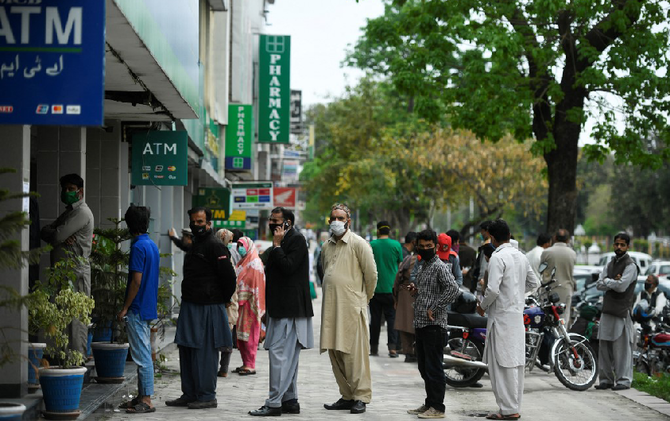
Residents wearing facemasks wait for their turn to withdraw money outside a bank in Islamabad on March 30, 2020. (AFP/File)
Short Url
Updated 10 December 2024
Follow

Deadline for Pakistanis to file Hajj applications under government scheme expires today

  • With 75,337 applications received by Tuesday, 14,268 slots remain vacant under government scheme
  • Last year, Pakistan surrendered 21,000 Hajj seats to Saudi Arabia due to a shortage of applications

ISLAMABAD: The deadline for Pakistanis to submit applications to perform the annual Hajj pilgrimage next year under the federal government scheme expires today, Tuesday, with over 75,000 submissions received.
The government last week extended the deadline for the submission of Hajj applications from Dec. 3 to Dec. 10. Saudi Arabia has allotted Pakistan a total quota of 179,210 pilgrims for the upcoming Hajj, to be divided equally between the government and private schemes.
With 75,337 Hajj applications received so far, 14,268 slots remain vacant under the government scheme as the deadline is due to expire today. Last year, Pakistan surrendered 21,000 Hajj seats to Saudi Arabia due to a shortage of applications, but this year the government hopes all slots can be filled.
“Designated banks will continue to receive Hajj applications today,” the Pakistan religious affairs ministry said on Tuesday.
“Application can be submitted to the nearest bank with the first installment of Rs200,000.”
Hajj applications opened on Nov. 18, with around 15 Pakistani banks designated to receive submissions from intending pilgrims.
The religious affairs ministry announced this year’s Hajj policy last month, allowing pilgrims to pay Hajj fees in installments for the first time. The first installment of Rs200,000 ($717) must be deposited along with the application while the second installment of Rs400,000 ($1,435) has to be submitted within ten days of balloting. The remaining amount has to be deposited by Feb. 10 next year.
Pakistan’s religious affairs ministry has launched the ‘Pak Hajj 2025’ mobile application to guide and facilitate pilgrims. The app is available for both Android and iPhone users.
The Pakistani government has also announced a reduction in airfares for Hajj 2025, with a Rs14,000 ($50) drop in ticket prices. Pilgrims enrolled in the federal program will now pay Rs220,000 for airfare, down from last year’s Rs234,000. The national flag carrier, the Pakistan International Airlines (PIA), Saudi Airlines and other private airlines have agreed to the relief package, according to the Pakistan government.


Pakistan alleges India behind Balochistan attacks that killed 18 civilians, 15 troops

Updated 6 sec ago
Follow

Pakistan alleges India behind Balochistan attacks that killed 18 civilians, 15 troops

  • Interior Minister Mohsin Naqvi accuses India of planning coordinated attacks across Balochistan this week 
  • Military says it killed 133 militants on Friday and Saturday in separate operations across various areas in Balochistan

ISLAMABAD: Pakistan’s Interior Minister Mohsin Naqvi this week alleged that India was behind the recent coordinated attacks in the southwestern Balochistan province that the military says killed 18 civilians and 15 troops, vowing to go after those responsible for the violence. 

Pakistan’s military said on Saturday that it had killed 133 militants in the past two days in separate operations in Balochistan. The Inter-Services Public Relations (ISPR) said 41 militants were killed in operations in Panjgur and Harnai areas on Friday while 92 militants, including three suicide bombers, were killed on Saturday as security forces repelled coordinated attacks on civilians and law enforcement personnel in Quetta, Gwadar, Mastung, Nushki, Dalbandin, Kharan, Panjgur, Tump and Pasni areas. 

It added that 18 civilians, including women, children, elderly people and laborers, were killed in the attacks in Gwadar and Kharan, while 15 security personnel were also killed during clearance operations and armed standoffs.

“India is behind these attacks,” Naqvi said during a joint press conference in Quetta late Saturday night with Balochistan Chief Minister Sarfraz Bugti. “I can tell you for sure that India planned these attacks along with these terrorists.”

He vowed that Islamabad would go after the militants who carried out these attacks and their “masters.”

“At this time it is very necessary that the world knows that the main country that is behind terrorism is India, who not only financially supports terrorists but also supports them in their planning and strategy as well,” the minister said. 

In its statement on Saturday, the ISPR said the attacks were launched by “Indian sponsored Fitna al Hindustan,” a reference the military frequently uses for the separatist Balochistan Liberation Army (BLA) militant group. 

The BLA also issued a statement on Saturday, saying it had launched what it called “Operation Herof 2.0,” claiming responsibility for attacks in multiple locations across Balochistan. 

The military had said intelligence reports have confirmed the attacks were orchestrated and directed by militant leaders operating from outside Pakistan who were in direct communication with attackers during the assaults.

Pakistan has frequently blamed India for supporting militant attacks in Balochistan and its northwestern Khyber Pakhtunkhwa (KP) provinces, charges that New Delhi has vehemently denied. 

Balochistan, which borders Iran and Afghanistan, has faced a decades-long insurgency by separatist militant groups, with Pakistani authorities frequently accusing foreign actors of backing the violence. India has repeatedly denied such allegations.