Turkiye to reopen Syria border post for returning refugees: Erdogan

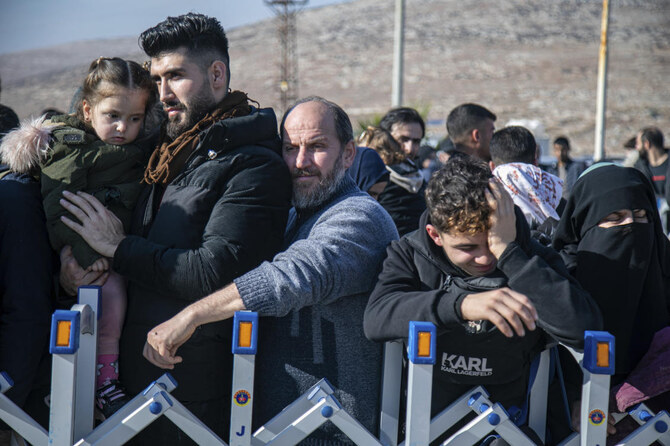
Syrians wait to cross into Syria from Turkiye at the Cilvegozu border gate, near the town of Antakya, southern Turkiye, Monday, Dec. 9, 2024. (AP)
Short Url
Updated 09 December 2024
Follow

Turkiye to reopen Syria border post for returning refugees: Erdogan

  • “In order to ease the traffic at the border, we’re opening the Yayladagi border gate,” Erdogan said, referring to a crossing on the westerly edge of the frontier

ANKARA: President Recep Tayyip Erdogan on Monday pledged to reopen a border post on Turkiye’s southern frontier with Syria to facilitate the return of refugees after the ouster of Bashar Assad.
“In order to ease the traffic at the border, we’re opening the Yayladagi border gate,” Erdogan said, referring to a crossing on the westerly edge of the frontier that has been closed since 2013.
Turkiye, which has a long border with Syria, is home to nearly three million refugees who fled their homeland after the start of the civil war in 2011, with many hundreds flocking to cross the frontier in the wake of Assad’s departure in order to finally return home.
Although not directly involved in the militant operation that ousted Assad, Turkiye has expressed support for the move and said it hoped the strongman’s removal would allow the refugees to return home.
“The strong wind of change in Syria will be beneficial for all Syrians, especially the refugees. As Syria gains stability, voluntary returns will increase and the 13-year longing of the Syrians for their homeland will come to an end,” he said.


Syria Kurds chief says ‘all efforts’ being made to salvage deal with Damascus

Updated 25 December 2025
Follow

Syria Kurds chief says ‘all efforts’ being made to salvage deal with Damascus

  • Abdi said the Syrian Democratic Forces (SDF), the Kurds’ de facto army, remained committed to the deal
  • The two sides were working toward “mutual understanding” on military integration and counter-terrorism

DAMASCUS: Syrian Kurdish leader Mazloum Abdi said Thursday that “all efforts” were being made to prevent the collapse of talks on an agreement with Damascus to integrate his forces into the central government.
The remarks came days after Aleppo saw deadly clashes between the two sides before their respective leaders ordered a ceasefire.
In March, Abdi signed a deal with Syrian President Ahmed Al-Sharaa to merge the Kurds’ semi-autonomous administration into the government by year’s end, but differences have held up its implementation.
Abdi said the Syrian Democratic Forces (SDF), the Kurds’ de facto army, remained committed to the deal, adding in a statement that the two sides were working toward “mutual understanding” on military integration and counter-terrorism, and pledging further meetings with Damascus.
Downplaying the year-end deadline, he said the deal “did not specify a time limit for its ending or for the return to military solutions.”
He added that “all efforts are being made to prevent the collapse of this process” and that he considered failure unlikely.
Abdi also repeated the SDF’s demand for decentralization, which has been rejected by Syria’s Islamist authorities, who took power after ousting longtime ruler Bashar Assad last year.
Turkiye, an important ally of Syria’s new leaders, sees the presence of Kurdish forces on its border as a security threat.
In Damascus this week, Turkish Foreign Minister Hakan Fidan stressed the importance of the Kurds’ integration, having warned the week before that patience with the SDF “is running out.”
The SDF control large swathes of the country’s oil-rich north and northeast, and with the support of a US-led international coalition, were integral to the territorial defeat of the Daesh group in Syria in 2019.
Syria last month joined the anti-IS coalition and has announced operations against the jihadist group in recent days.