

Israel says it will destroy Syria’s heavy strategic weaponry

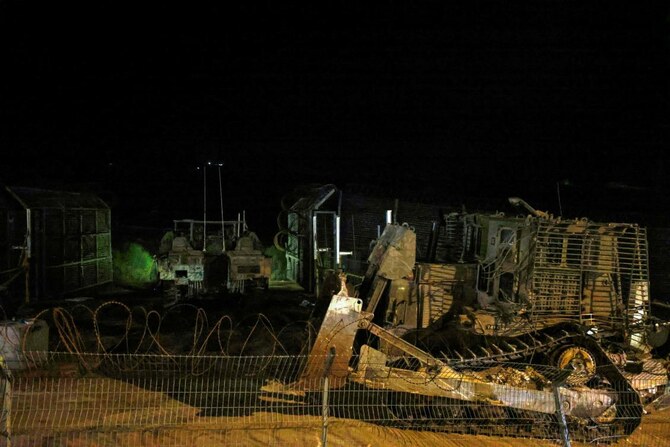
Above, Israeli military armored vehicles cross the fence to Syria near the Druze village of Majdal Shams in the Israel-annexed Golan Heights on Dec. 8, 2024. (AFP)
Short Url
Updated 09 December 2024
Follow

Israel says it will destroy Syria’s heavy strategic weaponry

  • Israeli will also keep a ‘limited’ troop presence on the ground, hoping to head off any threat that could emerge
  • The military on Monday published photos of Israeli commandos in the Syrian Mount Hermon area

JERUSALEM: Israel will step up airstrikes on Syrian stores of advanced weaponry, Israeli officials said on Monday, and keep a ‘limited’ troop presence on the ground, hoping to head off any threat that could emerge in the fallout of President Bashar Assad’s overthrow.

Israel has watched the upheaval in Syria with a mixture of hope and concern as it weighs the consequences of one of the most significant strategic shifts in the Middle East in years.

While Assad’s fall wiped out a bastion from which Israel’s arch-foe Iran had exercised influence in the region, the lightning advance of a disparate group of militant forces with roots in the Islamist ideology of Al-Qaeda poses risks.

Defense Minister Israel Katz said the military would “destroy heavy strategic weapons throughout Syria, including surface-to-air missiles, air defense systems, surface-to-surface missiles, cruise missiles, long-range rockets, and coastal missiles.”

A senior Israeli official said airstrikes would persist in the coming days, while Foreign Minister Gideon Saar said Israel had no interest in interfering in internal Syrian affairs and was concerned only with defending its citizens.

“That’s why we attack strategic weapons systems like, for example, remaining chemical weapons or long-range missiles and rockets in order that they will not fall into the hands of extremists,” Saar told reporters in Jerusalem.

Egypt has condemned Israel’s “further occupation of Syrian lands” and views the Israeli military’s movement into a buffer zone as an attempt to enforce a new reality on the ground, the foreign ministry said in a statement on Monday.

Still reeling from the Palestinian militant group Hamas’ attack in October 2023, Israel is also looking to head off any future threat from its neighbor.

Israeli forces had already cleared land mines and established new barriers on the frontier between the Israeli-occupied Golan Heights and a demilitarized strip bordering Syria in October.

Early on Sunday, the military said it had sent ground forces into the demilitarized zone, a 400-square-kilometer buffer created by a 1974 Separation of Forces Agreement and overseen by the UN Disengagement Observer Force (UNDOF).

The military on Monday published photos of Israeli commandos in the Syrian Mount Hermon area.

Saar said the troop presence was strictly limited. “It’s basically near our borders, sometimes a few hundred meters, sometimes one mile or two miles,” he said. “It is a very limited and temporary step we took for security reasons.”


Algeria inaugurates strategic railway to giant Sahara mine

President Tebboune attended an inauguration ceremony in Bechar. (AFP file photo)
Updated 02 February 2026
Follow

Algeria inaugurates strategic railway to giant Sahara mine

  • The mine is expected to produce 4 million tons per year during the initial phase, with production projected to triple to 12 million tons per year by 2030
  • The project is financed by the Algerian state and partly built by a Chinese consortium

ALGEIRS: Algerian President Abdelmadjid Tebboune on Sunday inaugurated a nearly 1,000-kilometer (621-mile) desert railway to transport iron ore from a giant mine, a project he called one of the biggest in the country’s history.
The line will bring iron ore from the Gara Djebilet deposit in the south to the city of Bechar located 950 kilometers north, to be taken to a steel production plant near Oran further north.
The project is financed by the Algerian state and partly built by a Chinese consortium.
During the inauguration, Tebboune described it as “one of the largest strategic projects in the history of independent Algeria.”
This project aims to increase Algeria’s iron ore extraction capacity, as the country aspires to become one of Africa’s leading steel producers.
The iron ore deposit is also seen as a key driver of Algeria’s economic diversification as it seeks to reduce its reliance on hydrocarbons, according to experts.
President Tebboune attended an inauguration ceremony in Bechar, welcoming the first passenger train from Tindouf in southern Algeria and sending toward the north a first charge of iron ore, according to footage broadcast on national television.
The mine is expected to produce 4 million tons per year during the initial phase, with production projected to triple to 12 million tons per year by 2030, according to estimates by the state-owned Feraal Group, which manages the site.
It is then expected to reach 50 million tons per year in the long term, it said.
The start of operations at the mine will allow Algeria to drastically reduce its iron ore imports and save $1.2 billion per year, according to Algerian media.