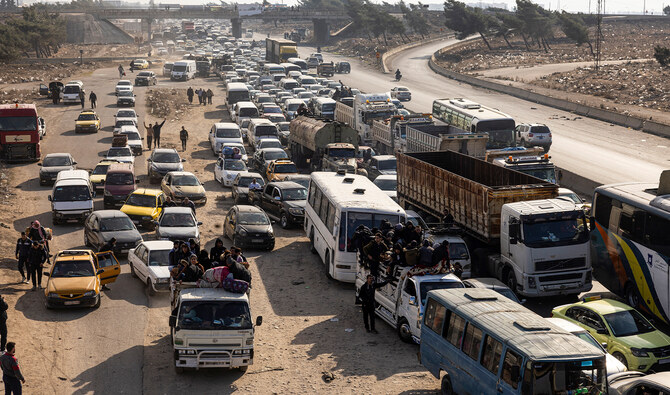
ISLAMABAD: Pakistan’s Foreign Office said on Sunday that it would repatriate more than 1,300 Pakistanis stranded in Syria once the Damascus airport reopens, following the fall of President Bashar Assad’s government.
Syria opposition forces raced into Damascus unopposed on Sunday, overthrowing President Assad and ending nearly six decades of his family’s iron-fisted rule after a lightning advance that reversed the course of a 13-year civil war.
In one of the most consequential turning points in the Middle East for generations, the fall of Assad’s government wiped out a bastion from which Iran and Russia exercised influence across the Arab world. Moscow gave him and his family asylum.
Pakistan’s Foreign Office said it was closely monitoring the evolving situation in Syria as shops and restaurants closed early in line with a curfew imposed by the Syrian opposition and people could be seen briskly walking home with stacks of bread.
“Pakistani nationals are safe in Syria and have been advised to exercise caution. The Embassy of Pakistan in Syria is open for support and advice,” the Foreign Office said on Sunday night.
“As of now Damascus Airport is closed. Our embassy remains in contact with stranded Pakistani nationals, including Zaireen [pilgrims]. It will facilitate their return once the airport opens.”
Pakistan’s embassy in Syria said it was focusing on accommodating Pakistani nationals at a school run by it so that they could have a secure place to stay while it arranges flights for their repatriation to Pakistan.
Muhammad Nafees, an official at the Pakistani embassy in Damascus, told Arab News that Syria’s airports and borders with Jordan and Oman were currently closed, posing a “major challenge” to the repatriation effort.
The official said there were around 1,200 Pakistanis expatriates living in Syria, while around 140 Pakistani pilgrims were stranded in the Sayyidah Zaynab city near Damascus.
“They were supposed to return from the pilgrimage by December 10, but are unable to proceed due to the suspension of flight operations and non-functional airports,” he added.
Separately, Pakistan’s deputy prime minister and foreign minister, Ishaq Dar, held a telephonic conversation with Turkish Foreign Minister Hakan Fidan on the unfolding situation in Syria.
“They also discussed possible cooperation between the two countries for the safety of the Pakistan nationals,” the Pakistani foreign ministry said.
Speaking to Arab News on Sunday, Pakistani pilgrims and expatriates in Syria expressed fears for their safety and called for expediting efforts to repatriate them.
Abeel Hassan, a pilgrim from Pakistan’s Parachinar, said although the situation was calm so far, the pilgrims were worried about their safety.
“Our group consists of 14 people, including women, and we have limited finances and cannot afford an extended stay at the hotel,” he said.
Ilyas Naqvi, a Pakistani expatriate from Islamabad who has been living and working in Sayyidah Zaynab along with his wife and two sons since 2000, wished for immediate repatriation.
“We request that our embassy and the Government of Pakistan act swiftly to evacuate us from Syria as soon as possible as many of us have small children,” he told Arab News, adding that there were around 200 Pakistanis, including women and children, living in Sayyidah Zaynab.
“Although the new forces have not yet threatened the people, everyone is very scared.”


![]()

Foreign Office says will repatriate Pakistanis stranded in Syria once Damascus airport reopens
Short Url
https://arab.news/cx4ut
Foreign Office says will repatriate Pakistanis stranded in Syria once Damascus airport reopens
- Pakistan’s embassy says more than 1,300 Pakistani expatriates and pilgrims are currently stranded in Syria
- Pakistani pilgrims and expatriates have expressed fears for their safety and called for immediate repatriation
Latest updates


© 2026 SAUDI RESEARCH & PUBLISHING COMPANY, All Rights Reserved And subject to Terms of Use Agreement.