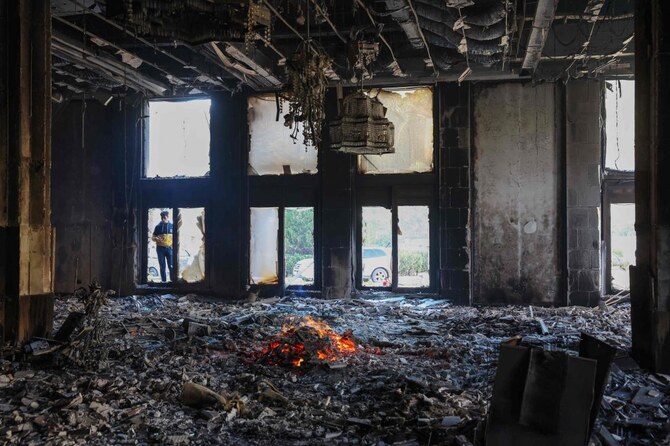
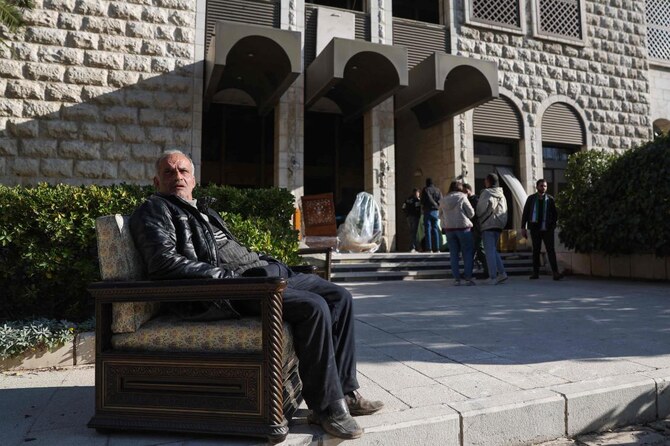
DAMASCUS: Syrians strolled through the palaces of President Bashar Assad on Sunday following his sudden ouster, wandering from room to room, posing for photographs, and with some taking away items of furniture or ornaments.
Video obtained by Reuters showed people entering the Al-Rawda Presidential Palace, as children ran through the grand, formal rooms and men slid a large trunk across the ornate patterned floor.
Several men marched out of the building carrying chairs over their shoulders. In a storeroom, cupboards had been ransacked and objects strewn across the floor.
Video of another palace, the older-style Muhajjreen Palace, verified by Reuters, showed groups of men and women walking across a white marble floor and through sets of tall wooden doors. A man carried a vase in his hand, and a large cabinet stood empty with its doors ajar. Chandeliers hung from the ceiling.
The scenes were reminiscent of the fall of Saddam Hussein’s Baathist regime in Iraq two decades ago. Then, Iraqis saw the extravagant luxury of his palaces where the bathrooms were famously fitted with gold taps.
Syrian militants seized control of Damascus on Sunday, forcing Assad to flee and ending his family’s decades of rule after more than 13 years of civil war in a seismic moment for the Middle East.
Another video verified by Reuters showed militants firing celebratory shots at the entrance gate to the New Shaab Palace (Peoples’ Palace), a vast complex on the western edge of Damascus that sits atop Mount Mazzeh.
“The army of Islam (the militants) is in the presidential palace. God is great, we have seized control of it,” said one of the militants. The group then filmed their walk through the deserted grounds and the stark, monumentalist architecture of the palace.
Assad, who had not spoken in public since the sudden militant advance a week ago, flew out of Damascus for an unknown destination earlier on Sunday, two senior army officers told Reuters, as militants said they had entered the capital with no sign of army deployments.
Russia, one of Assad’s closest allies, confirmed that Assad had left Syria but did not say where he was, including whether Moscow had given him refuge.


![]()
![]()
![]()

Syrians stroll through Assad’s palaces, take furniture and ornaments

Short Url
https://arab.news/rcm7m
Syrians stroll through Assad’s palaces, take furniture and ornaments
- The scenes were reminiscent of the fall of Saddam Hussein’s Baathist regime in Iraq two decades ago
- Video obtained by Reuters showed people entering the Al-Rawda Presidential Palace


Latest updates


© 2026 SAUDI RESEARCH & PUBLISHING COMPANY, All Rights Reserved And subject to Terms of Use Agreement.