

Kingdom in contact with all Syria stakeholders, says Saudi official 

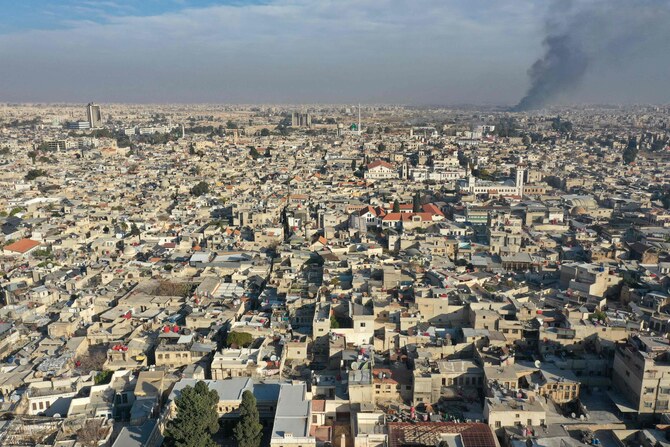
Aerial photo shows Damascus on Dec. 8, 2024, with smoke billowing in the background after militants declared that they have taken the Syrian capital in a lightning offensive, sending President Bashar Assad fleeing and ending five decades of rule in Syria. (AFP)
Short Url
Updated 08 December 2024
Follow

Kingdom in contact with all Syria stakeholders, says Saudi official 

  • 'Current situation direct consequence of Syrian govt’s lack of engagement in the political process'

DUBAI: Saudi Arabia has been communicating with all regional actors on Syria and is determined to do what is possible to avoid chaos following the ouster of President Bashar Assad, a Saudi official said on Sunday.

“We are in constant communication with Turkiye and every stakeholder involved,” the official told Reuters, adding that the Kingdom was not aware of Assad’s whereabouts.

His failure to re-engage several regional actors and the opposition was to blame for his downfall, the official said.

“The Turkish government attempted to engage and coordinate with the Syrian government, but these overtures were met with refusal,” he said.

“The current situation is a direct consequence of the Syrian government’s lack of engagement in the political process. This outcome reflects the inevitable result of such intransigence.”

Assad went to Saudi Arabia in 2023 to attend an Arab League summit, after a 12-year suspension.

“The hope was that this move would influence the Syrian government to engage more constructively with the opposition and the various stakeholders within Syria and in the region, rather than allowing the existing stalemate and fragile peace to be taken for granted,” the official said.

“We emphasized that the situation should not be underestimated, as it remained precarious. Unfortunately, this message did not result in any meaningful action from the Syrian side.”

The official said events in Syria showed some positive aspects that he hoped would continue.

“Notably, the transition has occurred without bloodshed, which is encouraging. Additionally, we appreciate the statements from various stakeholders emphasizing the importance of protecting state institutions, the sovereignty of Syria, and the rights of minority groups,” he said.

“We hope to see these positive trends continue and are committed to doing everything we can to maintain this momentum.”


UN rights chief shocked by ‘unbearable’ Darfur atrocities

Updated 19 January 2026
Follow

UN rights chief shocked by ‘unbearable’ Darfur atrocities

  • Mediation efforts have failed to produce a ceasefire, even after international outrage intensified last year with reports of mass killings, rape, and abductions during the RSF’s takeover of El-Fasher in Darfur

PORT SUDAN: Nearly three years of war have put the Sudanese people through “hell,” the UN’s rights chief said on Sunday, blasting the vast sums spent on advanced weaponry at the expense of humanitarian aid and the recruitment of child soldiers.
Since April 2023, Sudan has been gripped by a conflict between the army and the paramilitary Rapid Support Forces that has left tens of thousands of people dead and around 11 million displaced.
Speaking in Port Sudan during his first wartime visit, UN Human Rights commissioner Volker Turk said the population had endured “horror and hell,” calling it “despicable” that funds that “should be used to alleviate the suffering of the population” are instead spent on advanced weapons, particularly drones.
More than 21 million people are facing acute food insecurity, and two-thirds of Sudan’s population is in urgent need of humanitarian aid, according to the UN.
In addition to the world’s largest hunger and displacement crisis, Sudan is also facing “the increasing militarization of society by all parties to the conflict, including through the arming of civilians and recruitment and use of children,” Turk added.
He said he had heard testimony of “unbearable” atrocities from survivors of attacks in Darfur, and warned of similar crimes unfolding in the Kordofan region — the current epicenter of the fighting.
Testimony of these atrocities must be heard by “the commanders of this conflict and those who are arming, funding and profiting from this war,” he said.
Mediation efforts have failed to produce a ceasefire, even after international outrage intensified last year with reports of mass killings, rape, and abductions during the RSF’s takeover of El-Fasher in Darfur.
“We must ensure that the perpetrators of these horrific violations face justice regardless of the affiliation,” Turk said on Sunday, adding that repeated attacks on civilian infrastructure could constitute “war crimes.”
He called on both sides to “cease intolerable attacks against civilian objects that are indispensable to the civilian population, including markets, health facilities, schools and shelters.”
Turk again warned on Sunday that crimes similar to those seen in El-Fasher could recur in volatile Kordofan, where the RSF has advanced, besieging and attacking several key cities.
Hundreds of thousands face starvation across the region, where more than 65,000 people have been displaced since October, according to the latest UN figures.