White House on guard against Daesh resurgence in Syria

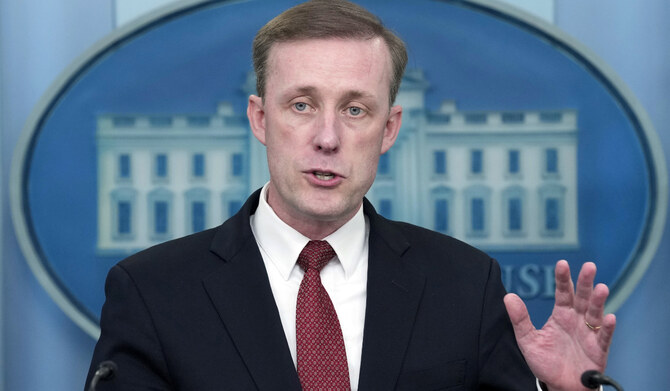
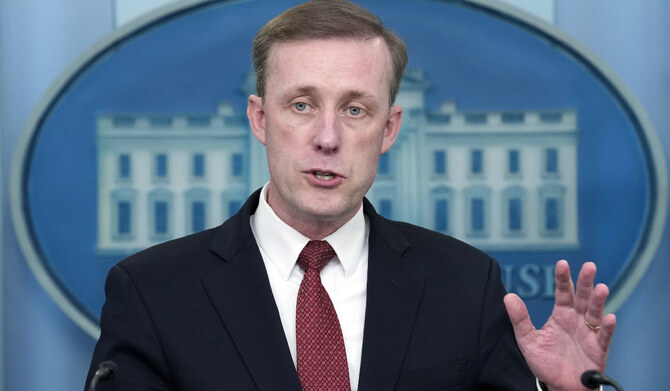
White House national security adviser Jake Sullivan speaks during the daily briefing at the White House in Washington, May 22, 2024. (AP)
Short Url
Updated 08 December 2024
Follow

White House on guard against Daesh resurgence in Syria

  • The main priority is to ensure “that the fighting in Syria not lead to a resurgence of Daesh,” Sullivan said
  • Trump, who visited Paris on Saturday, warned against US involvement in Syria, saying the country is “a mess” and “not our friend”

LOS ANGELES, United States: The White House said Saturday that US priorities in Syria now are to ensure the country’s conflict does not encourage a resurgence of the Daesh militant group or lead to a “humanitarian catastrophe.”
Spillover “is a concern,” said National Security Adviser Jake Sullivan, with particular worry about the so-called Daesh, also known as Daesh.
In previous phases of Syria’s long-running civil war, “at its worst, we saw the explosion of Daesh onto the scene,” he said at a conference in Simi Valley, California run by the Reagan National Defense Forum.
The main priority is to ensure “that the fighting in Syria not lead to a resurgence of Daesh,” Sullivan said. “We are going to take steps ourselves, directly and working with the Syrian Democratic Forces, the Kurds, to ensure that does not happen.”
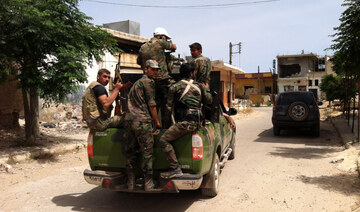
Militant forces are in the midst of a lightning offensive and say they have begun to encircle Syria’s capital Damascus.
Sullivan said the administration of outgoing US President Joe Biden is working to ensure allies Israel, Jordan, Iraq and others in the region, “who would potentially face spillover effects from Syria, are strong and secure, and we’re in touch with them every day.”
Washington is also alert to stopping a “humanitarian catastrophe, both in terms of civilians, access to life-saving necessities, and in terms of the protection of religious and ethnic minorities in Syria,” Sullivan said.
“Of course, an event like this happens and Daesh immediately looks to take advantage. We have seen reports of Daesh trying... to reconstitute to a certain extent.”
So the United States will seek to “contain the potential violence and instability,” protect allies and ensure that Daesh not “get new oxygen out of this” that could lead them to threaten US or allies’ interests, Sullivan added.
Sullivan’s remarks come as Washington prepares for a transition of power next month back to former president Donald Trump, who defeated Biden in November’s election.
Trump, who visited Paris on Saturday, warned against US involvement in Syria, saying the country is “a mess” and “not our friend.”
“THIS IS NOT OUR FIGHT,” Trump said on his Truth Social platform.
Sullivan, addressing Trump’s remarks, agreed, saying “the United States is not going to... militarily dive into the middle of a Syrian civil war.”


IAEA board meets over Ukraine nuclear safety concerns

Updated 4 sec ago
Follow

IAEA board meets over Ukraine nuclear safety concerns

  • The war in Ukraine “continues to pose the world’s biggest threat to nuclear safety,” Grossi said
  • The mission will assess 10 substations “crucial to nuclear safety,” according to Grossi

VIENNA: The UN nuclear watchdog’s board of governors on Friday discussed nuclear safety in Ukraine, with several countries expressing “growing concern” following Russian attacks on the power grid.
Energy supplies to Ukraine’s nuclear plants have been affected as Russia has pounded its neighbor’s power sector since the start of its 2022 invasion, prompting fears of a nuclear disaster.
The war in Ukraine “continues to pose the world’s biggest threat to nuclear safety,” Rafael Grossi, director general of the International Atomic Energy Agency (IAEA), said when opening the board meeting.
The extraordinary meeting that lasted four hours was called after 13 countries led by the Netherlands expressed in a letter seen by AFP a “growing concern about the severity and urgency of nuclear safety risks” following a series of attacks.
Ukrainian ambassador Yurii Vitrenko told reporters before the meeting that it was “high time” for the IAEA board to discuss the situation.
A weeks-long IAEA expert mission to Ukrainian substations and power plants is under way and expected to wrap up next month, Vitrenko said.
The mission will assess 10 substations “crucial to nuclear safety,” according to Grossi.
Russian Ambassador Mikhail Ulyanov dismissed the board’s gathering as “absolutely politically motivated,” adding there was “no real need to hold such a meeting today.”
Last week, Ukraine’s Chernobyl nuclear power plant temporarily lost all off-site power.
Europe’s biggest nuclear power plant, Zaporizhzhia, occupied by Russian forces since March 2022, has also been repeatedly affected by fighting.
Earlier this month, Russia and Ukraine agreed to a localized ceasefire to allow repairs on the last remaining backup power line supplying Zaporizhzhia.
The line was damaged and disconnected as a result of military activity in early January.
The Zaporizhzhia plant’s six reactors have been shut down since the occupation. But the site still needs electricity to maintain its cooling and security systems.
Moscow and Kyiv have repeatedly accused each other of risking a nuclear catastrophe by attacking the site.