

Earthquakes under a volcano near Alaska’s largest city raise concerns

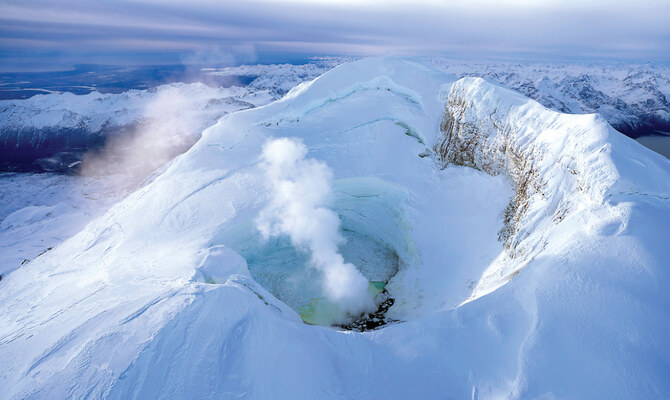
Alaska Volcano Observatory shows the summit of Mount Spurr on Oct. 24 in Alaska. It spewed ash cloud nearly 19km into the air in 1992. (AP)
Short Url
Updated 07 December 2024
Follow

Earthquakes under a volcano near Alaska’s largest city raise concerns

ANCHORAGE: An increase in the number of earthquakes under a volcano near Alaska’s largest city this year has geologists paying attention.

Mount Spurr, about 129 kilometers northwest of Anchorage, last erupted in 1992, spewing an ash cloud nearly 19 kilometers into the air, prompting flights to be canceled and people to don masks. Another eruption at the 3,383-meter stratovolcano could be severely disruptive to the city, according to the Alaska Volcano Observatory.

The observatory raised its alert status for Mount Spurr in October — from green to yellow — when the increase in seismic activity became pronounced and a ground deformation was spotted in satellite data. Observatory scientist David Fee said Friday there have been about 1,500 small earthquake below the volcano this year, compared to about 100 in a normal year.

While that might seem like a lot, it’s “not an enormous amount,” Fee said. It could be a precursor to an eruption — or not. Similar seismic unrest occurred from 2004 to 2006 before subsiding without an eruption.

“We don’t see any significant change in our data that would tell us that an eruption is imminent,” Fee said. “Things have been kind of this low-level unrest for a while now and we’re, of course, watching it very closely to detect any changes and what that might mean.”

Scientists are monitoring seismic stations, global satellite data and a webcam for additional changes that would signal an impending eruption. If magma is moving closer to the surface, there would be an increase in earthquakes, ground deformations, the creation of a summit lake or fumaroles, which are vents that open in the surface to vent gas and vapors. 


Ethiopia’s prime minister accuses Eritrea of mass killings during Tigray war

Updated 03 February 2026
Follow

Ethiopia’s prime minister accuses Eritrea of mass killings during Tigray war

  • Landlocked Ethiopia says that Eritrea is arming rebel groups, while Eritrea says Ethiopia’s aspiration is to gain access to a seaport
  • Ethiopia lost sovereign access to the Red Sea when Eritrea seceded in 1993 after decades of guerrilla warfare

ADDIS ABABA: Ethiopia’s government Tuesday for the first time acknowledged the involvement of troops from neighboring Eritrea in the war in the Tigray region that ended in 2022, accusing them of mass killings, amid reports of renewed fighting in the region.
Ethiopian Prime Minister Abiy Ahmed, while addressing parliament Tuesday, accused Eritrean troops fighting alongside Ethiopian forces of mass killings in the war, during which more than 400,000 people are estimated to have died.
Eritrean and Ethiopian troops fought against regional forces in the northern Tigray region in a war that ended in 2022 with the signing of a peace agreement.
Eritrea’s Information Minister Yemane Gebremeskel told The Associated Press that Ahmed’s comments were “cheap and despicable lies” and did not merit a response.
Both nations have been accusing each other of provoking a potential civil war, with landlocked Ethiopia saying that Eritrea is arming and funding rebel groups, while Eritrea says Ethiopia’s aspiration is to gain access to a seaport.
“The rift did not begin with the Red Sea issue, as many people think,” Ahmed told parliamentarians. “It started in the first round of the war in Tigray, when the Eritrean army followed us into Shire and began demolishing houses, massacred our youth in Axum, looted factories in Adwa, and uprooted our factories.”
“The Red Sea and Ethiopia cannot remain separated forever,” he added.
Ethiopia lost sovereign access to the Red Sea when Eritrea seceded in 1993 after decades of guerrilla warfare.
Gebremeskel said the prime minister has only recently changed his tune in his push for access to the Red Sea.
Ahmed “and his top military brass were profusely showering praises and State Medals on the Eritrea army and its senior officers. … But when he later developed the delusional malaise of ‘sovereignty access to the sea’ and an agenda of war against Eritrea, he began to sing to a different chorus,” he said.
Eritrea and Ethiopia initially made peace after Abiy came to power in 2018, with Abiy winning a Nobel Peace Prize for his efforts toward reconciliation.
In June, Eritrea accused Ethiopia of having a “long-brewing war agenda” aimed at seizing its Red Sea ports. Ethiopia recently said that Eritrea was “actively preparing to wage war against it.”
Analysts say an alliance between Eritrea and regional forces in the troubled Tigray region may be forming, as fighting has been reported in recent weeks. Flights by the national carrier to the region were canceled last week over the renewed clashes.