

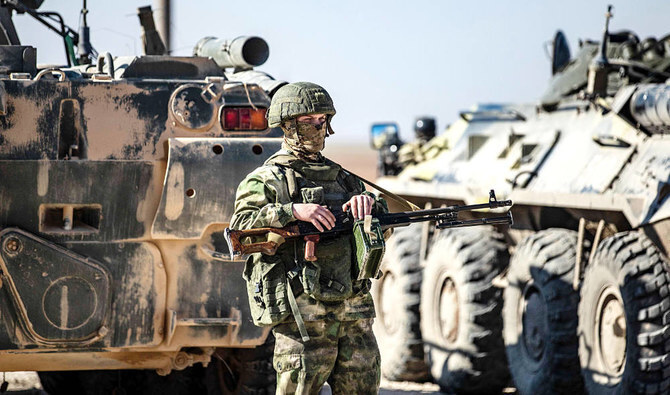

DAMASCUS: Two strategically-important Russian military facilities in Syria and Moscow’s very presence in the Middle East are under serious threat from rapidly advancing insurgents, Russian war bloggers have warned.
With Russian military resources mostly tied down in Ukraine where Moscow’s forces are rushing to take more territory before Donald Trump comes to power in the US in January, Russia’s ability to influence the situation on the ground in Syria is far more limited than in 2015 when it intervened decisively to prop up Syrian President Bashar Assad.
Rapid advances by the insurgents threaten to undermine Russia’s geopolitical clout in the Middle East and its ability to project power in the region, across the Mediterranean and into Africa. They also risk dealing an embarrassing setback to President Vladimir Putin, who casts Russia’s intervention in Syria as an example of how Moscow can use force to shape events far away and compete with the West.
But Russian war bloggers, some of whom are close to the Russian Defense Ministry and whom the Russian authorities allow greater freedom to speak out than the military, say the most immediate threat is to the future of Russia’s Hmeimim air base in Syria’s Latakia province and to its naval facility at Tartous on the coast.
The Tartous facility is Russia’s only Mediterranean repair and replenishment hub, and Moscow has used Syria as a staging post to fly its military contractors in and out of Africa.
Influential Russian war blogger “Rybar,” who is close to the Russian Defense Ministry and has over 1.3 million followers on his Telegram channel, said Moscow’s forces were facing a grave threat.
“In reality we need to understand that the insurgents will not stop,” Rybar warned.
“They will try to inflict the maximum defeat and the maximum reputational and physical damage on the representatives of the Russian Federation (in Syria) and in particular to destroy our military bases.”
Relying on the Syrian army alone was a lost cause, he added, saying it would continue to fall back unless properly supported by the Russian air force and specialists.
The Russian Defense Ministry could not be reached for comment on a non-working day. The Russian Embassy in Damascus has advised Russian nationals to leave Syria.
Asked on Saturday in Doha about the fate of the Russian bases, Russian Foreign Minister Sergei Lavrov said he was “not in the business of guessing” what would happen, but said Moscow was doing all it could to prevent “terrorists” from prevailing.
He said he was not worried about how events in Syria would affect his own reputation or that of Russia, but was worried about the fate of the Syrian people.
RUSSIAN FORCES BADLY EXPOSED, SAYS BLOGGER
The Russian air force has been helping government forces launch air strikes against insurgents and the Kremlin has said it still supports Assad and is analizing the situation to see what help is needed to stabilize the situation.
However, Russia’s “Fighterbomber” war blogger, who has over 500,000 followers, said Moscow’s forces in Syria were badly exposed and that losing the Hmeimim air base would mean losing the ability to carry out air strikes which he said was 75 percent of Moscow’s capabilities there.
“The Hmeimim airfield is not a multi-story industrial project with basements. It is a field with lightly assembled buildings on top, which will cease to function as soon as the enemy gets within artillery or drone flight range,” he said.
“The situation with the naval base in Tartous is about the same. Of course, it can be defended and held for quite a long time if there is someone and something to do it, but it will either not be able to function at all, or in a very limited way.”
Nor, he warned, would a full evacuation of all of Russia’s military equipment be possible if it became necessary.
“Therefore, the main task of our forces in Syria is to prevent the enemy from entering Latakia, even if we have to temporarily give up the rest of the territory.”
With over 600,000 followers, war blogger “Starshe Eddi” said Russia had paid a heavy price for a foothold in Syria.
“Ten years there, dead Russian soldiers, billions of roubles spent and thousands of tons of ammunition expended — they must be compensated somehow and somehow,” he wrote.
“The only thing that can...give us a chance to compensate for the current failure and the resources we have used up is our retention of the Latakia and Tartous provinces.”
Igor Girkin, a prominent Russian ex-militia commander who fought in Ukraine and who is serving a four-year jail term after accusing Putin and the army’s top brass of mistakes in the Ukraine war, said Moscow’s position in Syria had always been exposed from a reinforcement and supply point of view.
“Now our enemies have naturally decided to take advantage of our weakness at the moment when we are busy on the Ukrainian front,” he wrote from prison.
“We are overstretched. The defeat of the Syrian side will also be our defeat.”


