

Pakistan’s finmin says efficient management of state resources key to improving fiscal position

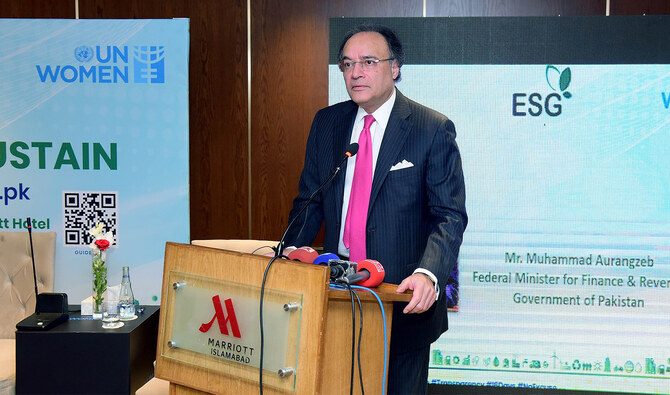
Pakistan’s Finance Minister Muhammad Aurangzeb is addressing a ceremony in Islamabad, Pakistan, onn December 5, 2024. (@Financegovpk/File)
Short Url
Updated 07 December 2024
Follow

Pakistan’s finmin says efficient management of state resources key to improving fiscal position

  • Pakistan is actively trying to sell its stakes in state-owned assets to private investors
  • Muhammad Aurangzeb urges private companies to focus on export-oriented growth 

ISLAMABAD: Pakistan’s Finance Minister Muhammad Aurangzeb on Saturday stressed the importance of efficient management of state assets by private investors in improving the country’s fiscal position, calling on the private sector to focus on increasing the country’s exports. 

Islamabad has sought to privatize loss-making state enterprises which have accumulated losses in the billions over decades, by handing over their management to private companies to create fiscal space. 

Pakistan has identified 25 public sector enterprises for privatization, including the flagship carrier Pakistan International Airlines (PIA), banks, hotels and power generation and distribution companies. Islamabad’s move to privatize the PIA and other state-owned enterprises is part of a deal with the IMF for financial bailout programs. 

“This is very important and I keep saying this repeatedly that the private sector has to lead this country,” Aurangzeb said during an event in Karachi. 

He added that SOEs were inflicting losses worth Rs2.2 billion [$7.9 million] per day to Pakistan, adding this amounts to Rs6 trillion [$21.5 billion] yearly. 

“Think about this, this year we have to collect taxes worth Rs12.9 trillion [$46.3 million], so approximately 50 percent of this, if there is no [financial] drag of the SOEs, if all of them are being run by the private sector, if this drag is not there then you can imagine our fiscal balance or imbalance it will become so much better,” he said. 

The Pakistani minister urged private companies to focus on exports, adding that while the country had achieved economic stability, it needed to achieve growth as well. 

“If we have to end this boom-bust cycle and if we have to take this economy toward to a 5, 6 and 7 percent growth, it has to be an export-led growth,” Aurangzeb said. 

Pakistan has made some economic gains in recent months, with the stock market performing impressively and breaching over 109,000 points at close of trade on Friday. 

Inflation in the country, which reached a record high of 38 percent in May 2023, slowed to 4.9 percent in November, lower than the government’s forecast. 


Security forces kill four militants in Pakistan’s volatile southwest, military says

Updated 13 January 2026
Follow

Security forces kill four militants in Pakistan’s volatile southwest, military says

  • Balochistan, Pakistan’s largest province by land area bordering Iran and Afghanistan, has long been the site of a low-level insurgency
  • The Balochistan government has recently established a threat assessment center to strengthen early warning, prevent ‘terrorism’ incidents

ISLAMABAD: Pakistani security forces gunned down four militants in an intelligence-based operation in the southwestern Balochistan province, the military said on Tuesday.

The operation was conducted in Balochistan’s Kalat district on reports about the presence of militants, according to the Inter-Services Public Relations (ISPR), the Pakistani military’s media wing.

The “Indian-sponsored militants” were killed in an exchange of fire during the operation, while weapons and ammunition were also recovered from the deceased, who remained actively involved in numerous militant activities.

“Sanitization operations are being conducted to eliminate any other Indian-sponsored terrorist found in the area,” the ISPR said in a statement.

There was no immediate response from New Delhi to the statement.

Balochistan, Pakistan’s largest province by land area bordering Iran and Afghanistan, has long been the site of a low-level insurgency involving Baloch separatist groups, including the Balochistan Liberation Army (BLA) and the Balochistan Liberation Front (BLF).

Pakistan accuses India of supporting these separatist militant groups and describes them as “Fitna Al-Hindustan.” New Delhi denies the allegation.

The government in Balochistan has also established a state-of-the-art threat assessment center to strengthen early warning and prevention against “terrorism” incidents, a senior official said this week.

“Information that was once scattered is now shared and acted upon in time, allowing the state to move from reacting after incidents to preventing them before they occur,” Balochistan Additional Chief Secretary Hamza Shafqaat wrote on X.

The development follows a steep rise in militancy-related deaths in Pakistan in 2025. According to statistics released by the Pakistan Institute for Conflict and Security Studies (PICSS) last month, combat-related deaths in 2025 rose 73 percent to 3,387.

These included 2,115 militants, 664 security forces personnel, 580 civilians and 28 members of pro-government peace committees, the think tank said.