Pakistan slashes power tariff by Rs1.14 per unit in fuel price adjustment

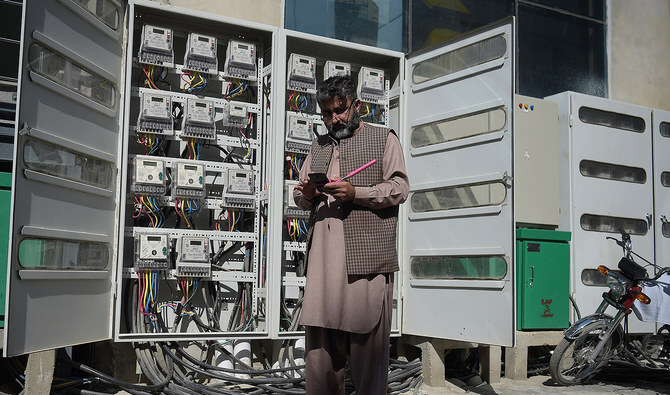
In this file photo, taken on November 7, 2018, a Pakistani employee of the state-run Islamabad Electric Supply Company (IESCO), takes a meter reading with his smartphone at a commercial building in Islamabad. (AFP/File)
Short Url
Updated 07 December 2024
Follow

Pakistan slashes power tariff by Rs1.14 per unit in fuel price adjustment

  • Price reduction will be applied to electricity bills of December 2024, says state-run media 
  • Move likely to bring relief to businesses, citizens reeling from steep increases in electricity tariffs

KARACHI: Pakistan’s National Electric Power Regulatory Authority (NEPRA) has slashed the power tariff by Rs1.14 per unit as a fuel price adjustment measure, state-run media reported on Saturday, with the move likely to further ease inflation in the country. 

The decision is expected to provide relief to businesses and citizens, who have suffered from steep and sudden increases in electricity tariffs following energy sector reforms suggested by the International Monetary Fund (IMF).

According to the Pakistan Bureau of Statistics, electricity charges had increased by 58.8% until May this year.

“According to a statement issued by the Power Division, NEPRA has once again reduced electricity prices by Rs1.14 per unit on account of fuel adjustment,” state broadcaster Radio Pakistan said. 

“The price reduction will be applied to the bills of December.”

The state media said electricity prices would continue to decrease because of the government’s prudent measures.

Meanwhile, Energy Minister Awais Ahmed Khan Leghari said in a statement the government was determined to make electricity more affordable for the people.

Pakistan produces expensive electricity due to a combination of factors including high reliance on imported fossil fuels, inefficient energy mix, substantial transmission and distribution losses and chronic issues like circular debt and regulatory inefficiencies. 

The outdated infrastructure and inadequate power plants further exacerbate costs, while underutilization of domestic resources such as hydropower and coal add to the problem.

Additionally, fluctuations in foreign exchange rates and complex tariff structures contribute to higher electricity prices. High power cost is one of the key factors that lead to spiraling inflation in the country.


US envoy, military officials attend Pakistan-US counterterrorism exercise

Updated 8 sec ago
Follow

US envoy, military officials attend Pakistan-US counterterrorism exercise

  • Exercise Inspired Gambit-2026 marks 13th round of Pakistan-US counterterrorism training
  • US Chargé d’Affaires Natalie Baker observed the drills with senior American military officials

ISLAMABAD: The top US diplomat in Pakistan, accompanied by senior American military officials, on Thursday observed joint counterterrorism drills conducted by Pakistani and US troops aimed at improving how the two forces operate together, Pakistan’s military said.

The drills are part of Exercise Inspired Gambit–2026 that is being held from Jan. 8 to Jan. 16 at the National Counter Terrorism Center in Pabbi, situated in the Punjab province, marking the 13th iteration of the bilateral training series since it began in 1995.

“Distinguished Visitors’ Day ceremony was held on 15 January 2026 at the National Counter Terrorism Center, Pabbi,” the military’s media wing, Inter-Services Public Relations (ISPR), said in a statement. “Her Excellency Ms. Natalie Baker, Chargé d’Affaires of the United States of America to Pakistan, accompanied by senior US military dignitaries, and Commander Rawalpindi Corps graced the occasion.”

“The visitors were briefed on the scope, objectives, and conduct of the exercise,” it added. “A high level of professionalism and competence was demonstrated by participants of both armies, which was appreciated by the visiting dignitaries.”

Pakistan and the United States have maintained close defense and security ties for decades, working together during the Cold War era, especially after the 1979 Soviet invasion of Afghanistan.

The relationship continued following the US-led intervention in Afghanistan after the Sept. 11, 2001, attacks, though cooperation became strained at times due to policy differences.

ISPR said the exercise was meant to enhance bilateral military cooperation through the exchange of counterterrorism experience, refinement of drills and procedures and the development of interoperability.