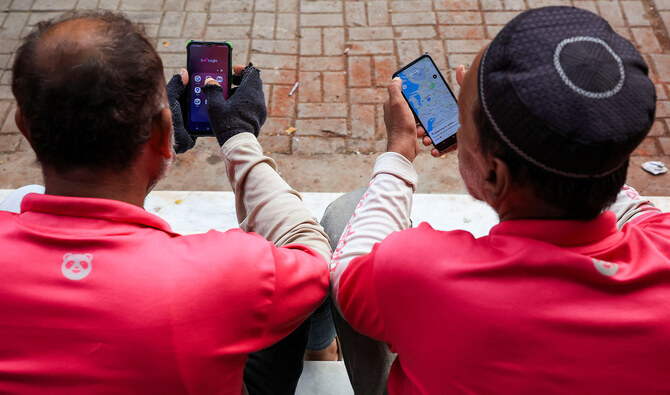

KARACHI: A protest by thousands in Pakistan’s capital last month demanding the release of jailed former Prime Minister Imran Khan triggered the arrest of hundreds, but also, digital rights campaigners say, nationwide Internet outages and slow-downs.
Pakistan has a record of curbing online access in response to political turmoil, banning social media sites or simply temporarily shutting down the Internet altogether.
The United States condemned Internet shutdowns in Pakistan following parliamentary elections in February in which Khan’s party won the most seats despite a crackdown on its activities.
Businesses that rely on the Internet have complained Pakistan could lose hundreds of millions of dollars of revenue as a result of the government’s imposition of a national firewall to monitor and regulate content and social media platforms and prolonged Internet disconnections.
The government denies any attempt at censorship.
“We’re seeing a loss of civilian control over basic IT and digital infrastructure, only made worse by a lack of transparency,” said Usama Khilji, a prominent digital rights activist. “It’s almost like a creeping coup.”
In Layyah, a small town in south-eastern Pakistan, getting steady Internet connection requires Sehrish Bano to hop from room to room balancing her laptop and toggling between the three different connections.
More often than not, she said, none of them work.
The 25-year-old said the poor, unreliable Internet connections hampered her ability to earn a living as a freelance video editor and complete her online graphic design course.
“I’m not able to take online classes because Zoom keeps freezing and I can’t understand what my teacher is saying,” she said. Compared to three months ago, “even simple things like sending an audio message via WhatsApp or downloading a picture or a PDF takes five times as long.”
Internet speeds have dropped by more than 30 percent in the last three months, Shahzad Arshad, chairman of the Wireless and Internet Providers Association of Pakistan, an advisory body of Internet service providers, told the Thomson Reuters Foundation.
Arshad attributed the decline to the government’s deployment of “a web management system or firewall.”
Farieha Aziz, co-founder of Bolo Bhi, a digital-rights and civil-liberties group, said there had been no acknowledgement of an official firewall and accused authorities of not coming clean on the issue.
“It seems sustained opacity is the official government policy,” Aziz said.
Rights group Amnesty International has also called on Pakistan to be transparent about Internet disruptions.
“The opacity of the Pakistani authorities regarding the use of monitoring and surveillance technologies that block content, slow down and control Internet speeds is an alarming concern,” Jurre Van Bergen, Amnesty technologist said in August.
“Time and again, the use of such technologies, including national firewalls, has proven to be incompatible with human rights,” Van Bergen said.
DIGITAL CHASM
Aziz said it was clear the government’s aim was to clamp down on free speech and dissent.
“Never before,” she said, has the government “been able to disrupt a whole function of an app; usually the entire website or application stops working. But here we are seeing that only media files are being disrupted.”
Aziz said the issue was compounded by the government’s attempts to restrict the use of Virtual Private Networks (VPNs), which encrypt data and mask IP addresses, allowing users to browse the Internet more securely.
The Pakistani government has said it would no longer pursue a ban on VPNs and denies any responsibility for slowing down of bandwidths nationwide.
The United Nations says Pakistan’s digital divide is vast — more than half the country does not have access to the Internet because of inadequate digital infrastructure and affordability challenges.
That divide could become a chasm, experts said.
“WhatsApp, sharing voice notes, links for education and work purposes, has become a way of life,” said Aziz. Government measures that slowed Internet speeds, or cut connections altogether, she said, were “creating digital haves and have-nots.”
The problem has become so bad that some whose livelihoods depend on Internet access are considering leaving the country.
Ehtesham Khan, a freelance photo editor and graphic designer, said he was contemplating moving to Dubai because frequent Internet disruptions had led to him losing clients.
And it is not just individuals who are thinking of leaving.
“Companies are already relocating to other places, Dubai, Singapore, where Internet access isn’t a problem,” Khilji said. “Our foreign income and Internet exports have reduced, and our IT industry’s potential is reducing by the day because of these issues.”