Police believe gunman who killed insurance CEO has left New York City

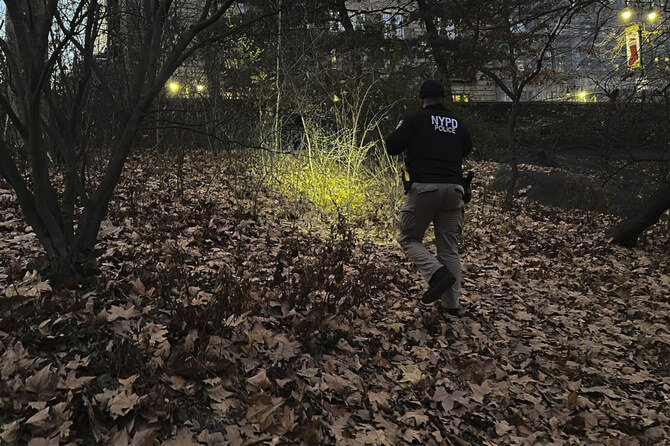
A New York City Police officer walks through brush and foliage in Central Park. (AP)
Short Url
Updated 07 December 2024
Follow

Police believe gunman who killed insurance CEO has left New York City

  • Security experts cautioned that the first 48 hours after such a crime are the best window of opportunity to catch a gunman

New York City police believe the man who fatally shot a UnitedHealth top executive has left the city, Police Commissioner Jessica Tisch said on Friday, as the hunt for the gunman passed the crucial 48-hour mark.

Brian Thompson, 50, the CEO of UnitedHealth’s insurance unit, was shot in the back on Wednesday in what police described as a targeted attack. Police have released multiple photos of the suspect — who fled the scene, climbed on an electric bicycle and disappeared into Central Park — and have asked the public for help in tracking him down.

Investigators on Friday recovered from Central Park a backpack they believe to be the suspect’s, CNN reported, citing unnamed police sources. The discarded backpack, potentially loaded with evidence, was missed on a first pass but found on a subsequent, expanded search through the 843-acre (341-hectare) park, CNN said.

Tisch said in an interview with CNN earlier on Friday that authorities now believe he has left New York City, after new video emerged showing him arriving at a bus terminal.

New York Police Department Chief of Detectives Joseph Kenny, in the same interview, said the video shows the suspect climbing into a taxi that took him to a Port Authority bus station near the George Washington Bridge in Upper Manhattan.

“Those buses are interstate buses. That’s why we believe he may have left New York City,” Kenny said.

The expanded hunt comes after security experts cautioned that the first 48 hours after such a crime are the best window of opportunity to catch a gunman, a timeframe that has now passed.

Felipe Rodriguez, a former NYPD police detective and an adjunct professor at the John Jay College of Criminal Justice, said solving the case is like putting together a difficult jigsaw puzzle.

“You start from edges first and work your way in, but right now they might not have all the pieces. But the case is moving forward,” Rodriguez said.

Police have yet to identify the suspect, at least not publicly. They believe he arrived in New York 10 days before the shooting on a Greyhound bus that originated in Atlanta and checked into a Manhattan youth hostel using a fake ID from New Jersey, several media outlets reported. Reuters has not independently verified this account.

New York City police offered a $10,000 reward for information leading to an arrest and conviction. The Federal Bureau of Investigation (FBI) offered a reward of up to $50,000 for the same.

SECURITY PRECAUTIONS

UnitedHealth is the largest US health insurer, providing benefits to tens of millions of Americans, who pay more for health care than people in any other country.

Thompson joined UnitedHealth in 2004 and became the CEO of UnitedHealthcare, a unit of UnitedHealth Group, in April 2021.

Following the attack, UnitedHealth and several other health insurers including CVS Health and Centene took down pictures of executives from their corporate websites in an apparent tightening of security measures.

Centene said late on Thursday it would no longer hold an in-person investor day next week, and that the event would be streamed.

The words “deny,” “defend” and “depose” were carved into shell casings found at the scene, police sources told several media outlets. A New York City Police Department spokesperson would not comment on the report.

The words evoke the title of Jay Feinman’s 2010 book critical of the insurance industry “Delay Deny Defend: Why Insurance Companies Don’t Pay Claims and What You Can Do About It.”

Feinman, a professor emeritus at Rutgers University Law School, declined to comment.

Detectives believe the perpetrator was experienced with firearms based on how he slowly and deliberately carried out the shooting, CNN reported, citing police sources who spoke on the condition of anonymity because the investigation was ongoing.

Security video showed the shooter, wearing a hooded jacket, ski mask and a gray backpack, walking up behind Thompson, raising his handgun fitted with a silencer and firing at his back. Police said the gunman arrived outside the hotel several minutes before Thompson and waited for him to walk past before firing, ignoring other passers-by.

Before the report about the backpack, CNN, whose reporter John Miller is a former NYPD deputy commissioner, said police found a phone in an alley that the gunman ran through and also recovered a water bottle the shooter bought just minutes before the attack.

Miller said the best picture of the suspect’s face was captured when the man lowered his balaclava at the request of a hostel desk clerk in a flirtatious moment when she asked to see his face.

“He lowers the mask and gives that big smile. That little flirtation between the two of them in some good-humored way actually yielded what is so far the most significant clue to identifying him,” Miller said.


Old Delhi iftars revive Mughal heritage, one course at a time

Updated 4 sec ago
Follow

Old Delhi iftars revive Mughal heritage, one course at a time

  • Dastarkhwan-e-Jahaanuma iftars have been held in Old Delhi since 2017
  • Muslim and non-Muslim participants arrive from across India and abroad

NEW DELHI: On a rooftop in Delhi’s historic walled city, guests from across India sit on cushions around a low table overlooking Jama Masjid, waiting for its sunset call to prayer — the signal to start a special iftar that will take them back four centuries, to the Mughal era, if only for a while.

Mughals ruled the Indian subcontinent between the 16th and 19th centuries. Originally from Central Asia, they carried traditions borrowed from Arabs, Persians and Ottomans, which they merged with the various local Indian styles — a fusion that marked the global revival of Islamic architecture and culture.

Jama Masjid is one of the most iconic examples of the Mughal style — a scenic background to the curated iftars that bring 40 to 50 people from across India to share a meal, knowledge and experience.

“People getting together from different walks of life, different parts of the country, different religions, different cultures coming together — it was absolutely and completely amazing,” said Arvind Sirohi, who took part in the event with his wife.

“Lovely storytelling, amazing food, and end of the day, right next to Jama Masjid in Old Delhi. The ambience, the environment, the atmosphere came together so beautifully.”

The community-led iftar experience is called Dastarkhwan-e-Jahaanuma — from Urdu words meaning a “spread of food” and “showing the world.”

For Veena Sirohi, it did exactly what the name promised by bringing together people from different communities, different parts of India, and abroad.

“I think that’s a great way of synthesizing different cultures, bringing people together, bringing the human aspect of what we all are ... we are actually all one,” she told Arab News.

“And we had some wonderful comperes who told us about … the history of Ramadan, what goes behind it, how the food is curated, and how each and every item has a specific place in the menu.”

Served in gilded bowls and plates from traditional Indian crockery, with rose petals dotting the dastarkhwan cloth, the dishes were some of the festive Ramadan delicacies, offering a taste of Mughal culinary heritage.

Among them was mutanjan, or fragrant rice cooked with ghee, sugar, saffron, cardamom, and studded with nuts, which for many Indian Muslims is traditionally the first dish to break the fast.

It was followed by shabde, a rich, slow-cooked aromatic meat stew or the Delhi biryani — a fragrant, mildly spiced saffron rice and meat dish, where marinated chicken or mutton is layered with basmati rice and cooked slowly.

The hearty feast closed with nihari, a hearty stew simmered overnight with spices and bone marrow, which emerged in the 18th century and was originally eaten by Mughal royals for breakfast.

“These are the traditional dishes which are not usually available in the market, but are specially prepared by the bawarchees (cooks) of Old Delhi. Some of the dishes are occasional dishes,” said Abu Sufiyan Khan, the founder of Tales of City, the cultural experience company that has been curating Dastarkhwan-e-Jahaanuma since 2017.

The special iftars are hosted once a week throughout the fasting month, usually on weekends. There are variations in dishes served as they come from different kitchens, as Tales of City collaborates with various local artisans and cooks.

“We are curating this with different experts and every time the menu changes,” Khan said.

“We bring all these dishes onto a single dastarkhwan, and we share this meal with the people coming from all over India to break bread together in the holy month of Ramadan, know each other, learn about each other’s culture, and create a dialogue space where we can have more meaningful conversations and an opportunity to get to know each other.”

Those who take part, like Ayandrali Dutta, a food critic, appreciate everything about the experience, especially as it takes place in Old Delhi, where the vibe is always “jovial, lively, in all positive ways” during Ramadan.

“You get to meet interesting people, you get to hear interesting stories ... It’s a great initiative to show what Ramadan is, what kind of food is eaten, talk about the cultures between Lucknow and Delhi and other parts of the country. And it just brings a lot of happiness,” she said.

“I loved it. My heart is happy, my belly is full. Nothing else I can ask for.”