Sudan documentary implores world to remember how a hopeful revolution became a forgotten war

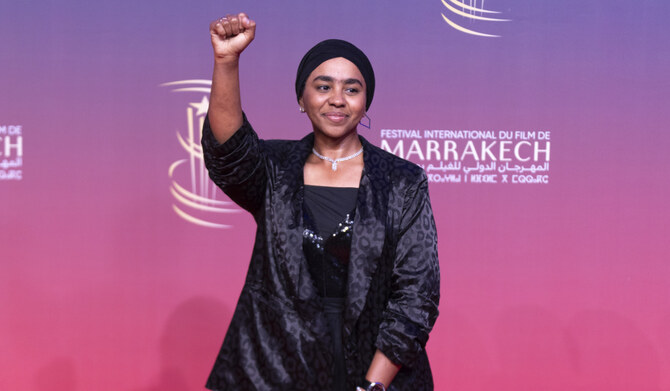
Sudanese activist, Shajan Suliman, gestures while attending the screening of Sudan Remember Us movie, during the Marrakech International Film Festival, in Morocco, Monday, Dec. 2, 2024. (AP)
Short Url
Updated 07 December 2024
Follow

Sudan documentary implores world to remember how a hopeful revolution became a forgotten war

  • A former France 24 journalist, Meddeb gravitated toward documentary for the breathing room it offered to let stories unfold in an unpredictable way, she said in an interview

MARRAKECH, Morocco: In the early days of Sudan’s 2019 revolution, Shajjane Suliman brought sandwiches, coffee and mint tea to demonstrations in closed-off sections of Khartoum. But as hope made way for despair, she decided more than food was needed to nourish the movement.
Public outcry had sprung up against Sudan’s longtime military dictator and his mismanagement of the country’s economy. Throughout months of demonstrations, hundreds were killed or injured by security forces suppressing protests.
So Suliman donned a gas mask and headed to the streets carrying posters adorned with lines like, “Souls cannot be killed, let alone ideas.”
A continent away, filmmaker Hind Meddeb was finishing “Paris Stalingrad,” a documentary about the plight of refugees living in encampments near the edge of the French capital. Sudanese refugees encouraged her to go to Khartoum and film their nascent revolution.
Such is the origin story of “Sudan, Remember Us,” Meddeb’s 75-minute documentary being shown in competition at the Marrakech Film Festival this week after screening at festivals in Venice and Toronto.
Sudan, a predominantly Arab country on the edge of sub-Saharan Africa, descended into civil war in 2023, as fighting erupted between the military and a paramilitary group known as the Rapid Support Forces that grew out of Darfur’s notorious Janjaweed militia.
Though estimates are difficult to come by, at least 24,000 people have been killed and millions displaced in a conflict that has largely been eclipsed in the world’s attention by wars in the Middle East and Ukraine.
To Suliman, who ended up as one of its protagonists, the documentary’s purpose is similar to what she wrote on a poster five years ago: an effort to motivate a despairing public years after revolution failed to cement civilian rule.
The revolution, she said, felt like “a piece of heaven” despite the violence, full of music, poetry and optimism about Sudan’s future.
“Everyone forgot or lost hope,” Suliman said in an interview with The Associated Press. “It’s different for us now than when the revolution started. We were together so it was easy. Now we need to change how we want to continue.”
“Sudan, Remember Us” begins with a series of voice messages to Meddeb from April 2023, the month that civil war broke out. Activists describe their feelings of shock and disbelief about how what UN officials have called a “forgotten war” has ruined life and made their country unrecognizable.
Mostly, it brings viewers to 2019, the year that Sudan’s military ousted President Omar Al-Bashir, paving the way for power-sharing and a short-lived transitional government led by generals and civilians.
Largely shot on a handheld camera in a country that has at times blocked the Internet, banned foreign news channels and arrested its own journalists, the movie is both a story of collective hope and a feat of reportage.
Meddeb’s observational approach and lingering on poems differs from gripping streaming-friendly protest documentaries such as Jehane Noujaim’s “The Square” (2013), Evgeny Afineevsky’s “Winter on Fire” (2015) or Kiwi Chow’s “Revolution of Our Times” (2021). She captures a revolution documentary’s requisite images — the chaos and terror as well as solidarity and joy of demonstrators facing off against security forces.
But the movie aims for a different kind of storytelling.
A former France 24 journalist, Meddeb gravitated toward documentary for the breathing room it offered to let stories unfold in an unpredictable way, she said in an interview.
“It’s a very spontaneous film. I was diving into what was happening and and filming what was inspiring me,” she said at the Marrakech Film Festival.
What she found and was inspired by was a country described as a “land of literature” and a revolution in which women played a central role.
The protests rendered in the documentary pulsate with drums beating at marches and through the rhythm of poems recited at sit-ins. Meddeb takes the audience from phone camera-filmed street fighting to underground cafes to the Nile River as young people discuss their hopes for Sudan.
“The revolution was a time of beautiful feelings and projects,” one woman says after security forces killed more than 100 people in a June 2019 massacre. “It made you want to take part. A painting, a poem, anything to bring people together.”


Mini op-ed: Coffee, fasting and finding your rhythm this Ramadan

Updated 17 February 2026
Follow

Mini op-ed: Coffee, fasting and finding your rhythm this Ramadan

DUBAI: Ramadan is a month of reflection, balance and listening more closely to our bodies. It is also a time when everyday rituals, including coffee, naturally shift. Rather than giving it up completely, many people simply change how, when and what they drink. And that is where a little understanding can go a long way.

There is no single “right” way to enjoy coffee during Ramadan. Taste preferences, caffeine sensitivity, work schedules and sleep patterns are deeply personal. The key is finding what supports you during the fast.

Suhoor, the pre-dawn meal before fasting begins, is often where people think carefully about caffeine. Some find a small coffee helps them feel alert through the morning. Others prefer to avoid it so they can return to sleep more easily after the meal. How you metabolize caffeine plays a big role here, some people feel energized for hours, while others crash quickly or feel jittery.

Choosing a lower-caffeine option can help. Coffees made from 100 percent Arabica beans naturally contain less caffeine than Robusta, while still offering plenty of flavor and aroma.

Iftar, traditionally broken with water and dates, is usually followed by a light meal or soup. Coffee often comes later, once the body has rehydrated and blood sugar levels have stabilized. Enjoyed mindfully, it can be part of a beautiful evening ritual rather than a stimulant.

There is no single “right” way to enjoy coffee during Ramadan. Taste preferences, caffeine sensitivity, work schedules and sleep patterns are deeply personal. (Shutterstock) 

One of the most important things to remember during Ramadan is hydration. Coffee should never replace water, especially when fasting hours are long. Drinking enough water between iftar and suhoor helps reduce fatigue and headaches far more effectively than extra caffeine.

Added sugar in coffee can also cause blood sugar spikes, followed by dips in energy. If you enjoy sweetness, try reducing it slightly or pairing coffee with food to soften the impact.

If you are worried about caffeine withdrawal during Ramadan, decaffeinated coffee can be a very helpful bridge. High-quality decaf, such as coffee processed using the Swiss water method (which avoids chemical solvents), retains flavor while removing most of the caffeine.

Ramadan is not about restriction for restriction’s sake. It is about awareness, intention and care, including care for your own body. Coffee can absolutely remain part of that journey, as long as it’s enjoyed thoughtfully.

Whether you choose to drink less, switch origins, reduce caffeine or simply slow down and savor it more, the best coffee choice this Ramadan is the one that supports your rhythm, your rest and your well-being.

Here are a few RAW coffees that feel gentle, balanced and comforting during Ramadan:

RITUAL Blend
Created at the request of many customers from the Levant, this is our only blend that combines Arabica with a small amount of Robusta. The result is a bold, full body with very low acidity. Smooth and grounding, it works beautifully as espresso, Moka pot or Turkish coffee, and pairs well with milk.

Brazil — Serra Dos Ciganos (Single Origin)
A beautifully approachable coffee with tasting notes of roasted hazelnuts, nougat, baker’s chocolate and pear. Comforting and elegant, especially when brewed.

Guatemala — Pampojila Natural
Often chosen as a “breakfast coffee”, this is gently sweet with notes of brown sugar, nuts and orange, offering a medium body and soft fruit character.

Mexico — Mazateca
Another favourite for earlier in the day, with flavors of orange, malted barley and cacao, balanced, warm and easy to drink.

Kim Thompson is the founder and director of Culture & Brand at RAW Coffee Co.