

Ghanaians see presidential vote as a way out of hardship

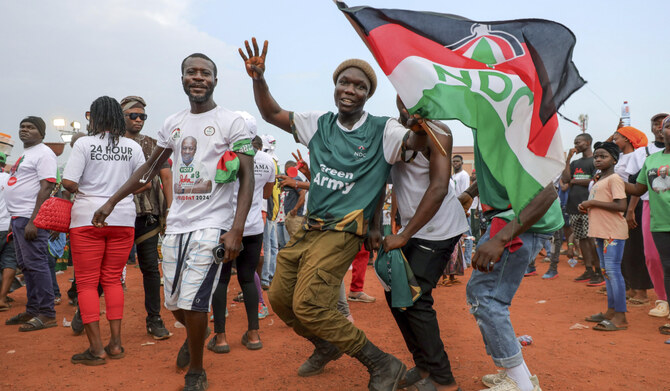
Supporters of the former Ghana President and presidential candidate for the National Democratic Congress, John Mahama, in Accra. AP Supporters of presidential candidate for the National Democratic Congress, John Mahama, in Accra. (AP)
Short Url
Updated 07 December 2024
Follow

Ghanaians see presidential vote as a way out of hardship

  • Ghana’s presidential elections have historically been two-horse races

ACCRA: Joseph Antwi knows what he wants as a young person in Ghana casting his vote for the first time on Saturday when the West African nation elects its next president.
What he is not sure of, though, is whether the election’s outcome would improve the worst cost-of-living crisis in a generation in Ghana, one of the region’s economic powerhouses which has struggled in recent years with high public debt, a weakened local currency and high inflation.
“I want to vote to kick out the current government because they have not been kind to young people,” said Antwi, a trader in the capital of Accra, accusing the outgoing government of President Nana Addo Akufo-Addo of breaking its electoral promises since it was first elected eight years ago.
But the options for a candidate that will bring change are limited, he said, echoing the concerns of some of the 18.7 million people registered to vote for both president and members of parliament.
Ghana’s presidential elections have historically been two-horse races. This time is no different.
Although 12 candidates are running to become Ghana’s next president, it is seen as a tight race between Vice President Mahamudu Bawumia of the ruling New Patriotic Party government that has struggled to resolve the economic crisis, and immediate past President John Mahama, the leader of the main opposition National Democratic Congress.
In their final campaign rallies on Thursday, both candidates made a last push to pitch their political parties as the answer to Ghana’s economic woes.
Bawumia, a former deputy governor of the central bank, promised to build on the outgoing administration’s efforts and stabilize the economy. “I know what I want to do from day one in the presidency,” Bawumia, 61, told cheering supporters in Accra.
Mahama, on the other hand, restated his promise to “reset” the country on various fronts. “We need to reset our democracy, governance, economy, finances, agriculture, infrastructure, environment, health sector, and all that we hold dear as a people,” the 65-year-old former president said.
Across the city, the election mood has been high-spirited with political rallies, while election jingles and songs blast from public speakers.
In addition to the economic hardship, illegal gold mining — known locally as galamsey — has also been a major source of concern, triggering protests in recent weeks.
Ghana is Africa’s top gold producer and the world’s sixth largest, but illegal gold mining, which pollutes rivers and the environment, has spiked as people become more desperate for a better life.
Voters will be looking at whoever will promise to solve the problem of unemployment and hardship, said Lord Mawuko-Yevugah, a professor of political economy at the Ghana Institute of Management and Public Administration.
Ghana’s opposition parties have also alleged plans by the election commission to rig the vote in favor of the ruling party, although without providing any evidence. The claims raised fears for a country seen as a beacon of democratic values at a time when democracy in West Africa is threatened by coups.
“We view transparency, responsiveness, and inclusiveness as critical to ensuring, credible and fair processes,” said Jean Mensa, head of the Ghanaian electoral commission. “And we have demonstrated these three elements in all aspects of our work.”


Mystery of CIA’s lost nuclear device haunts Himalayan villagers 60 years on

Updated 48 min 12 sec ago
Follow

Mystery of CIA’s lost nuclear device haunts Himalayan villagers 60 years on

  • Plutonium-fueled spy system was meant to monitor China’s nuclear activity after 1964 atomic tests
  • Porter who took part in Nanda Devi mission warned family of ‘danger buried in snow’

NEW DELHI: Porters who helped American intelligence officers carry a nuclear spy system up the precarious slopes of Nanda Devi, India’s second-highest peak, returned home with stories that sent shockwaves through nearby villages, leaving many in fear that still holds six decades later.

A CIA team, working with India’s Intelligence Bureau, planned to install the device in the remote part of the Himalayas to monitor China, but a blizzard forced them to abandon the system before reaching the summit.

When they returned, the device was gone.

The spy system contained a large quantity of highly radioactive plutonium-238 — roughly a third of the amount used in the atomic bomb dropped by the US on the Japanese city of Nagasaki in the closing stages of the Second World War.

“The workers and porters who went with the CIA team in 1965 would tell the story of the nuclear device, and the villagers have been living in fear ever since,” said Narendra Rana from the Lata village near Nanda Devi’s peak.

His father, Dhan Singh Rana, was one of the porters who carried the device during the CIA’s mission in 1965.

“He told me there was a danger buried in the snow,” Rana said. “The villagers fear that as long as the device is buried in the snow, they are safe, but if it bursts, it will contaminate the air and water, and no one will be safe after that.”

During the Sino-Indian tensions in the 1960s, India cooperated with the US in surveillance after China conducted its first nuclear tests in 1964. The Nanda Devi mission was part of this cooperation and was classified for years. It only came under public scrutiny in 1978, when the story was broken by Outsider magazine.

The article caused an uproar in India, with lawmakers demanding the location of the nuclear device be revealed and calling for political accountability. The same year, then Prime Minister Morarji Desai set up a committee to assess whether nuclear material in the area near Nanda Devi could pollute the Ganges River, which originates there.

The Ganges is one of the world’s most crucial freshwater sources, with about 655 million people in India, Nepal, and Bangladesh depending on it for their essential needs.

The committee, chaired by prominent scientists, submitted its report a few months later, dismissing any cause for concerns, and establishing that even in the worst-case scenario of the device’s rupture, the river’s water would not be contaminated.

But for the villagers, the fear that the shell containing radioactive plutonium could break apart never goes away, and peace may only come once it is found.

Many believe the device, trapped within the glacier’s shifting ice, may have moved downhill over time.

Rana’s father told him that the device felt hot when it was carried, and he believed it might have melted its way into the glacier, remaining buried deep inside.

An imposing mass of rock and ice, Nanda Devi at 7,816 m is the second-highest mountain in India after Kangchenjunga. 

When a glacier near the mountain burst in 2021, claiming over 200 lives, scientists explained that the disaster was due to global warming, but in nearby villages the incident was initially blamed on a nuclear explosion.

“They feared the device had burst. Those rescuing people were afraid they might die from radiation,” Rana said. “If any noise is heard, if any smoke appears in the sky, we start fearing a leak from the nuclear device.”

The latent fear surfaces whenever natural disasters strike or media coverage puts the missing device back in the spotlight. Most recently, a New York Times article on the CIA mission’s 60th anniversary reignited the unease.

“The apprehensions are genuine. After 1965, Americans came twice to search for the device. The villagers accompanied them, but it could not be found, which remains a concern for the local community,” said Atul Soti, an environmentalist in Joshimath, Uttarakhand, about 50 km from Nanda Devi.

“People are worried. They have repeatedly sought answers from the government, but no clear response has been provided so far. Periodically, the villagers voice their concerns, and they need a definitive government statement on this issue.”

Despite repeated queries whenever media attention arises, Indian officials have not released detailed updates since the Desai-appointed committee submitted its findings.

“The government should issue a white paper to address people’s concerns. The white paper will make it clear about the status of the device, and whether leakage from the device could pollute the Ganges River,” Soti told Arab News.

“The government should be clear. If the government is not reacting, then it further reinforces the fear.”