MONTEVIDEO: The EU and four South American countries have concluded a huge, but controversial trade deal that is opposed by France and many European farmers, European Commission chief Ursula von der Leyen announced on Friday.
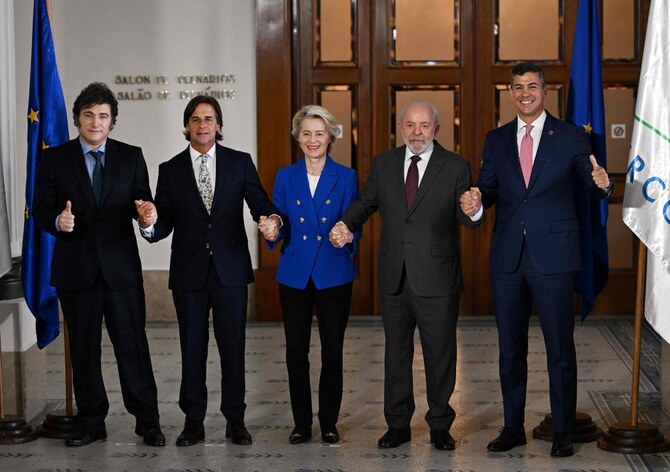
“This is a win-win agreement,” von der Leyen said in Uruguay, where she was attending a summit of the Mercosur bloc involved in the deal, which also includes Brazil, Argentina and Paraguay.
The agreement would create a sprawling free-trade zone of more than 700 million people.
She called the agreement — nearly a quarter of a century in the making — “a truly historic milestone” that builds trade bridges at a time when “strong winds are blowing in the opposite direction, toward isolation and fragmentation.”
But the European farmers’ group COPA-COGECA immediately reiterated its opposition to the agreement and called for a “flash” protest in Brussels on Monday.
EU countries and the European Parliament “must now firmly challenge the terms of this agreement,” the umbrella organization said.
While negotiations have concluded, the EU-Mercosur deal still needs to be greenlit by at least 15 of the European Union’s 27 member nations representing 65 percent of the EU population, as well as the European Parliament.
France, which has been rocked by successive protests by farmers saying the agreement would bring unfair competition, has tried to forge a blocking minority of EU countries.
Poland has rallied to France’s side, and Italian government sources say Rome believes “the conditions are not met” to back the deal. The Netherlands and Austria have also expressed reservations.
France’s minister for trade, Sophie Primas, said that von der Leyen’s announcement “regards only her.”
“Today is not the end of the story.... This only commits the commission, not the (EU) member states,” she said in a statement to AFP.
But Germany, desperate to open more trade opportunities amid gloom for its manufacturing sector, had strongly come out in favor of the EU-Mercosur deal, as had Spain.
German Chancellor Olaf Scholz reacted to the announcement from von der Leyen — a former German defense minister — by saying on X that “an important hurdle” had been overcome.
Spanish Prime Minister Pedro Sanchez hailed a “historic agreement with Mercosur to establish an unprecedented economic bridge between Europe and Latin America.”
The broad outlines of a deal were agreed back in 2019 but it was never ratified amid concerns over the impact of Brazilian farming on climate change, among other factors.
Von der Leyen nodded to that preoccupation, saying: “The EU-Mercosur agreement reflects our steadfast commitment to the Paris Agreement (on fighting climate change) and to the fight against deforestation.”
She said efforts being made by the government of Brazilian President Luiz Inacio Lula da Silva to protect the Amazon “are welcome, and they are necessary — but preserving the Amazon is a shared responsibility of all humanity.”
She also singled out European farmers, telling them: “We have heard you, listened to your concerns, and we are acting on them. This agreement includes robust safeguards to protect your livelihoods.”
The deal, once ratified, would allow the EU to export cars, machinery and pharmaceutical products more easily to South America.
In return, Brazil and its neighbors would be able to sell meat, sugar, rice, honey, soybeans and other products to Europe with fewer restrictions.
The treaty aims to eliminate most import taxes between the EU and Mercosur to create a vast free-trade area of more than 700 million consumers.
Sources familiar with the negotiations told AFP the deal would include changes to “several chapters,” including government contracts, services, intellectual property and the environment.
French President Emmanuel Macron on Thursday had repeated a warning to von der Leyen that the agreement was “unacceptable in its current state.”


![]()

EU and South America countries conclude Mercosur trade deal
Short Url
https://arab.news/cbp5u
EU and South America countries conclude Mercosur trade deal
- Agreement will create a sprawling free-trade zone of more than 700 million people
- France, which opposes the deal, says the agreement would bring unfair competition for agriculture

Latest updates


© 2026 SAUDI RESEARCH & PUBLISHING COMPANY, All Rights Reserved And subject to Terms of Use Agreement.