MANILA: The United States deployed a reconnaissance aircraft while Japan and the Philippines sent navy ships in a joint patrol in the disputed South China Sea on Friday, two days after the allied forces condemned actions by Chinese coast guard vessels against Philippine patrol ships.
The US Indo-Pacific Command said the joint patrol was conducted in the Philippines’ exclusive economic zone by allies and partners to “uphold the right to freedom of navigation and overflight” and “other lawful uses of the sea and international airspace.”
Those phrases are used by the US, Japan and the Philippines to oppose China’s increasingly aggressive actions in the disputed waters.
Two Philippine security officials said the patrol was staged about 40 nautical miles (74 kilometers) from Scarborough Shoal, a fishing area hotly disputed by Beijing and Manila off the northwestern Philippines. The two officials spoke on condition of anonymity because they didn’t have authority to discuss such details publicly.
China claims the South China Sea virtually in its entirety and has guarded it assertively with its coast guard, navy and suspected militia fleets. They have confronted forces from rival claimant states including the Philippines, Vietnam, Malaysia and Brunei.
Indonesia also has had faceoffs with Chinese coast guard ships escorting fishermen in the gas-rich Natuna waters in the southern fringes of the South China Sea.
The joint naval patrol, the latest in recent months by the Philippines, the US and their security partners, was delayed by several typhoons that battered the region and was not in reaction to a confrontation on Wednesday that involved Chinese and Philippine ships off Scarborough Shoal, the two Philippine officials said.
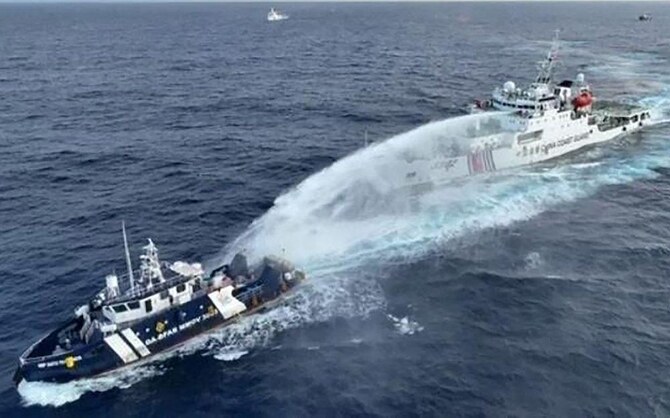
The Philippine coast guard said Chinese coast guard vessels, backed by navy ships, fired powerful water cannons and blocked and sideswiped a much smaller Philippine bureau of fisheries vessel escorted by coast guard ships off Scarborough Shoal.
The Philippine vessels were delivering fuel, food and other aid to Filipino fishermen in the shoal, which has been closely guarded by the Chinese coast guard since a tense 2012 territorial standoff with Philippine ships.
The Philippine Department of Foreign Affairs protested the Chinese actions.
The Chinese coast guard provided another account of the incident. It said the Philippine vessels encroached on China’s territory, prompting it to take action. It said, without offering proof, that a Philippine vessel maneuvered in a way that led to a collision.
The United States, Japan, the European Union and other Western allies expressed alarm over the hostilities, which have increased in frequency since last year.
Japan, which also has territorial conflicts with Beijing in the East China Sea, said the “use of water cannon and obstructive maneuvers undermine the safety of ship and crew.” It’s ambassador to Manila, Endo Kazuya, said “Japan upholds the rule of law and opposes any actions which increase tensions.”
Japan is providing 1.6 billion yen ($10.6 million) in security assistance this year to provide the Philippine navy with coastal radars, inflatable boats and other defense equipment to strengthen surveillance of Philippine sea lanes, including in the South China Sea. Japan has also helped improve the Philippine air force’s aerial surveillance radar, the two countries said Thursday.
The US has warned that it is obligated to defend the Philippines, a treaty ally, if Filipino forces come under attack in the South China Sea.
The US defense commitment to the Philippines has received strong bipartisan support in Washington, which Philippine officials say they expect will continue under the incoming Trump administration.


![]()

US, Japan and Philippine forces jointly patrol in South China Sea after hostilities involving China
Short Url
https://arab.news/gdfhw
US, Japan and Philippine forces jointly patrol in South China Sea after hostilities involving China
- Two Philippine security officials said the patrol was staged about 74 kilometers from Scarborough Shoal
- Scarborough Shoal is a fishing area hotly disputed by Beijing and Manila off the northwestern Philippines


Latest updates


Recommended


© 2026 SAUDI RESEARCH & PUBLISHING COMPANY, All Rights Reserved And subject to Terms of Use Agreement.