BEIRUT: Thousands of people fled the central Syrian city of Homs, the country’s third largest, as insurgents seized two towns on the outskirts Friday, positioning themselves for an assault on a potentially major prize in their march against President Bashar Assad.
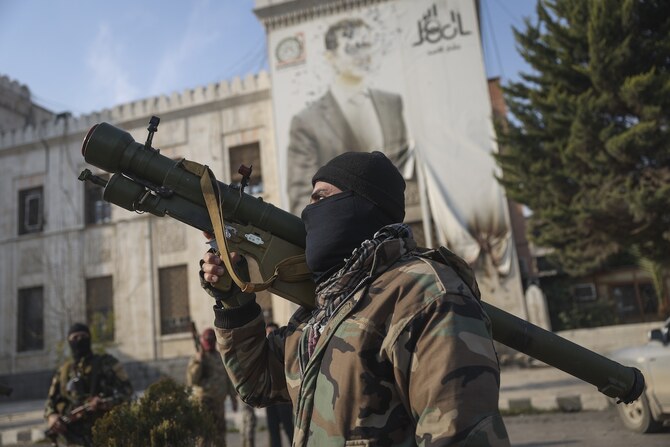
The move, reported by pro-government media and an opposition war monitor, was the latest in the stunning advances by opposition fighters over the past week that have so far met little resistance from Assad’s forces. A day earlier, fighters captured the central city of Hama, Syria’s fourth largest, after the army said it withdrew to avoid fighting inside the city and spare the lives of civilians.
The insurgents, led by the jihadi Hayat Tahrir Al-Sham group, or HTS, have vowed to march to Homs and the capital, Damascus, Assad’s seat of power. Videos circulating online showed a highway jammed with cars full of people fleeing Homs, a city with a large population belonging to Assad’s Alawite sect, seen as his core supporters.
If Assad’s military loses Homs, it could be a crippling blow. The city, parts of which were controlled by insurgents until 2014, stands at an important intersection between Damascus and Syria’s coastal provinces of Latakia and Tartus, where Assad enjoys wide support. Homs province is Syria’s largest in size and borders Lebanon, Iraq and Jordan.
Pressure on the government intensified from multiple directions.
Opposition protesters stormed security posts and army positions in the southern province of Sweida, opposition activists said. US-backed Kurdish forces who control eastern and northeastern Syria began to encroach on government-held territory.
Offensive leaves Assad reliant on Russia
After years of largely being bottled up in a northwest corner of the country, the insurgents burst out a week ago, captured the northern city of Aleppo, Syria’s largest, and have kept advancing since. Government troops have repeatedly fallen back.
The sudden offensive has flipped the tables on a long-entrenched stalemate in Syria’s nearly 14-year-old civil war. Along with HTS, the fighters include forces of an umbrella group of Turkish-backed Syrian militias called the Syrian National Army. Turkiye has denied backing the offensive, though experts say insurgents would not have launched it without the country’s consent.
HTS’s leader, Abu Mohammad Al-Golani, told CNN in an exclusive interview Thursday from Syria that Assad’s government was on the path to falling, propped up only by Russia and Iran.
“The seeds of the regime’s defeat have always been within it,” he said. “But the truth remains, this regime is dead.”
A key question about Assad’s ability to fight back is how much top ally Russia — whose troops back Assad’s forces — will throw support his way at a time when it is tied up in the war in Ukraine.
Russian Foreign Minister Sergey Lavrov said he planned to discuss the developments in Syria with his Turkish and Iranian counterparts at a meeting Friday in the Qatari capital, Doha.
In an interview with former Fox News host Tucker Carlson, he said international actors were backing the insurgents’ advances and that he would discuss “the way to cut the channels of financing and arming them.”
Meanwhile, Russia’s embassy in Syria issued a notice reminding Russian citizens that they may use commercial flights to leave the country “in view of the difficult military-political situation.”
The foreign ministers of Iran, Iraq and Syria — three close allies — gathered Friday in Baghdad to consult on the rapidly changing war. Syrian Foreign Minister Bassam Sabbagh said the current developments may pose “a serious threat to the security of the region as a whole.”
Assad opponents move in center, south and east
The insurgent fighters on Friday took over the central towns of Rastan and Talbiseh, putting them 5 kilometers (3 miles) from Homs, according to the Britain-based Syrian Observatory for Human Rights, an opposition war monitor.
“The battle of Homs is the mother of all battles and will decide who will rule Syria,” said Rami Abdurrahman, the Observatory’s chief.
Pro-government Sham FM said the insurgents entered Rastan and Talbiseh without facing any resistance. There was no immediate comment from the Syrian military.
The Observatory said Syrian troops had left Homs. But the military denied that in comments reported by the state news agency SANA, saying troops were reinforcing their positions in the city and were “ready to repel” any assault.
In eastern Syria, the Kurdish-led Syrian Democratic Forces coalition said it had moved into the government-held half of the city of Deir Ezzor, apparently without resistance. One of the main cities in the east, Deir Ezzor had long been split between the government on the western side of the Euphrates River and the SDF on the eastern side.
The SDF also said it took control of further parts of the border with Iraq. That appeared to bring it closer to the government-held Boukamal border crossing. The crossing is a vital for the government because it is the gateway to the corridor to Iran, a supply line for Iran-backed fighters, including Lebanon’s Hezbollah.
At the same time, insurgents seized Syria’s sole crossing to Jordan, according to opposition activists. Jordan announced it was closing its side of the crossing. Lebanon also closed all but one of its border crossings with Syria.
Worsening economy could hurt Assad’s war effort
The opposition assault has struck a blow to Syria’s already decrepit economy. On Friday, the US dollar was selling on Syria’s parallel market for about 18,000 pounds, a 25 percent drop from a week ago. When Syria’s conflict erupted in March 2011, a dollar was valued at 47 pounds.
The drop further undermines the purchasing power of Syrians at a time when the UN has warned that 90 percent of the population is below the poverty line.
Syria’s economy has been hammered for years by the war, Western sanctions, corruption and an economic meltdown in neighboring Lebanon, Syria’s main gate to the outside world.
Damascus residents told The Associated Press that people are rushing to markets to buy food, fearing further escalation.
The worsening economy could be undermining the ability of Syria’s military to fight, as the value of soldiers’ salaries melts away while the insurgents are flush with cash.
Syria’s military has not appeared to put up a cohesive counteroffensive against the opposition advances. SANA on Friday quoted an unnamed military official as saying the Syrian and Russian air forces were striking insurgents in Hama province, killing dozens of fighters.
Syria’s defense minister said in a televised statement late Thursday that government forces withdrew from Hama as “a temporary tactical measure” and vowed to gain back lost areas.
“We are in a good position on the ground,” Gen. Ali Mahmoud Abbas said, saying troops remained “at the gates of Hama.” He spoke before the opposition advanced further south toward Homs.
He said the insurgents, whom he described as “takfiri” or Muslim extremists, are backed by foreign countries. He did not name the countries but appeared to be referring to Turkiye and the United States.


![]()
![]()
![]()

Thousands flee Homs as Syrian militants push on lightning offensive


Short Url
https://arab.news/62paf
Thousands flee Homs as Syrian militants push on lightning offensive
- Militants have captured two major cities so far and are now thrusting toward Homs
- Seizing Homs would cut off Damascus from the coast, a longtime redoubt of Bashar Assad


Latest updates


© 2026 SAUDI RESEARCH & PUBLISHING COMPANY, All Rights Reserved And subject to Terms of Use Agreement.