

Pakistan says will push Central Asian states, UAE to expedite trans-Afghan railway project

1 / 2
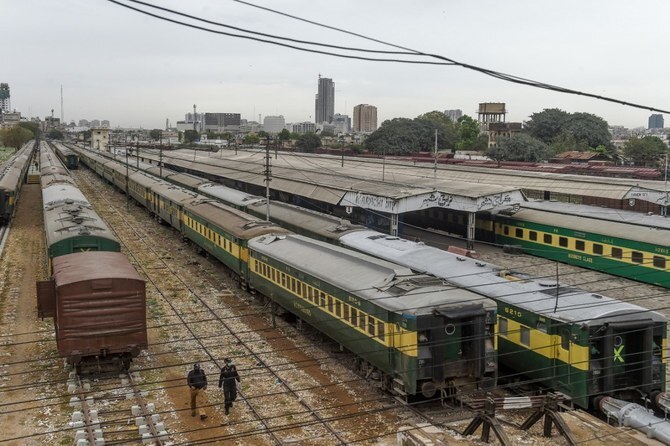
Policemen walk along trains stationed on a deserted platform at Karachi Cantonment railway station in Karachi, on March 26, 2020. (AFP/File)
2 / 2
Pakistan’s Federal Minister for Commerce, Jam Kamal Khan meets the Ambassador of Kazakhstan to Pakistan, Yerzhan Kistafin in Islamabad, on December 5, 2024. (APP)
Short Url
Updated 06 December 2024
Follow

Pakistan says will push Central Asian states, UAE to expedite trans-Afghan railway project

  • The railway corridor will run from northeastern Kazakhstan to Pakistan via Uzbekistan and Afghanistan
  • Aim is to use both land and sea routes to eventually link South and Central Asia with Jebel Ali port in UAE

ISLAMABAD: Federal Minister for Commerce Jam Kamal Khan said this week Pakistan would reach out to Uzbekistan, Turkmenistan as well as the UAE to expedite work on a trans-Afghan railway project that will connect South and Central Asia with the aim of enhancing trade and economic opportunity in the region.

Running from northeastern Kazakhstan to Pakistan via Uzbekistan and Afghanistan, the railway initiative is part of a broader strategy to establish a southern corridor using both land and sea routes to eventually link South and Central Asia with the port of Jebel Ali in the UAE.

On Thursday, the Pakistani commerce minister reaffirmed Islamabad’s commitment to the project in a meeting with Kazakh Ambassador Yerzhan Kistafin to discuss trade, regional connectivity, and economic cooperation and lay the groundwork for several collaborative initiatives.

“The Minister reiterated the significance of the Trans-Afghan railway for strengthening connectivity with Central Asia,” the commerce ministry said in a statement on Thursday. “He committed to reaching out to Afghanistan, Uzbekistan, Turkmenistan, and Abu Dhabi authorities to expedite the project’s completion.”

In recent months, the railway project has seen the involvement of several countries, including Pakistan, the UAE, Uzbekistan, Afghanistan and Qatar.

Earlier this year, the Taliban government in Kabul signed a memorandum with Uzbekistan and the UAE to begin studies on the project’s viability after a meeting in Tashkent on Feb. 19, where technical, financial, and strategic aspects of the scheme were discussed. These developments followed an earlier meeting between transport ministers from Uzbekistan, Afghanistan, Pakistan, and Qatar, which led to the approval of the main routes and implementation modalities for the corridor.

However, Pakistan faces several challenges to the corridor’s completion. 

Political instability, insurgency in the southwestern Balochistan province bordering Afghanistan and Iran, and security threats to ongoing projects under the China-Pakistan Economic Corridor (CPEC) are significant hurdles. Strained relations with Afghanistan due to the activities of the Tehreek-e-Taliban Pakistan (TTP) militant groups, which Islamabad says operates from safe havens in Afghanistan, and an expulsion drive targeting Afghan refugees will also complicate Pakistan’s aim to secure trade routes vital to the corridor. The Taliban rulers in Afghanistan deny they allow Afghan soil to be used by terror groups. 

The railyway project is part of Pakistan’s wider push to consolidate its role as a pivotal trade and transit hub connecting the landlocked Central Asian states with the rest of the world, leveraging its strategic geographical position. In recent weeks, there has been a flurry of visits, investment talks and economic activity between officials from Pakistan and the Central Asian nations.


US approves sale of $686 million tech upgrade, equipment for Pakistan’s F-16 fighter jets

Updated 4 sec ago
Follow

US approves sale of $686 million tech upgrade, equipment for Pakistan’s F-16 fighter jets

  • US Defense Security Coope­ration Age­ncy informs Congress sale will allow Pakistan to partner with US in counterterror efforts, won’t alter regional military balance
  • Non-Major Defense Equipment includes aircraft hardware and software modifications, precision navigation, cryptographic devices, and spare and repair parts

ISLAMABAD: The United States has approved the sale of advanced technology support and equipment for Pakistan’s F-16 fighter jets valued at $686 million, according to a letter sent by the US Defense Security Coope­ration Age­ncy (DSCA) to the American Congress, saying the move would allow Islamabad to partner with Washington in ongoing counterterrorism efforts. 

As per a copy of the document dated Dec. 8 seen by Arab News, the letter stated that Islamabad has requested to buy 92 Link-16 systems communication/data-sharing networks and six Mk–82 inert 500-lb general purpose bomb bodies. The letter also said that the sale includes non-Major Defense Equipment items such as aircraft hardware and software modifications, precision navigation, cryptographic devices, other weapons integration, test and support equipment such as spare and repair parts. 

“The estimated total cost is $686 million,” the DSCA’s letter to Congress reads. “This proposed sale will support the foreign policy and national security objectives of the United States by allowing Pakistan to retain interoperability with US and partner forces in ongoing counterterrorism efforts and in preparation for future contingency operations.”

Pakistan and the US have been key allies in battling militants in the region, with Islamabad counted among Washington’s closes non-NATO allies during the “War on Terror” campaign. The proposed sale takes place as Washington, under US President Donald Trump, warms up to Pakistan after his recent meetings with Prime Minister Shehbaz Sharif and Chief of Defense Forces Field Marshal Syed Asim Munir. 

The DSCA letter said the sale will maintain Pakistan’s capability to meet current and future threats by updating and refurbishing its Block–52 and Mid Life Upgrade F–16 fleet. 

“These updates will provide more seamless integration and interoperability between the Pakistan Air Force and the US Air Force in combat operations, exercises, and training, and refurbishment will extend the aircraft life through 2040 while addressing critical flight safety concerns,” the letter added. 

It further said Pakistan has shown a commitment to maintaining its military forces and “will have no difficulty” absorbing these articles into its armed forces. 

“The proposed sale of this equipment and support will not alter the basic military balance in the region,” the letter said. 

The principal contractor for the deal will be Lockheed Martin Company, the DSCA said, adding that the implementation of the sale will not require the assignment of any additional US government or contractor representatives to Pakistan. 

“All defense articles and services listed in this transmittal have been authorized for release and export to the Government of Pakistan,” the letter concluded. 

The development takes place as Pakistan undertakes efforts to expand its fleet of fighter jets, defense exports and deepen military-industrial partnerships with other countries. Islamabad claimed last month that a “friendly country” signed a memorandum of understanding to procure Pakistan’s JF-17 fighter aircraft during the Dubai Airshow 2025. 

The JF-17 Thunder, a multi-role fighter that Pakistan jointly developed with China, has become the backbone of the Pakistan Air Force (PAF) over the past decade. It is designed to replace aging legacy aircraft. 

The South Asian country has been eager to assert its regional dominance, especially when it comes to air warfare, after its four-day military confrontation with India in May. 

Pakistan claimed it shot down seven Indian fighter jets during the May altercation between the two forces. Indian officials have acknowledged their planes were shot down but have refused to share the exact number, rejecting Pakistan’s claim it had shot down seven.