MELBOURNE: Arsonists extensively damaged a Melbourne synagogue on Friday in what Australia’s prime minister condemned as an antisemitic attack on Australian values.
The blaze in the Adass Israel Synagogue is an escalation in targeted attacks in Australia since the war began between Israel and Hamas last year. Cars and buildings have been vandalized and torched around Australia in protests inspired by the war.
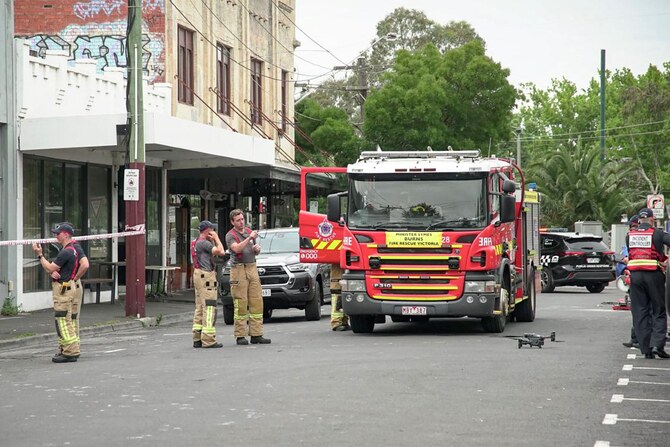
A witness who had come to the synagogue to pray saw two masked men spreading a liquid accelerant with brooms inside the building at 4:10 a.m., officials said.
About 60 firefighters with 17 fire trucks responded to the blaze, which police said caused extensive damage.
Investigators have yet to identify a motive, but Prime Minister Anthony Albanese blamed antisemitism.
“This was a shocking incident to be unequivocally condemned. There is no place in Australia for an outrage such as this,” Albanese told reporters.
“To attack a place of worship is an attack on Australian values. To attack a synagogue is an act of antisemitism, is attacking the right that all Australians should have to practice their faith in peace and security,” he added.
Israel’s Ambassador to Australia Amir Maimon noted that dozens of pro-Palestinian activists staged a three-hour protest outside The Great Synagogue in downtown Sydney on Wednesday, demanding sanctions against Israel. Worshippers were prevented from leaving the synagogue during the demonstration.
“We are talking about the values you expect Australians to follow, not my own values. And for me it’s clear that everyone should have the right to worship his own religion, own beliefs, as long as they also respect others,” Maimon said.
A religious leader at the torched mosque, Rabbi Gabi Kaltmann, described the arsonists as “thugs.”
“Tonight is the Sabbath. We must all go and find a sense of calmness, comradery and community by gathering for the Sabbath tonight and praying together as one community,” Klatmann told reporters outside the synagogue.
Federal law in January banned the Nazi salute and the public display of Nazi symbols in response to growing antisemitism.
The government appointed special envoys this year to combat antisemitism and Islamophobia in the community.
The Jewish envoy, Jillian Segal, a Sydney lawyer and business executive, said the Jewish community in Australia was “feeling ever more rattled by what is going on.”
“I’m very concerned. Here is one major escalation in terms of burning synagogues which has resonance as to what happened during the Holocaust,” Segal said.
Victoria state Premier Jacinta Allan noted in a statement that the synagogue was “built by Holocaust survivors.”
Many of the synagogue’s original worshippers were post-World War II immigrants from Hungary.
Allan offered 100,000 Australian dollars ($64,300) to help repair the synagogue and said there would be an increased police presence in the area.
“Every available resource will be deployed to find these criminals who tried to tear a community apart,” Allan said.
“We stand against antisemitism now and forever,” she added.
Daniel Aghion, president of the Executive Council of Australian Jewry, said the broader Australian community needed to condemn the arson attack.
“I’ve been getting phone calls this morning from the Hindu community, from other people, from good people who are prepared to stand up and that’s my message for this morning to Australia, to the good people of Australia,” Aghion told reporters.
“Don’t leave the Jewish people behind. Don’t isolate us. Don’t leave us exposed to the risk of attacks upon our religious institutions, our communal institutions. Stand with us. Stand against this hate. And stand against this kind of horrendous attack which should not occur on Australian soil,” he added.


![]()

Australian leader blames antisemitism for arson that extensively damaged a Melbourne synagogue
Short Url
https://arab.news/mut4t
Australian leader blames antisemitism for arson that extensively damaged a Melbourne synagogue
- Fire broke out at 4:10 a.m. in the Adass Israel Synagogue when some congregants were already inside
- Members of the congregation form human chain to remove religious items from the damaged synagogue


Latest updates


© 2026 SAUDI RESEARCH & PUBLISHING COMPANY, All Rights Reserved And subject to Terms of Use Agreement.