BUCHAREST: Romania’s constitutional court on Friday canceled the country’s presidential election following allegations of Russian interference in favor of the far-right frontrunner, just two days ahead of the run-off.
Romanian authorities objected after outsider Calin Georgescu topped the first round of the election on November 24, a shock result in the EU and NATO member bordering Ukraine.
On Wednesday, the presidency declassified documents detailing allegations against Georgescu and Russia, including “massive” social media promotion and cyber-attacks.
The court said it had unanimously decided “to annul the entire electoral process for the election of the president of Romania... to ensure the correctness and legality of the electoral process.”
“The government will set a new date for the election of the president of Romania,” it added.
Georgescu, a former senior civil servant, had been due to face centrist mayor Elena Lasconi in Sunday’s runoff.
“Today is the moment when the Romanian state has trampled democracy,” Lasconi, a former journalist, 52, said in a video recording, calling the decision “illegal, immoral... crushing the very essence of democracy.”
Fears had been raised that if Georgescu won, the country would join the EU’s far-right bloc and undermine European unity against Russia.
Washington has warned of “serious negative impacts” if Romania — whose strategic importance has increased since Russia invaded Ukraine — turned away from the West.
Outgoing Prime Minister Marcel Ciolacu — who lost in the first round of presidential elections — welcomed the court’s decision in a post on Facebook.
It was, he said, “the only correct solution after the declassification of the documents... which show that the result of the Romanians’ vote was blatantly distorted as a result of Russia’s intervention.”
The documents, drawn up for a security council meeting and published Wednesday, the authorities said data had “revealed an aggressive promotional campaign, in violation of electoral legislation, and an exploitation of algorithms to increase the popularity of Calin Georgescu at an accelerated pace.”
Last week authorities slammed “preferential treatment” of Georgescu by TikTok, which the social media platform has denied. It said Thursday it had “no evidence that a coordinated campaign has taken place on our platform to date.”
The European Commission announced however that it had stepped up monitoring of TikTok’s role in the elections.
A separate intelligence services document stated that Romania “is perceived by Moscow’s policy centers as an enemy state.”
Romania is a “target for aggressive Russian hybrid actions, including cyberattacks and hacks and leaks and sabotage,” it added.
Anti-corruption prosecutors on Friday said they have opened an investigation into “illegal operations with computer devices or software.”
Prosecutors are already probing “possible violations of electoral legislation” and “money laundering offenses.”
Georgescu, 62, shot into the limelight with his performance in the first round of voting.
Having praised Russian President Vladimir Putin in the past, he has recently avoided answering questions about him being pro-Russian.
A critic of the EU and NATO, he says he does not want to leave either group but wants to put Romania “on the world map.”
Like his idol US president-elect Donald Trump, he is opposed to military aid to Ukraine.
While the president’s post is largely ceremonial, the head-of-state has moral authority and influence on Romania’s foreign policy.
The president also designates the prime minister — a key role especially since legislative elections last weekend returned a fragmented parliament.
The governing pro-European Social Democrats won the vote, but far-right parties made strong gains, together securing a third of the ballots.
Since the fall of Communism in 1989, Romania has never seen such a breakthrough by the far right, fueled by mounting anger over soaring inflation and fears over Russia’s war in neighboring Ukraine.
George Simion, leader of the far-right AUR party, also slammed Friday’s court ruling, calling it a “state coup in full swing.”


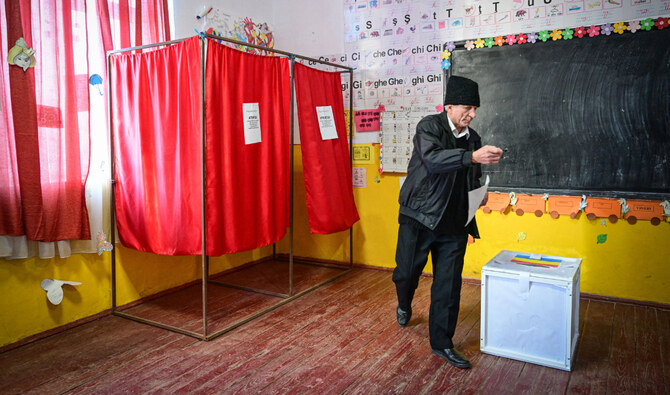
Romania’s top court scraps presidential election
https://arab.news/pppcb
Romania’s top court scraps presidential election

- The court said it had unanimously decided “to annul the entire electoral process for the election of the president of Romania”
- “The government will set a new date for the election of the president of Romania“


Venezuela to debate historic amnesty bill for political prisoners
- Venezuela could pass a landmark bill on Thursday granting amnesty to political prisoners, marking an early milestone in the transition from the rule of toppled leader Nicolas Maduro
CARACAS:Venezuela could pass a landmark bill on Thursday granting amnesty to political prisoners, marking an early milestone in the transition from the rule of toppled leader Nicolas Maduro.
The legislation, which covers charges used to lock up dissidents under Maduro and his predecessor Hugo Chavez, aims to turn the page on nearly three decades of state repression.
It was spearheaded by interim president Delcy Rodriguez, who replaced Maduro after he was captured by US forces in Caracas last month and flown to New York to face trial.
Rodriguez took Maduro’s place with the consent of US President Donald Trump, provided she does Washington’s bidding on access to Venezuelan oil and expanding democratic freedoms.
She has already started releasing political prisoners ahead of the pending amnesty. More than 400 people have been released so far, according to rights group Foro Penal, but many more are still behind bars.
Rodriguez also ordered the closure of the notorious Helicoide prison in Caracas, which has been denounced as a torture center by the opposition and activists.
Lawmakers voted last week in favor of the amnesty bill in the first of two debates.
The second debate on Thursday coincides with Youth Day in Venezuela, which is traditionally marked by protests.
Students from the Central University of Venezuela, one of the country’s largest schools and home to criticism of Chavismo, called for a rally on campus.
Venezuela’s ruling party also announced a march in the capital Caracas.
’We deserve peace’
Venezuela’s attorney general said Wednesday that the amnesty — which is meant to clear the rap sheets of hundreds of people jailed for challenging the Maduro regime — must apply to both opposition and government figures.
He urged the United States to release Maduro and his wife, both in detention in New York.
“We deserve peace, and everything should be debated through dialogue,” Attorney General Tarek William Saab told AFP in an interview.
Delcy Rodriguez’s brother Jorge Rodriguez, who presides over the National Assembly, said last week that the law’s approval would trigger the release of all political prisoners.
“Once this law is approved, they will all be released the very same day,” he told prisoners’ families outside the notorious Zona 7 detention center in Caracas.
’We are all afraid’
Venezuelan opposition leader Juan Pablo Guanipa was one of the detainees granted early release.
But he was re-arrested less than 12 hours later and put under house arrest.
Authorities accused him of violating his parole after calling for elections during a visit to Helicoide prison, where he joined a demonstration with the families of political prisoners.
Guanipa is a close ally of Nobel Peace Prize laureate and opposition leader Maria Corina Machado, who was in hiding for over a year before she fled the country to travel to Oslo to receive the award.
“We are all afraid, but we have to keep fighting so we can speak and live in peace,” Guanipa’s son told reporters outside his home in Maracaibo.