

CERN aims to open data center at Saudi university

1 / 3
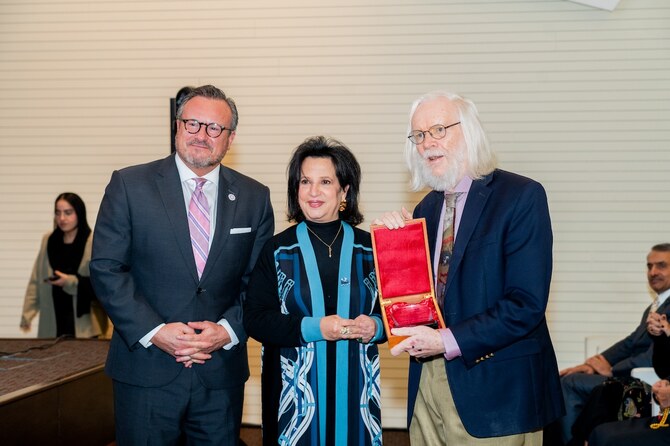
CERN physicist John Ellis (right) receives an award from Bahrain's Shaikha Mai bint Mohammed Al-Khalifa (center) and Bradley J Cook, American University of Bahrain President, during an event in Manama on Tuesday Dec. 3, 2024. (AN/Abdulrahman bin Shalhoub)
2 / 3
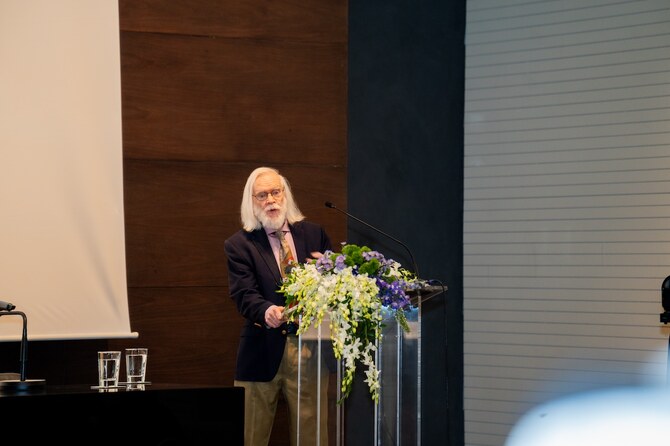
CERN physicist John Ellis delivers a speech during an event in Manama, Bahrain on Tuesday Dec. 3, 2024. (AN/Abdulrahman bin Shalhoub)
3 / 3
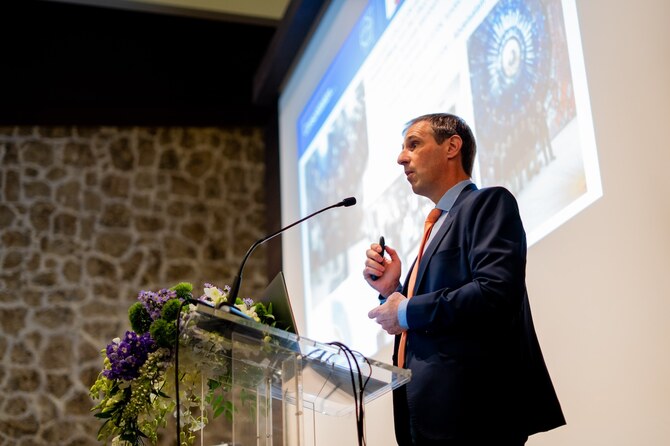
CERN's Martin Gastal speaks during an event in Manama, Bahrain on Tuesday Dec. 3, 2024. (AN/Abdulrahman bin Shalhoub)
Short Url
Updated 04 December 2024
Follow

CERN aims to open data center at Saudi university

MANAMA: Leading particle physics research center CERN is looking to deepen its collaboration with Saudi Arabia by opening a data center at the King Abdullah University of Science and Technology, a staff member has told Arab News.

Martin Gastal, CERN adviser to the Middle East and North African region, told Arab News that “the ambition of the Kingdom is to try and integrate CERN into one of its drivers for research,” adding that there are plans to launch the center at the Saudi university to analyze CERN data.

KAUST already collaborates with the Swiss center, with four KAUST students taking part in internships at CERN.

According to Gastal, the Research, Development and Innovation Authority in Saudi Arabia aims to bring together more particle physicists in the Kingdom to improve research efficiency.

Also working with NEOM University, Gastal said he hopes to find synergies between the technology developed at CERN and the research conducted at Saudi universities.

“Scientific cooperation is a way of bringing together lots of brains with different ways of thinking that bring different ideas to the table and maybe also different techniques for testing those ideas,” CERN physicist John Ellis told Arab News.

Ellis, who holds the Clerk Maxwell Professorship of theoretical physics at King’s College London, and is known for his work in helping discover the Higgs-Boson particle, spoke to Arab News at a recent event on promising work in nuclear research and particle physics.

“Most countries in the Gulf region now have some sort of collaboration with CERN … Bahrain is perhaps the most advanced,” he said.

Ellis added that Saudi Arabia, Qatar, the UAE and Oman have also forged significant partnerships with CERN, with Saudi Arabia taking part in one of its experiments.

He said that CERN’s biggest focus is on “the smallest constituents of matters,” or the particles that make up the universe.

The research center aims to understand the behavior of these particles and decipher how they once behaved in the early history of the universe to answer the fundamental questions of who we are, why we are here and where we are going.

One focus is on the particles that make up dark matter, which, astrophysicists believe, constitute most of the matter in the universe, Ellis said.

CERN is home to the Large Hadron Collider, the world’s biggest and most powerful particle accelerator. It works by colliding hadrons to create new particles and it is responsible for discovering the Higgs-Boson in 2012, a breakthrough that Ellis said was the “holy grail that we physicists have been looking for, for almost 50 years.”

Now, the focus is on carrying out more particle collisions and upgrading the experiments.

“The technological output from CERN is not just from the particles that we discover, but also from the techniques we develop to discover those particles.”

Ellis spoke to Arab News at a CERN event held jointly with the American University of Bahrain and the Sheikh Ebrahim bin Mohammed Al-Khalifa Center for Culture and Research in Manama on Tuesday.

The event hosted officials from CERN and Bahrain universities to discuss scientific collaboration between Gulf and international countries in particle physics.

Saudi hospitality boom sparks innovation beyond the plate

Chefs at Julien prepare meals to pair with Diageo drinks. (AN photo by Basmah Albasrawi)
Updated 11 January 2026
Follow

Saudi hospitality boom sparks innovation beyond the plate

  • At the Four Seasons Riyadh, Diageo hosted a private tasting at Tonic Bar followed by a 10-course dinner at Julien
  • Dinner at Julien paired dishes with drinks made using Tanqueray 0.0, Captain Morgan 0.0, and Guinness 0.0

RIYADH: As restaurants and hotels in Saudi Arabia refine their culinary identities, beverages are increasingly being treated as crafted experiences in their own right, shaped by technique and intention.

At the Four Seasons Riyadh, Diageo hosted a private tasting at Tonic Bar followed by a 10-course dinner at Julien, offering a snapshot of how this evolution is beginning to take shape, as international players and local venues test new approaches to pairing and presentation. 

Speaking to Arab News, Nick Rees, marketing director of Diageo MENA, pointed to the rapid growth of the nonalcoholic segment globally and in the region: “There’s a far faster growing percentage of it (the industry) is non-alcohol … There (are) trends globally … A lot of it will be pointed to wellness, mindful drinking.”

Rees said that Saudi Arabia’s fast-developing culinary and hospitality scene calls for beverages that match the level of excellence seen in kitchens across the Kingdom.

“It’s kind of the lack of choices and that’s where we want to be able to provide people the option, and people here absolutely have the same kind of talent and desire as their counterparts behind the kitchen,” he said.

“That’s where our role is to give people the kind of core ingredients for them to be able to work with … we have many more brands that we would love to introduce to the Kingdom.”

The dinner at Julien paired dishes with drinks made using Tanqueray 0.0, Captain Morgan 0.0, and Guinness 0.0, offering a glimpse into the range of styles Diageo is bringing to the market.

Flavor profiles ranged from light and refreshing combinations with cucumber and capers brine to richer, malt-forward blends, each designed to complement the accompanying dishes, from ravioli to black cod. 

Rees emphasized that pairing food with thoughtfully crafted beverages is becoming an essential part of the hospitality experience. 

“In the Kingdom, we’re looking at giving people the experience that currently is not available to them because I know for sure that the kind of quality and expertise and craftsmanship that can go into creating some of these drinks is absolutely as exciting as the work that the chefs would do with their food,” he said.

Anthony Abou Haider, head of Gulf at Diageo, said the company sees long-term potential in Saudi Arabia’s hospitality sector. 

“It’s such an opportunity to be a part of this transformation journey,” he told Arab News. “We’re not looking for a short-term gain, we’re looking at a very long-term gain here because whatever we do now is building for the future.”