

Saudi Arabia positioned to lead global hydrogen production, say experts

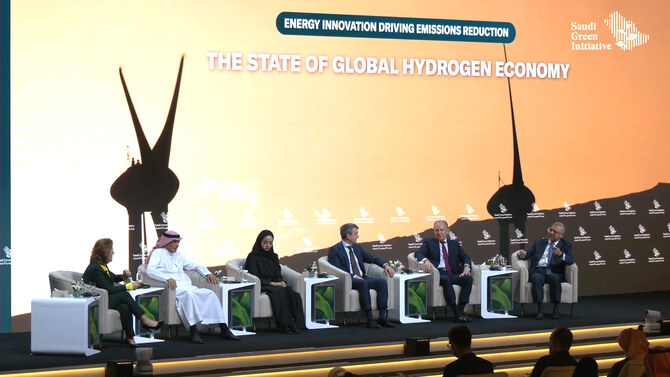
Speakers express their views on global hydrogen production at a panel at the Saudi Green Initiative Forum in Riyadh.
Short Url
Updated 04 December 2024
Follow

Saudi Arabia positioned to lead global hydrogen production, say experts

  • SABIC, in collaboration with its parent company Aramco, plans to produce low-carbon ammonia
  • COP16 panelists cautioned hydrogen alone will not solve global decarbonization challenges

RIYADH: Saudi Arabia is poised to become one of the world’s leading producers of hydrogen, capitalizing on its abundant renewable energy resources and robust infrastructure, experts say.

At the Saudi Green Initiative Forum in Riyadh, Abdulrahman Al-Fageeh, CEO and executive board member of SABIC, outlined the Kingdom’s unique advantages in the hydrogen sector.

“Saudi Arabia, by the way, as a country, is going to be the best competitive in terms of the economics of producing hydrogen from any source by having the solar, by having the wind and also by having the gray hydrogen that we have in our systems,” he said. 

Al-Fageeh underscored that the Kingdom’s hydrogen ambitions would depend on close collaboration across the entire value chain, as well as strong regulatory support.

“Collaboration across the value chain is key, and regulators will play a crucial role,” he emphasized, highlighting the importance of coordinated efforts to scale production and integrate hydrogen into fuel systems and broader decarbonization strategies.

As part of its hydrogen strategy, SABIC, in collaboration with its parent company Aramco, plans to produce low-carbon ammonia.

“We have committed to advancing our decarbonization efforts using hydrogen and will collaborate with Aramco to produce low-carbon ammonia, which will play an important role in the fuel systems of the future,” Al-Fageeh added.

Sanjiv Lamba, CEO of Linde, also spoke positively about Saudi Arabia’s potential, describing hydrogen as a vital link in the global energy transition.

“Low-carbon hydrogen offers a cost-effective, scalable solution with mature technologies today, ensuring safe and reliable hydrogen production,” he said, adding that Saudi Arabia is particularly well-positioned to produce green hydrogen at globally competitive prices.

Kholoud Al-Otaibi, a clean hydrogen analyst at the Saudi Ministry of Energy, highlighted the Kingdom’s ongoing progress in building the necessary infrastructure for hydrogen production and export.

“The Kingdom is already taking deliberate steps to develop the protection and capacity, as well as the export infrastructure needed for hydrogen,” she said, underscoring the potential of hydrogen to support a sustainable energy future.

Despite the optimism, panelists cautioned that hydrogen alone will not solve global decarbonization challenges.

“It is one of many solutions. To address this pragmatically, we need to answer three key questions: where, what, and how,” said Al-Fageeh.

Francois Jackow, CEO of Air Liquide, noted that the energy transition is at a critical “scale-up phase,” requiring substantial investment and industrial innovation to unlock its full potential.

The forum also tackled broader challenges in climate finance, with experts stressing the urgent need to bridge the funding gap for climate adaptation, particularly in low- and middle-income countries.

Mohammed Ayoub, lead climate finance negotiator at the Saudi Ministry of Energy, warned that macroeconomic factors, such as unsustainable debt levels and foreign exchange risks, are restricting access to capital for developing nations.

“This is driving up the cost of capital due to lower sovereign ratings,” Ayoub said, explaining that it limits critical investments in climate adaptation measures that save lives and improve quality of life in vulnerable regions.

Florent Baarsch, founder and CEO of finres, highlighted the scale of the shortfall, pointing out that current overseas development assistance stands at $220 billion annually, far below the $300 billion to $500 billion needed each year for climate adaptation.

“Even if we allocated the entire ODA to adaptation, it would still fall short,” Baarsch said.

Rachel Kyte, the UK special representative on climate, said that adaptation finance must prioritize the most vulnerable populations and combine public and private funding to meet the scale of the challenge.


Saudi Maaden reports 156% profit surge to $2bn on strong commodity prices, record production

Updated 05 March 2026
Follow

Saudi Maaden reports 156% profit surge to $2bn on strong commodity prices, record production

RIYADH: Saudi mining and metals company Maaden has reported a 156 percent jump in its net profit attributable to shareholders for 2025, driven by higher commodity prices, record production volumes, and a one-off bargain purchase gain.

The state-backed giant posted a net profit of SR7.35 billion ($1.95 billion) for the full year 2025, an increase from SR2.87 billion in the previous year. The firm’s revenue surged by 19 percent to SR38.58 billion, up from SR32.55 billion in 2024.

This comes as Saudi Arabia steps up efforts to expand its mining sector as a pillar of economic diversification, encouraging international participation and private investment to unlock the Kingdom’s estimated $2.5 trillion in untapped mineral resources under Vision 2030.    

In a statement on Tadawul, the company said: “Performance was led by record phosphate production, near record aluminum production, an increase in all three of Maaden’s main output commodity prices.”

The performance was also fueled by a 60 percent increase in gross profit, which reached SR14.79 billion. In its annual results announcement, Maaden attributed the top-line growth to “higher commodity market prices for phosphate, aluminum and gold business units,” as well as increased sales volumes in its phosphate and aluminum segments. This was partially offset by slightly lower sales volume in the gold unit.

Maaden’s CEO, Bob Wilt, hailed 2025 as a transformative year for the company, marked by strategic growth and operational excellence. “This was a great year for Maaden’s strategic growth. We delivered strong financial results and sustained operational excellence across the business,” he said in a statement.

“This was driven by growth in production across all businesses, including record-breaking DAP (di-ammonium phosphatevolumes), disciplined cost control across and a clear commitment to our role as a cornerstone of the Saudi economy,” Wilt added.

Profitability was further bolstered by an increased share of net profit from joint ventures and an associate. This included a one-off bargain purchase gain of SR768 million related to Maaden’s investment in Aluminium Bahrain B.S.C. The company also benefited from lower finance costs.

The fourth quarter of 2025 was strong, with Maaden swinging to a net profit of SR1.67 billion, compared to a loss of SR106 million in the same period of the prior year. Quarterly revenue rose 7 percent to SR10.64 billion.

The firm achieved record production of di-ammonium phosphate, reaching 6.72 million tonnes for the year, a 9 percent increase. Aluminum production remained near-record levels, while the company added a net 7.8 million ounces to its reportable gold mineral resources through discovery and resource development.

The phosphate division saw sales jump 17 percent to SR20.77 billion, with the earnings before interest, taxes, depreciation, and amortization margin expanding to 47 percent. The aluminum business reported a 9 percent increase in sales to SR10.99 billion, with EBITDA more than doubling in the fourth quarter.

Looking ahead, Wilt emphasized that the pace of growth will accelerate as the company advances key initiatives, including the Phosphate 3 Phase 1 and Ar Rjum projects, which remain on budget and schedule. Maaden has also secured a gas supply for its future Phosphate 4 project.

“This pace of growth will only accelerate. Not only as we advance projects and increase the scale of our exploration program, but as we continue to grow production and implement technology that will further modernize, streamline and unlock value,” Wilt added.

Earnings per share for the year rose sharply to SR1.91, up from SR0.78 in 2024. Total shareholders’ equity increased by 18.7 percent to SR61.59 billion.