

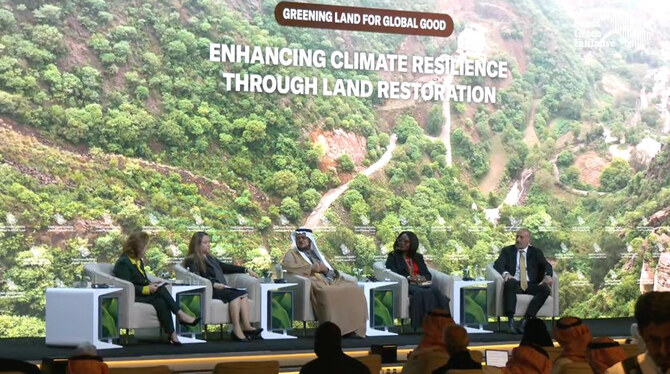

RIYADH: Metals and minerals are critical to the global energy transition, industrialization, modernization, and the broader push for sustainability, according to Ma’aden CEO Robert Wilt.
Wilt made the statement during a panel discussion on “Enhancing climate resilience through land restoration” at the 4th Saudi Green Initiative Forum in Riyadh.
He emphasized the essential role that these resources play in driving global sustainability and innovation, stressing the importance of securing the materials necessary for transformative progress in energy and industry.
“The world cannot make the energy transition. It cannot industrialize, it cannot energize, it cannot modernize without metals and minerals,” Wilt said.
As Saudi Arabia continues to work toward its Vision 2030 goals, the need for collaboration between the public and private sectors to achieve environmental sustainability has become increasingly clear.
Wilt, whose company Ma’aden is a key player in the mining industry, stated that the private sector is crucial in helping the Kingdom meet its sustainability targets.
He added: “That’s why our board in the Kingdom has said that if you’re going to be the third pillar of the Saudi economy, you’re going to be an ESG (environmental, social, and governance) role model, and you’re going to do it right.”
Wilt also outlined Ma’aden’s ambitious sustainability goals, including achieving double-digit reductions in waste, water usage, and carbon emissions year on year, with the ultimate goal of carbon neutrality by 2050. The company’s commitment to sustainability is also reflected in its efforts to plant over a million trees annually. Wilt argued that the mining sector, often seen as a contributor to environmental degradation, should be recognized as part of the solution to the climate crisis.
“If you want to save the world, join mining because we are the solution, not the problem,” he said, aiming to challenge public perceptions and inspire the next generation to consider careers in the industry.
Saudi Arabia’s Deputy Minister for Environment Osama Faqeeha also addressed environmental challenges during the forum. He pointed out that Riyadh consumes over 1 million cubic meters of water daily. “That’s like a river. So now we are actually aiming for 200 percent recycling,” he noted.
Faqeeha further explained that the government has upgraded several wastewater treatment plants to produce high-quality, reusable water, which will be repurposed for industry, land restoration, and other uses.
He emphasized that effective land restoration requires understanding the broader purpose behind the efforts, cautioning that focusing only on carbon storage offers a limited view. He added that ecosystems provide a wide range of services beyond carbon sequestration, making a holistic approach essential.
In terms of greening efforts, Faqeeha shared that Saudi Arabia is implementing a large-scale and detailed plantation plan, which spans both environmental and urban areas.
He also highlighted ongoing collaboration with the Ministry of Transportation to green the country’s highways, broadening the scope of the Kingdom’s land restoration initiatives.
Grethel Aguilar, director general of the International Union for Conservation of Nature, also stressed the private sector’s key role in driving environmental action.
“The private sector is fundamental, and this is not just about offsetting. It’s about planning. It’s about taking the right decisions at the right time. It’s about measuring what is the impact and taking action,” she stated.
Faqeeha echoed this sentiment, emphasizing that environmental sustainability is not merely a desirable objective but an essential one. “Environmental sustainability is not something nice to do, but it’s an imperative,” he said, underscoring that both business and government must work together to achieve meaningful progress.
The panel discussions highlighted the Kingdom’s commitment to embracing innovation and change in its pursuit of both environmental and business success.
Faqeeha remarked: “I think with the determination and actually the will to change, to embrace innovation, I think you can win on the business front, production, as well as environmental.”
For Wilt and Ma’aden, sustainability is not only about benefiting the planet but is also a critical driver of their business strategy.
“Everything we’re doing is sure to save the planet, to green the world, all that. But at the end of the day, we’re a business. We need to make money and make profits,” he concluded, reinforcing that environmental responsibility and profitability can go hand in hand.


