

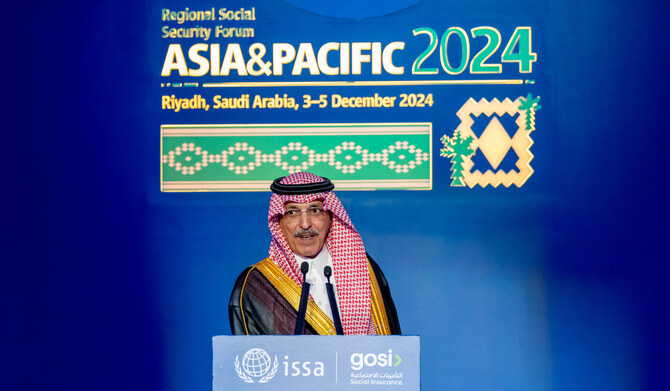
Finance minister highlights Saudi Arabia’s social security milestones at Riyadh forum

Mohammed Al-Jadaan, Minister of Finance and Chairman of the General Organization for Social Insurance (GOSI), spoke at the opening of the Regional Social Security Forum for Asia and the Pacific in Riyadh on Tuesday. (Supplied/ GOSI)
Short Url
Updated 03 December 2024
Follow

Finance minister highlights Saudi Arabia’s social security milestones at Riyadh forum

  • Al-Jadaan said that the Kingdom is a leading model in developing a robust social insurance system, a key pillar of Saudi Vision 2030

RIYADH: The Regional Social Security Forum for Asia and the Pacific opened in Riyadh on Tuesday, under the patronage of Mohammed Al-Jadaan, minister of finance and chairman of the General Organization for Social Insurance.

Organized every three years by the International Social Security Association, the forum addresses future challenges and opportunities in social security.

It aims to strengthen strategic partnerships and facilitate the exchange of experiences in various sectors.


Mohammed Azman, President of ISSA, spoke at the opening of the Regional Social Security Forum for Asia and the Pacific in Riyadh on Tuesday. (Supplied/GOSI)

Al-Jadaan said that the Kingdom is a leading model in developing a robust social insurance system, a key pillar of Saudi Vision 2030.

“In recent years, we have launched innovative initiatives and services to enhance social protection and ensure financial and living stability for the community,” he said.

He also highlighted the merger of the Public Pension Agency and the General Organization for Social Insurance to unify systems, streamline policies, and strengthen financial sustainability.


Crowd of interested individuals and specialists attended the opening of the Regional Social Security Forum for Asia and the Pacific in Riyadh on Tuesday. (Supplied/GOSI)

The total assets of the organization, after merging with the PPA, exceed SR1.2 trillion ($319 billion), Al-Jadaan added.

He also pointed to the Citizen Account Program, which supports Saudi families against the economic effects of reforms, with total aid exceeding SR222 billion since its launch.

“Collaboration among government institutions has led to the launch of several digital platforms, enhancing citizen services. This effort positioned the Kingdom fourth globally in the E-Government Development Index, first regionally, and second among G20 nations,” he said.

Al-Jadaan said that Riyadh has become a global hub for gatherings and a leading platform for international cooperation, where key issues are addressed and solutions proposed for today’s challenges.

Mohammed Azman, president of the ISSA, said: “Today we gather in Riyadh, a city steeped in history yet looking boldly to the future. This forum is not just another meeting; it is a testament to our shared commitment to innovation, inclusion, and resilience in insurance protection.”

Abdulaziz Alboug, governor of GOSI, said that during the COVID-19 pandemic, Saudi Arabia supported more than 480,000 employees with $2.5 billion through the SANED program. Additionally, 12 million workers benefit from the Occupational Hazards Branch.

The organization invested in digital infrastructure, completing 130 million electronic operations this year and securing second place in the Digital Experience Maturity Index. The organization prioritizes innovative insurance solutions for citizens, residents, and visitors, he added.

Amr Kurdi, assistant governor for financial sustainability and risk management at GOSI, said that social insurance implements strategies to address challenges and risks in insurance systems. It follows a systematic approach to managing investment funds, with a specialized team ensuring optimal returns to support financial sustainability.

Marwan Al-Ghamdi, assistant governor for strategy and transformation at GOSI, highlighted the opportunity to expand insurance coverage, particularly with the growing number of young workers. He emphasized the continuous evolution of insurance systems to enhance pension efficiency and provide optimal protection for participants and their families, aligning with labor market changes.

Abdulmohsen Al-Khalaf, vice minister of finance, said that social insurance is a vital component of the social protection system, offering financial support to private sector and government employees covered by labor laws, ensuring their insurance protection after service completion.

Ahmed Al-Omran, assistant governor for IT at GOSI, said that artificial intelligence is transforming work processes, recently surpassing doctors in diagnostic accuracy tests. However, AI also contributes to job losses, which the SANED program addresses by supporting the unemployed.

He also said that Saudi Arabia’s centralized database enhances personalized services and helps entrepreneurs provide tailored solutions to clients.


Saudi Arabia designates 2026 the Year of Artificial Intelligence

Updated 9 sec ago
Follow

Saudi Arabia designates 2026 the Year of Artificial Intelligence

  • SDAIA unveils official logo after it was approved by the Cabinet

RIYADH: Saudi Arabia has designated 2026 as the Year of Artificial Intelligence, underscoring the Kingdom’s growing leadership in global AI adoption, and reaffirming AI as a top priority by supporting the nation’s AI ambitions in line with Saudi Vision 2030.

With the Kingdom emerging as a global hub for data and AI, driven by the support of Crown Prince Mohammed bin Salman, the move was underscored by the Saudi Cabinet’s approval on Tuesday.

The Saudi Data and Artificial Intelligence Authority, meanwhile, launched the official logo for the Year of Artificial Intelligence, Saudi Press Agency reported Wednesday.

The logo integrates symbolism in its elements: a palm tree signifies the national emblem and the Kingdom’s cultural heritage, while the letters “AI” highlight the technological and innovative aspects central to promoting digital inclusion as part of Vision 2030.

The palm tree’s green color symbolizes the Saudi flag and the Kingdom’s national identity, while the accompanying blue color represents digital technology and progression toward advanced technological development.

The logo is accompanied by the official hashtag for the Year of Artificial Intelligence: #SaudiAIYear.

Muhammad Khurram Khan, a professor of cybersecurity at King Saud University, told Arab News: “Saudi Arabia’s decision to designate 2026 as the Year of Artificial Intelligence represents a strategic milestone in the Kingdom’s digital transformation under Vision 2030.

“Over the past several years, SDAIA has successfully moved the national AI agenda from planning to large-scale implementation. The progress is visible in the Kingdom’s rapid rise in global AI rankings, its significant investment in emerging technologies, and the development of advanced infrastructure such as national data platforms and large-scale data centers,” he said.

The Kingdom ranked 14th in the 2025 Global AI Index and holds a leading position in the Arab world for AI model development.

Investment in the sector has grown significantly, with government spending on emerging technologies rising by more than 56 percent in 2024 and AI companies securing $9.1 billion in funding.

“The newly unveiled logo effectively reflects this vision. The logo thoughtfully blends Saudi Arabia’s heritage with its technological ambitions, reflecting the Kingdom’s forward-looking vision for a technology-driven future,” said the professor.

“What distinguishes Saudi Arabia’s approach is its holistic strategy. Rather than focusing solely on technology deployment, the Kingdom has invested heavily in talent development, regulatory frameworks, and ecosystem building. Training thousands of specialists and engaging more than a million participants through national AI initiatives demonstrates a long-term commitment to building a sustainable knowledge economy. Equally important is the Kingdom’s emphasis on responsible AI governance, reflected in its participation in international AI partnerships focused on ethics,” he added.

Welcoming the Cabinet’s decision to designate 2026 as the Year of Artificial Intelligence, Abdullah bin Sharaf Al-Ghamdi, SDAIA president, said on Tuesday the decision reflects the crown prince’s vision to strengthen the Kingdom’s global standing in advanced technologies.

He described it as an important step toward creating national momentum around innovation and the role of artificial intelligence in shaping a smarter and more sustainable future.

Since its establishment in 2019, SDAIA has led the National Strategy for Data and Artificial Intelligence, which focuses on six pillars: ambition, competencies, policies, investment, innovation, and ecosystem.

These efforts have moved the Kingdom from strategic planning to implementation, including regulating AI sectors and developing advanced digital infrastructure.

Infrastructure has expanded with the launch of the Shaheen III supercomputer and the Hexagon data center, the world’s largest government data facility with a capacity of 480 megawatts.

The Kingdom has also established a National Data Lake integrating more than 430 government systems.

Human capital development remains a priority. More than 11,000 specialists have been trained, and the SAMAI program has reached over one million participants.

Internationally, Saudi Arabia has strengthened its presence in the AI sector. It became the first Arab nation to join the Global Partnership on AI and hosts the UNESCO-sponsored International Center for Artificial Intelligence Research and Ethics in Riyadh.

These initiatives reflect the Kingdom’s commitment to the responsible and ethical use of artificial intelligence to support economic diversification and serve humanity globally.