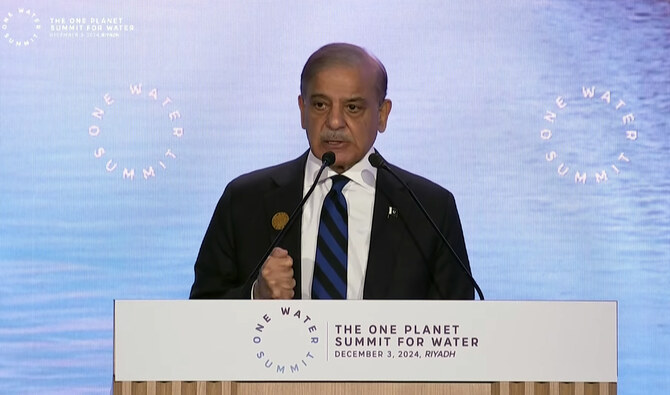
ISLAMABAD: Prime Minister Shehbaz Sharif on Tuesday called for transfer of technology, financing and international cooperation to ensure sustainable management of water for all as he addressed the One Water Summit in Riyadh, Saudi Arabia.
The summit, a joint initiative of Saudi Arabia, France, Kazakhstan and the World Bank, aimed for high-level political commitments to promote global cooperation and a coherent international approach toward water resource management.
Addressing the summit, Sharif said water was lifeblood of the planet, which transcended political boundaries, connected nations and fostered shared ecosystem, which was why his country attached great importance to transboundary cooperation.
“At the global level, I would submit for your kind consideration a number of steps to overcome water-related challenges. First, we need international cooperation and collaboration to ensure availability, sustainable management of water and sanitation for all,” he told attendees at the summit.
“Second, exchange of knowledge and expertise as well as transfer of technologies on innovative water management must be prioritized. Third, adequate funding for climate-resilient infrastructure and overcoming financing gap remains critical for climate-vulnerable countries.”
He appreciated the Kingdom of Saudi Arabia, France, Kazakhstan and the World Bank for the initiative, saying the world required “strong political will and global leadership to overcome the water crisis.”
“We must also focus on framework for transparency, data-sharing and regional cooperation to avoid conflicts and promote water-sharing,” the Pakistan premier said.
“We must invest in skills development, research and institutional strengthening to tackle water challenges at national and global levels.”
Sharif detailed steps taken by his government to ensure water security and climate-resilience, saying Pakistan was proud of joining this initiative and looked forward to providing all possible support in achieving its goals.
“As leaders, policymakers and custodians of the future, it is our duty to ensure that these rivers, lakes and aquifers that have nourished civilizations for centuries must not be reduced to tales of the past,” he added.
The One Water Summit is being held on Dec. 3-4 on the margins of the next high-level session of the COP16 of the United Nations Convention to Combat Desertification (UNCCD). It aims to contribute to ongoing United Nations discussions and processes to enhance global water governance, accelerate action on SDG6 on water and sanitation, and build on the momentum of the UN Water Conference in 2023.
The summit aims to scale up projects by stimulating partnerships between states, international organizations, local authorities, development and private banks, businesses, philanthropies, scientific experts, NGOs and civil society, in line with previous One Planet Summits, according to the forum’s website.
The forum will also act as an incubator for solutions in preparation for the next UN Water Conference in 2026, and integrate its agenda into the other existing water processes and initiatives such as the World Water Forum, the Dushanbe Conference and the World Water Week.


![]()

Pakistan PM calls for global cooperation for sustainable water management at Riyadh forum
Short Url
https://arab.news/wrczd
Pakistan PM calls for global cooperation for sustainable water management at Riyadh forum
- The One Water Summit, a joint initiative of Saudi Arabia, France, Kazakhstan and World Bank, aims to stimulate global partnerships for water resource management
- PM Shehbaz Sharif says it is their duty as leaders to ensure that water resources that have nourished civilizations for centuries must not be reduced to tales of past
Latest updates


© 2026 SAUDI RESEARCH & PUBLISHING COMPANY, All Rights Reserved And subject to Terms of Use Agreement.