India’s Naga tribes renew efforts to repatriate ancestral skulls from UK collections

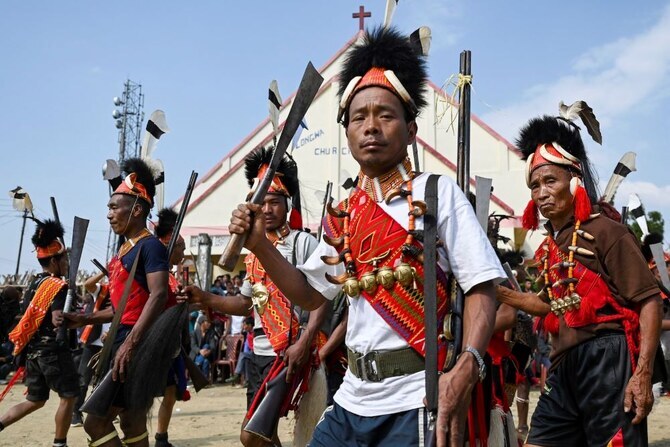
Konyak tribesmen perform a traditional dance at their community gathering in Longwa village, in the northeast Indian state of Nagaland, on April 8, 2023. (AFP/File)
Short Url
Updated 03 December 2024
Follow

India’s Naga tribes renew efforts to repatriate ancestral skulls from UK collections

  • British auction house put 19th-century Naga tribesman’s skull up for sale in October
  • Colonial authorities started to collect Naga skulls as specimens in the mid-19th century

NEW DELHI: Ellen Konyak Jamir was left in a state of disbelief when she discovered that the skull of a tribesman from the state of Nagaland was being auctioned in the UK. What made the discovery even more unsettling was that it was being publicly advertised.
Part of a “Curious Collector Sale” at an auction house in Oxfordshire, the 19th-century horned skull was one of thousands of items — including human remains — that British colonial administrators had collected from the northeastern Indian state and placed in museums and private collections.
It was featured on the sale’s website in October as a piece that “would be of particular interest to collectors with a focus on anthropology and tribal cultures,” and was offered with an opening bid of $4,400.
“When the news of the auction by the Swan in Tetsworth, Oxfordshire was brought to our attention, we were absolutely shocked and dismayed,” Konyak, a Nagaland native and member of the Forum for Naga Reconciliation, an association of members of various Naga tribes, told Arab News.
“(It was) an act of disrespect, dehumanization and the continuation of colonial violence ... We appreciated the prompt response and the removal of the item.”
The listing was quickly removed, but the incident has resulted in renewed efforts by the Naga community to repatriate the remains of their ancestors held in Britain.
“It created shockwaves of anger, humiliation and disbelief that in this century some people will be advertising to sell human skulls. That’s very serious,” said Visier Sanyu, a professor of history and an elder of the Angami tribe in Nagaland, who leads the Forum for Naga Reconciliation.
“We were approached to bring back these human remains, the skull, the hair, and hands and all from the Pitts River Museum, where they were exhibited for about 100 years ... It is a very long process. It can take 10 to 15 years.”
The University of Oxford’s Pitts River Museum has the largest Naga collection, featuring more than 6,500 items taken from the state. The items include dozens of human remains.
There are 16 Naga tribes inhabiting northeastern India and until the early 20th century most of them would collect the heads of their rivals after winning battles.
British colonial authorities started to take those skulls as specimens in the mid-19th century, but most were collected when anthropologist John Henry Hutton was an administrator in the region.
“He was the one who collected many of them,” Sanyu said.
“Hutton was here somewhere in the beginning of the century and then he went away during World War One and then he came back and stayed on for a long time, probably up till the 1930s or 40s.”
Dr. Dolly Kikon, a member of the Naga community and anthropology professor at the University of California, who co-founded the Recover, Restore, and Decolonize group under the Forum for Naga Reconciliation, is involved in the efforts to return human skulls from the UK.
She said the organization will request the respective tribes to decide what will happen to the remains of their ancestors once they are brought back to India.
“In cases where the remains are clearly identified as belonging to a respective Naga cultural group, it will depend on the elders and community members to determine the process. There are suggestions for burials, common memorial ceremonies, a memorial park signifying Naga unity and history, and also keeping the skulls as part of community history,” she said.
“Our role is to facilitate dialogues and take up awareness programs ... There is a need to connect repatriation to larger issues of colonial violence and the quest for dignity and justice.”
While it is not clear yet who will cover the expenses, some Naga activists, such as retired school principal Nyamto Wangsha, believe the UK should bear them.
“After identifying, we have to bury them and lay a memory stone in their name ... I feel the UK government should bear the expenses,” he said.
“It is the responsibility of the Britishers to bring back the skulls because they have taken them.”


Two high-speed trains derail in Spain, police sources say 21 people killed

Updated 19 January 2026
Follow

Two high-speed trains derail in Spain, police sources say 21 people killed

  • The accident happened near Adamuz, in Cordoba province. So far, 21 people ​have been confirmed dead by police

MADRID: A high-speed train derailed and smashed into another oncoming train in southern Spain on Sunday, pushing the second train off the tracks in a collision that police sources confirmed to Reuters had killed at least 21 people.
The accident happened near Adamuz, in Cordoba province. So far, 21 people ​have been confirmed dead by police, with state broadcaster Television Espanola adding that 100 people had been injured, 25 seriously. The driver of one of the trains, which was traveling from Madrid to Huelva, was among those who died, the TV station added.
“The Iryo 6189 Malaga — (to Madrid) train has derailed from the track at Adamuz, crashing onto the adjacent track. The (Madrid) to Huelva train which was traveling on the adjacent track has also derailed,” said Adif, which runs the rail network, in a social media post.
Adif said the accident happened at 6:40 p.m. (1740 GMT), about 10 minutes after the Iryo train left Cordoba heading toward Madrid.
Iryo is a private rail operator, majority-owned by Italian state-controlled railway group Ferrovie dello Stato. The train involved was a Freccia 1000 train which was traveling between ‌Malaga and Madrid, ‌a spokesperson for Ferrovie dello Stato said.
The company said in a statement that it ‌deeply ⁠regretted what ​had happened ‌and had activated all emergency protocols to work closely with the relevant authorities to manage the situation.
The second train was operated by Renfe, which also did not respond to a request for comment.
Adif has suspended all rail services between Madrid and Andalusia.

HORRIFIC SCENE
The Iryo train had more than 300 passengers on board, while the Renfe train had around 100.
Paco Carmona, Cordoba fire chief, told TVE the first train heading to Madrid from Malaga had been evacuated.
The other train’s carriages were badly damaged, he said, with twisted metal and seats. “There are still people trapped. We don’t know how many people have died and the operation is concentrating on getting people out of areas which are very narrow,” he ⁠said. “We have to remove the bodies to reach anyone who is still alive. It is proving to be a complicated task.”
Transport Minister Oscar Puente said he was following events ‌from rail operator Adif’s headquarters in Madrid.
“The latest information is very serious,” ‍he posted on X. “The impact was terrible, causing the first two ‍carriages of the Renfe train to be thrown off the track. The number of victims cannot be confirmed at this time. ‍The most important thing now is to help the victims.”
The mayor of Adamuz, Rafael Moreno, told El Pais newspaper that he had been among the first to arrive at the scene of the accident alongside the local police and saw what he believed to be a badly lacerated body several meters from the accident site.
“The scene is horrific,” he said. “I don’t think they were on the same track, but it’s not clear. Now ​the mayors and residents of the area are focused on helping the passengers.”

CALLS FOR MEDICS
Images on local television showed a reception center set up for passengers in the town of Adamuz, population 5,000, with locals coming ⁠and going with food and blankets amid nighttime temperatures of around 42 degrees Fahrenheit (6 degrees Celsius).
A woman named Carmen posted on X that she had been on board the Iryo train to Madrid. “Ten minutes after departing (from Cordoba) the train started to shake a lot, and it derailed from coach 6 behind us. The lights went out.”
Footage posted by another Iryo train passenger, also on X, showed an Iryo staffer in a fluorescent jacket instructing passengers to remain in their seats in the darkened carriages, and those with first aid training to keep watch over fellow passengers. He also urged people to maintain mobile phone batteries to be able to use their torches when they disembarked.
Salvador Jimenez, a journalist for RTVE who was on board the Iryo train, shared images showing the nose of the rear carriage of the train lying on its side, with evacuated passengers sitting on the side of the carriage facing upwards.
Jimenez told TVE by phone from beside the stricken trains that passengers had used emergency hammers to smash the windows and climb out, and they had seen two people taken ‌out of the overturned carriages on stretchers.
“There’s a certain uncertainty about when we’ll get to Madrid, where we’ll spend the night, we’ve had no message from the train company yet,” he said. “It’s very cold but here we are.”