TBILISI: Georgia’s prime minister on Tuesday threatened to punish his political opponents, accusing them of being behind violence at mass protests, as Tbilisi’s top court rejected a key lawsuit to annul the result of a contested October vote.
Prime Minister Irakli Kobakhidze — who infuriated protesters last week by announcing his government would shelve EU accession talks until 2028 — also suggested he would take retribution on public servants if they take part in protests.
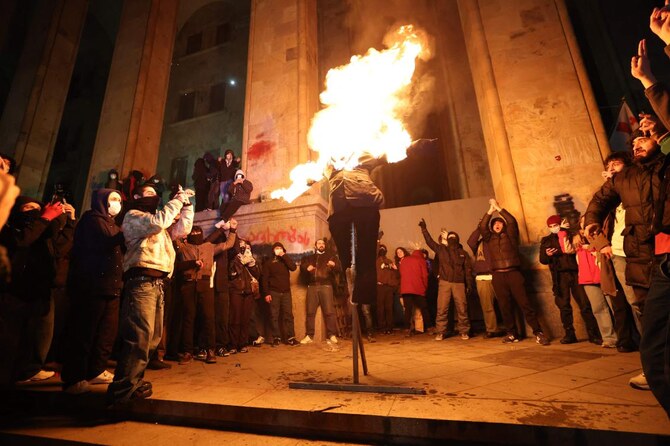
Thousands of demonstrators took to the streets on Monday against the ruling Georgian Dream party in a fifth straight night of protests, with more demonstrations planned on Tuesday.
They accuse the government of bringing Tbilisi back into Moscow’s orbit and betraying the Black Sea nation’s bid for EU membership, which is enshrined in its constitution and supported by around 80 percent of the population.
Georgia has been gripped by political turmoil since a contested October election, which pro-EU President Salome Zurabishvili and the opposition say Georgian Dream rigged, demanding a re-run.
But, intensifying the crisis, Tbilisi’s top court on Tuesday rejected a lawsuit filed by Zurabishvili and opposition parties to overturn the election result.
A re-run of the contested vote was one of the protesters’ main demands.
Zurabishvili, who backs the protests and whom Georgian Dream are trying to remove from office, did not yet respond to the court’s decision to throw out her case.
That announcement came shortly after Kobakhidze — who has ruled out talks with the opposition — vowed to punish his opponents.
“Opposition politicians who have orchestrated the violence in recent days while hiding in their offices will not escape responsibility,” he said at a press conference.
The ruling Georgian Dream party has refused to back down despite increasing international criticism of Georgia’s handling of its protests, with several Western countries saying Tbilisi had used excessive force.
Kobakhidze, 46, also threatened to punish civil servants who join the protests, after several ambassadors and a deputy foreign minister resigned over the demonstrations crack-down and his decision to suspend EU talks.
“The process of self-cleansing within the public sector has been very interesting. We are closely monitoring everyone’s actions, and they will not go without a response,” he said.
Evoking language used by the Kremlin, Kobakhidze alledged the protest movement was “funded from abroad.”
He also singled out NGOs — heavily targeted in a repressive pre-election campaign by authorities — for being behind the protests, vowing that they will “not evade responsibility as defined by law.”
Tbilisi earlier this year adopted Russian-style legislation designed to restrict the activity of NGOs as well measures that the EU says curb LGBTQ rights.
The adoption of the laws prompted the US to slap sanctions on Georgian officials.
But Kobakhidze said his government hoped that the “US attitudes toward us will change after January 20” — when Donald Trump, who has criticized federal support for gender transition, takes office.
Kobakhidze’s threats to the opposition came as more Western leaders criticized Tbilisi’s police response to the protests.
NATO chief Mark Rutte on Tuesday slammed as “deeply concerning” the situation in Georgia, condemning “unequivocally” the reports of violence.
The mostly young protesters accuse Georgian Dream of acting on Russian orders and fear the ex-Soviet country will end up back under Russian influence.
“We want freedom and we do not want to find ourselves in Russia,” 21-year-old protester Nika Maghradze, told AFP.
Georgia’s health ministry earlier said that 26 people — 23 protesters and three law enforcement officers — were injured in the latest protest on Monday night.
President Zurabishvili has described the protests as Georgians “rising against the Russian puppetry regime.”
“The message is clear: Give me my vote back! Give me my European future back!,” she had said on social media on Monday.
Some protesters placed their hopes in the 72-year-old president.
“She is our only chance,” 43-year-old demonstrator Mariam told AFP on Monday.


![]()

Georgia PM vows retribution for protests as court rejects bid to annul vote
Short Url
https://arab.news/ydkp8
Georgia PM vows retribution for protests as court rejects bid to annul vote
- Prime Minister Irakli Kobakhidze also suggested he would take retribution on public servants if they take part in protests
- Georgia has been gripped by political turmoil since a contested October election


Latest updates



Recommended


© 2026 SAUDI RESEARCH & PUBLISHING COMPANY, All Rights Reserved And subject to Terms of Use Agreement.