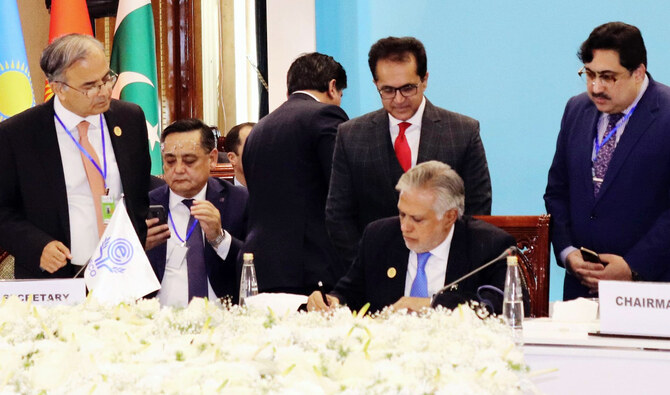
ISLAMABAD: Pakistan’s deputy prime minister and foreign minister, Ishaq Dar, on Tuesday called for greater collaboration among Economic Cooperation Organization (ECO) member states as he addressed a summit of the ECO Council of Foreign Ministers in Iran.
The ECO is a political and economic intergovernmental organization that promotes economic, technical, and cultural cooperation among member states. Founded in 1985 by Iran, Pakistan and Turkiye, the ECO aimed to succeed the Regional Cooperation for Development (RCD), which existed from 1964 to 1979.
The ECO’s objectives include contributing to the development of member states, removing trade barriers within the ECO region, developing intra-regional trade, promoting the ECO region’s integration with global markets and strengthening cultural and historical ties among member states.
Addressing the ECO summit in Mashhad, Dar said this year’s theme, “Enhanced and Resilient ECO Region Through Expansion of Intra-Regional Trade,” was a guiding principle for all that the progress and prosperity of the ECO region “hinges upon expansion of intra-regional trade.”
“It is a matter of great concern that the ECO region, comprising an area of 8 million square kilometers and half a billion population, roughly 15 percent of the world population, has intra-regional trade of unfortunately less than 8 percent of region’s aggregate and only 2 percent of the global trade,” he said.
“[This] is in stark contrast to other regional groupings such as EU [European Union], wherein the intra-regional trade stands about 70 percent and ASEAN [Association of Southeast Asian Nations], which is around 23 percent.”
During the summit, Dar signed the ECO charter on clean energy to enhance regional cooperation for transition to sustainable energy, according to the Pakistani foreign ministry.
“The charter is a flagship initiative of ECO in the energy sector which will focus on research & development for innovative renewable clean energy sources to combat climate change [and] play a bridging role in enhancing regional cooperation for smooth transition to sustainable energy,” it said in a statement.
The ECO clean energy charter would contribute to the global network of regional sustainable energy centers under the framework of the UN’s Sustainable Energy for All Initiative.
Dar also held a bilateral meeting with Iranian foreign minister Seyed Abbas Araghchi.
“During the meeting, they exchanged views on areas of mutual interest and the latest regional and global developments,” Pakistan’s state-run APP news agency reported. “Both countries agreed to deepen bilateral cooperation in all spheres.”
The meeting came weeks after Araghchi’s visit to Islamabad to hold consultations with Pakistani leaders on the Middle East situation following Israel’s invasion of Gaza and Lebanon, and to discuss bilateral ties.
Separately, the Pakistani deputy PM held meetings with ECO Secretary General Dr. Asad Majeed and Deputy Prime Minister of Kazakhstan Murat Nurtleu to discuss the latest regional and global developments, and to boost inter-regional connectivity and trade cooperation among ECO members.


![]()

Pakistan deputy PM calls for greater economic cooperation among ECO nations at Iran summit
Short Url
https://arab.news/47d5e
Pakistan deputy PM calls for greater economic cooperation among ECO nations at Iran summit
- The ECO is an intergovernmental organization that promotes economic, technical and cultural cooperation among members
- Deputy PM Ishaq Dar expressed concern over significantly lower ECO intra-regional trade than other regional groupings
Latest updates


© 2026 SAUDI RESEARCH & PUBLISHING COMPANY, All Rights Reserved And subject to Terms of Use Agreement.