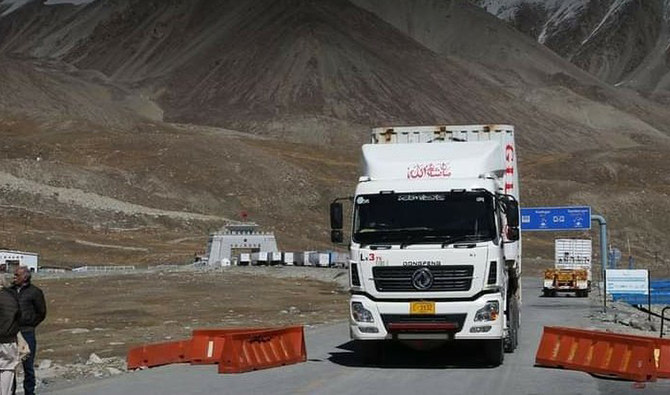
KHAPLU, Gilgit-Baltistan: In a first, the high-altitude Khunjerab Pass, the only land-connected route between China and Pakistan and a major trade station between the two nations, will remain open year-round for all types of trade and transportation, officials confirmed on Monday, with businesses welcoming the move.
At over 4.600 meters above sea level, Khunjerab, which connects Gilgit-Baltistan with China’s Xinjiang region, is the highest paved international crossing in the world and an important gateway to South Asia and Europe.
The pass is located in the Karakoram and holds a significant strategic position on the northern border of Pakistan, specifically in Gilgit-Baltistan’s Hunza and Nagar Districts. China mainly imports textiles, agricultural products and daily commodities through the pass, and exports plants and herbs.
Due to high altitude and harsh weather conditions, the border was previously open only between April to November and remained closed from December to March. Last October, however, Caretaker Prime Minister Anwaar-ul-Haq Kakar said at the Belt and Road Forum in Beijing that the pass would be converted into an all-weather border.
“The Government of the People’s Republic of China has formally concurred to the year-round opening of the Khunjerab Pass,” a latest notification from Pakistan’s Ministry of Foreign Affairs said.
“Consequently, operation of the Khunjerab-Sost border crossing are hence forth expanded from 1st April – 30thNovember each year to year-round operation,” the statement said, instructing all relevant agencies and government departments to continue their operations at the port from Dec. 1.
Confirming the development, Faizullah Faraq, the spokesperson for the Gilgit-Baltistan regional government, said authorities were “utilizing all resources” to clear the roads of snow on the Pakistani side to ensure smooth functioning of trade and transport activities.
The Gilgit-Baltistan region in northern Pakistan, flanked by soaring mountain ranges and glaciers, is also a major tourist destination in the country.
“The year-round opening of the border will also help in the promotion of tourism,” Faraq added. “The economic engagement of people of both regions [China and Pakistan] is associated with this border. So the local economy will be uplifted.”
Speaking to Arab News, Muhammad Iqbal, the president of the GB Importers and Exporters Association, welcomed the decision.
“The historic decision to keep the border open for the whole season will help boost import and export trade, and commerce between Pakistan and China,” he said. “For traders, this decision will ensure uninterrupted access to the Chinese market. This route will also give access to Central Asian and other countries and people-to-people contact between Pakistan’s G-B and China’s Xinjiang province will be enhanced.”
Imran Ali, the president of the Gilgit-Baltistan Chamber of Commerce, said “new avenues of development” would be opened by keeping the border open throughout the year.
“More than 20,000 people, including traders and laborers, are associated with this border, and due to this decision, business activities will be increased and traders and locals will directly get benefits,” he added.
According to APP, Pakistan’s state-run news agency, Khunjerab Pass recorded over 50,000 inbound and outbound passengers between Apr. 1 and the end of October, while import and export cargo volume reached 40,900 tones, up 42.6 percent and 72.7 percent year-on-year respectively.
China is a major ally and investor in Pakistan. The two countries collaborate on the China-Pakistan Economic Corridor, a flagship project under China’s Belt and Road Initiative, with more than $65 billion pledged for road, rail, and other infrastructure developments in the South Asian nation.


![]()

Traders welcome decision to keep Khunjerab Pass linking Pakistan, China open year-round
Short Url
https://arab.news/pvdnx
Traders welcome decision to keep Khunjerab Pass linking Pakistan, China open year-round
- High-altitude Khunjerab Pass is closed from Nov. 30 to Apr. 1 each year due to harsh weather
- This year, border crossing has been opened from Dec. 1 for all kinds of trade and transportation
Latest updates


Recommended


© 2026 SAUDI RESEARCH & PUBLISHING COMPANY, All Rights Reserved And subject to Terms of Use Agreement.