

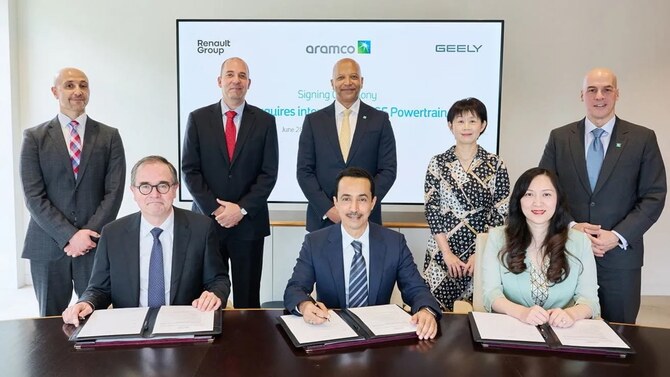

RIYADH: Energy giant Saudi Aramco has finalized its acquisition of a 10 percent stake in HORSE Powertrain Ltd., advancing hybrid combustion technologies to drive down transport emissions.
According to a joint statement, the deal valued at €7.4 billion ($7.7 billion), followed the signing of definitive agreements on June 28, and subsequent regulatory approvals.
Renault Group and Geely, through Geely Holding and Geely Auto, retain 45 percent stakes each in HORSE Powertrain. This collaboration is set to leverage Aramco’s expertise in synthetic fuels and lower-carbon mobility solutions, aligning with HORSE Powertrain’s vision to become a premier Tier 1 powertrain supplier.
Strategic goals
Aramco’s investment supports ongoing research and development in lower-emission technologies.
Ahmad Al-Khowaiter, Aramco’s executive vice president of technology and innovation, said: “Addressing transport emissions requires a wide range of approaches that consider the diverse nature of the global vehicle fleet, broad disparities in transport infrastructures, and the specific needs of motorists in different countries.”
He added: “At Aramco, we are pursuing a number of potential innovative solutions, from lower-carbon synthetic fuels to more efficient internal combustion engines, as we look for opportunities to make a difference.”
Al-Khowaiter highlighted that Aramco’s investment in HORSE Powertrain builds on its extensive research and development efforts, aiming to collaborate with two leading carmakers to advance lower-emission mobility solutions.
Matias Giannini, CEO of HORSE Powertrain, highlighted the partnership’s strategic value. “Aramco’s expertise in alternative and synthetic fuels makes Aramco the ideal partner for us to deliver lower-emission powertrain solutions,” he said.
Giannini added: “By strengthening our technology leadership with this partnership, HORSE Powertrain will only become more valuable as a partner to automotive brands looking to benefit from our expertise and global production footprint.”
Operational synergies
According to the statement, HORSE Powertrain will collaborate with Aramco and Valvoline Global Operations, focusing on innovations in internal combustion engine technology, alternative fuels, and lubricants.
Jamal Muashsher, CEO of Valvoline Global Operations, said: “As a technical partner and supplier to HORSE Powertrain, we look forward to applying Valvoline Global’s 150-plus years of automotive expertise and tradition of innovation to advance future-ready solutions in internal combustion engine technology, fuels, and lubricants.”
He added: “Our newest joint effort with HORSE Powertrain and Aramco builds on Valvoline Global’s strong history in original equipment manufacturer partnerships. Through collaboration, we are helping to shape the next generation of mobility.”
The partnership aims to accelerate the development of next-generation ICE and hybrid powertrains, enhancing HORSE Powertrain’s global production footprint.
This strategic alliance underscores Aramco’s commitment to sustainable energy transitions and reinforces HORSE Powertrain’s role as a key player in next-generation powertrain solutions.
Aramco has been actively expanding its global partnerships in recent months.
On Nov. 19, the company signed a framework agreement with China’s Rongsheng Petrochemical Co. to boost the expansion of SASREF, enhancing its refining and petrochemical capabilities.
Earlier, on Oct. 30, Aramco agreed to collaborate with Vietnam Oil and Gas Group, or Petrovietnam, on energy storage, supply, and trading. This agreement, formalized during the Vietnamese Prime Minister’s visit to Saudi Arabia, aims to optimize operations and drive value across both companies’ energy and petrochemical sectors.


