

Shared vision meets ambition as French President Macron begins Saudi Arabia state visit

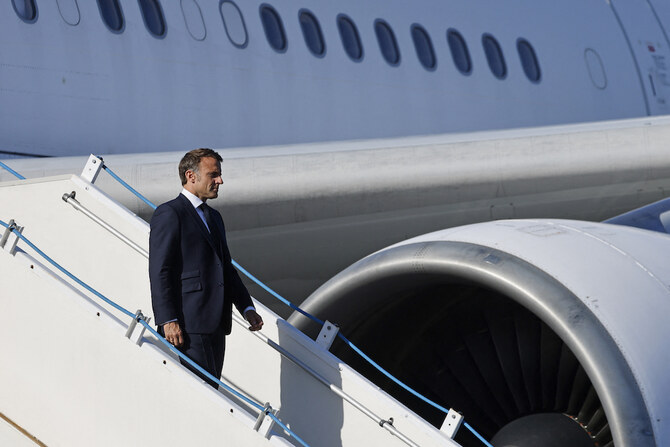
French President Emmanuel Macron’s arrival in Riyadh for a three-day state visit is a testament to the deepening ties between France and Saudi Arabia. (AFP)
Short Url
Updated 02 December 2024
Follow

Shared vision meets ambition as French President Macron begins Saudi Arabia state visit

  • Visit to advance common goal of enhancing cooperation across various sectors in alignment with Saudi Vision 2030 and France 2030
  • Schedule includes high-level meetings, a visit to Riyadh Metro, Saudi-French Economic Forum and cultural stops in Diriyah and AlUla

RIYADH: French President Emmanuel Macron’s arrival in Riyadh for a three-day state visit is a testament to the deepening ties between France and Saudi Arabia. His visit, which follows an invitation from Crown Prince Mohammed bin Salman, reflects the shared ambition to enhance cooperation across various sectors and to align with Saudi Vision 2030 and France 2030.

The state visit underscores a partnership rooted in mutual respect and long-term collaboration. It is the latest of several high-profile exchanges, including Macron’s Gulf tour in December 2021, which concluded in Jeddah, and Crown Prince Mohammed bin Salman’s visit to Paris in June 2023, accompanied by a ministerial delegation. These meetings set the stage for France’s endorsement of Saudi Arabia’s successful bid to host Expo 2030, marking a milestone in bilateral relations.

Macron’s schedule includes high-level meetings, a visit to Riyadh Metro, the Saudi-French Economic Forum and cultural stops in Diriyah and AlUla. Elysee Palace views Saudi Arabia’s ongoing modernization and reforms as vital to the strengthening of the Kingdom’s position as a central player in a more interconnected Middle East. Accordingly, it supports Saudi bids for major global events, such as hosting Expo 2030, 2034 football World Cup and Winter Olympics, considering them as opportunities for deeper cooperation.
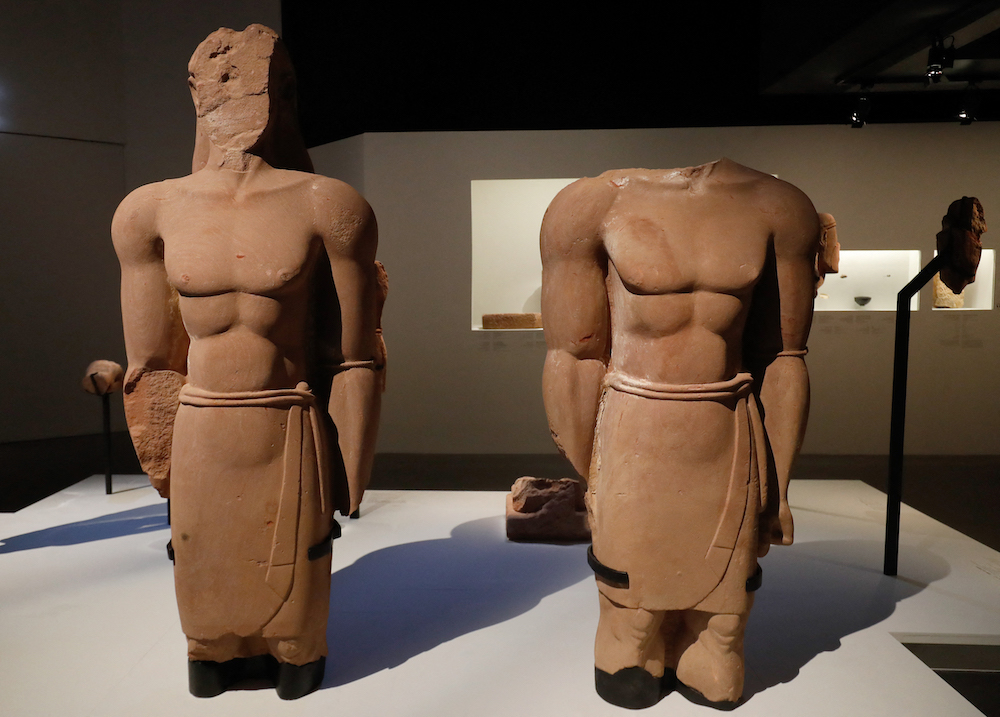


Two statues from the fifth to first century BC are displayed during the exhibition “AlUla: Wonder of Arabia” at the l’Institut du monde arabe in Paris on Oct. 7, 2019. (AFP)

The historical relationship between the two nations predates the Kingdom’s establishment. France opened its first consulate in 1830 in Jeddah in a part of the Arabian Peninsula that would later emerge as the Kingdom of Saudi Arabia. It was also one of the first countries to recognize Saudi Arabia as a sovereign state in 1926. Nearly a century later, the two countries share common values in international relations, including sovereignty, non-interference and respect for international law.

This partnership has evolved to address contemporary challenges. At the Summit for a New Global Financial Compact in June 2023, Saudi Arabia and France emphasized the need for an inclusive financial system to combat inequality, fund green transitions and achieve the UN Sustainable Development Goals. Their shared vision highlights the alignment of priorities between the two leaders, united in their commitment to development and innovation.

Through the centuries, France has positioned itself as a global power in defense, energy, engineering, diplomacy, art and culture. But modern France is also undergoing a transformation aimed at adapting its economy to new emerging industries, collectively termed the Fourth Industrial Revolution, empowering its youth, and addressing climate-related challenges.

This transformation into a greener, more technology-driven economy aligns with Saudi Arabia’s ambitions under Vision 2030. Both countries have prioritized clean energy, with Saudi Arabia emerging as a significant player in renewable energy. Its investments in solar, wind, and hydro projects are matched by its leadership in the circular carbon economy, all key pillars of its Saudi Green and Middle East Green Initiatives. These initiatives resonate with France’s own climate goals, fostering a natural synergy between the two nations.

FASTFACTS

• The number of French companies operating in Saudi Arabia has increased by more than 43% since 2020.
• French investors in KSA: Air Liquide, Airbus, Alstom, Crédit Agricole, L’Oréal, Sanofi Aventis, Thales, Total and Veolia.

Economic collaboration continues to flourish. French companies are integral to the Kingdom’s economic diversification efforts, spanning sectors such as energy, healthcare, retail and tourism. Organizations like Business France and the Saudi-French Business Council play pivotal roles in facilitating trade and investment. Initiatives like Vision Golfe, an annual gathering of French and Gulf Cooperation Council ministers, entrepreneurs and executives, further cement this partnership through dialogue and innovation by offering a platform to promote business cooperation in markets with high growth potential.

Security and stability remain central to this relationship, particularly in addressing global challenges such as the Ukraine conflict. France has sought Saudi support in navigating the war’s human and economic repercussions and its impact on global supply chains. Energy security has also emerged as a focal point, with Saudi Arabia supplying hydrocarbons to Europe while advancing its role as a clean energy provider and one of the world’s biggest investors in renewables like solar, wind and hydro.

Saudi Arabia’s investments in renewable energy resources are part of a broader environmental strategy, being implemented as part of Vision 2030, Saudi Green Initiative and Middle East Green Initiative, as well as the Kingdom’s adoption of the circular carbon economy
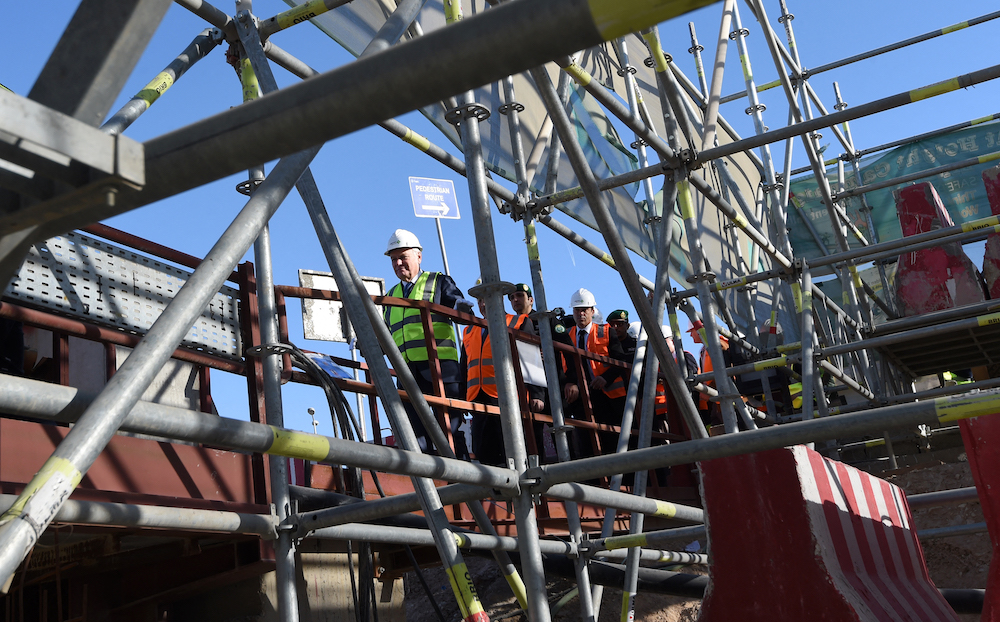


French foreign minister Jean-Marc Ayrault, center, visits the construction site of a section of the Riyadh Metro under the contract of French company ALSTOM in Riyadh on Jan. 24, 2017. (AFP)

Regional developments will also likely figure prominently in the discussions during Macron’s visit, particularly regarding Lebanon, which remains without a president after more than two years of political paralysis.

Saudi Arabia and France have both played roles in seeking solutions to Lebanon’s crises, so any initiatives taken by them in the wake of the devastating monthslong conflict between Israel and the military wing of Hezbollah will be eagerly awaited. Partnership and consultation with Saudi Arabia are viewed by France as crucial to restoring order to the chaos in Lebanon.

With regard to the Israel-Palestine conflict, Elysee Palace is pushing for a ceasefire, release of hostages and humanitarian protections in Gaza. To this end, it has emphasized the importance of Saudi contributions through the Arab League and the Organization of Islamic Cooperation to advance a two-state solution for Palestine.

In addition to these pressing issues, Macron’s visit coincides with Saudi Arabia hosting COP16, a global platform addressing desertification under the theme “Our Land. Our Future.” Alongside this, he will attend the One Water Summit, co-chaired by France and Kazakhstan, which aims to address water resource management challenges in the face of climate change. These events underscore the commitment of both nations to environmental sustainability, a cornerstone of their partnership.

The relationship between Saudi Arabia and France is of course not limited to defense, business and energy transition. Cultural collaboration also forms a significant part of the Franco-Saudi relationship. Saudi Arabia’s rich heritage, from AlUla to Diriyah and the Sarawat Mountains, offers a canvas for joint initiatives. At the heart of this is Villa Hegra, a cultural institution in AlUla, the ancient Saudi city, established through an intergovernmental agreement in 2021.

Villa Hegra was officially established following an intergovernmental agreement signed on Dec. 4, 2021, by Saudi Arabia’s Minister of Culture Prince Badr bin Abdullah bin Farhan Al-Saud and Jean-Yves Le Drian, the then French minister of foreign affairs and current president of Afalula, the French agency for the development of AlAula. Villa Hegra serves as an incubator for artists and creators, fostering dialogue and collaboration while exploring the socio-economic impact of cultural projects on local communities.
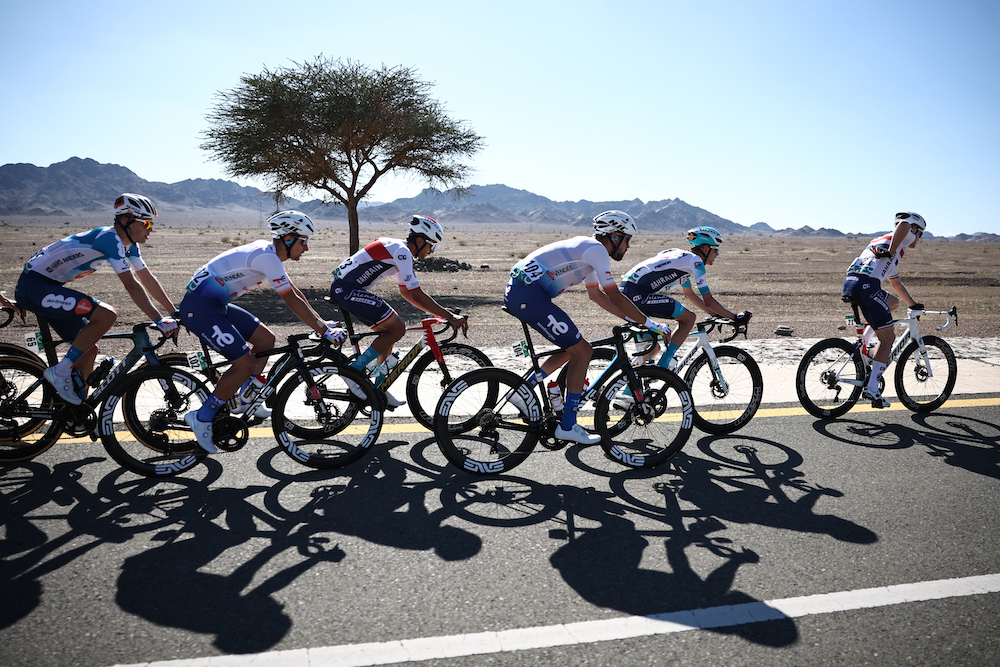


France’s Fabien Doubey and Paul Ourselin of TotalEnergies team ride during the first stage of the AlUla Tour cycling race in Al-Ula on Jan. 30, 2024. (AFP)

The duality of Villa Hegra, blending Saudi and French influences, mirrors the broader partnership between the two nations. Macron’s anticipated visit to AlUla will underscore the significance of these cultural ties and highlight Saudi Arabia’s emergence as a regional hub for art and heritage. This emphasis on culture complements the Kingdom’s efforts to diversify its economy, attract global talent and position itself as a tourism and investment destination.

Amid these developments, the relationship between France and Saudi Arabia remains firmly anchored in mutual respect and shared goals. Macron’s visit offers an opportunity to build on a foundation that spans nearly two centuries, reinforcing partnerships in defense, energy, culture and economic development. The discussions in Riyadh will likely set the tone for future collaborations, as both nations continue to navigate a rapidly changing global landscape.

After Macron concludes his stay, the focus will shift to the outcomes of this visit, particularly in areas like artificial intelligence, fintech and cybersecurity. France’s upcoming AI Action Summit in February 2025 presents another opportunity to align technological ambitions, ensuring that the partnership remains dynamic and forward-looking. Whether in addressing global challenges or celebrating shared heritage, the relationship between France and Saudi Arabia stands as a testament to the enduring power of collaboration.


What new technologies are revealing about the Silk Road’s forgotten landscapes

Updated 17 January 2026
Follow

What new technologies are revealing about the Silk Road’s forgotten landscapes

  • Drones and digital tools are allowing archaeologists to map vast areas in hours rather than months of ground surveys
  • In Saudi Arabia, aerial mapping has uncovered dense prehistoric and Bronze Age sites previously thought to be empty

DUBAI: Across the deserts and mountain valleys of the Arab world, drones are now doing work that once took teams of archaeologists months to complete.

In northern Saudi Arabia, for example, aerial surveys can map an entire ancient settlement in minutes, revealing faint outlines of walls, pathways and structures hidden beneath the surface.

These images are later turned into 3D models — part of a growing effort across the region to use technology to trace old trade routes, map forgotten sites and better understand how people once moved across Arabia and beyond.

Much of this work is connected to renewed interest in the Silk Road and the networks that once linked Arabia with the wider world.

Harrat, Khaybar. (Supplied)

The Silk Road refers to a network of ancient trade routes that linked East Asia with the Middle East, North Africa and Europe for more than 1,500 years.

Rather than a single road, it was a vast web of caravan paths and maritime corridors connecting cities from China and Central Asia to Iran, Iraq, the Arabian Peninsula, the Levant and the Mediterranean.

Along these routes, merchants, scholars and travelers exchanged goods such as silk, spices and metalwork, as well as ideas, technologies and cultural traditions that shaped the development of the wider region.

In more recent times, scholars, students and heritage authorities across the Middle East and Central Asia are increasingly relying on drones, laser scanning, photogrammetry and satellite analysis to document archaeological landscapes.

In Saudi Arabia’s AlUla and Khaybar regions — now considered some of the world’s densest concentrations of prehistoric and Bronze Age structures — drone surveys have helped researchers record sites that would otherwise remain inaccessible.

Dr. Hugh Thomas, a lecturer in archaeology at the University of Sydney and co-director of the Prehistoric AlUla and Khaybar Excavation Project, says the scale of the Saudi landscape makes aerial work essential.

“Saudi Arabia contains an exceptionally dense archaeological landscape distributed across a vast geographic area,” he told Arab News. “Drone-based surveys allow large volumes of archaeological data to be collected efficiently.” 

A Neolithic mustatil next to a Bronze Age pendant burial in Kaybar. (Supplied/Mat Dalton)

Indeed, many structures sit on steep or remote terrain that ground teams cannot easily reach. This shift to aerial archaeology has also revealed details that would be almost impossible to see from ground level.

Thomas notes that researchers have long suspected a link between water sources and Neolithic mustatil structures, which date back approximately 7,000 years. In 2020, drone images captured by his team near Khaybar also strengthened theories linking mustatil to water sources.

“The drone images revealed that recent rains had settled in specific parts of wadi valleys, exactly where the mustatil were built,” he said. Since then, multiple surveys and peer-reviewed studies have supported this connection, with many mustatil shown to point directly toward water.

In parallel, new technologies are reshaping how archaeologists understand the wider landscape. Thomas says tools such as drones, satellite imagery and 3D modelling allow researchers to document vast areas quickly and at far higher resolution than ever before.

These approaches “enable the rapid, cost-effective documentation of this vast and previously understudied landscape” and create permanent digital records that support long-term monitoring and analysis, he said.

This has been transformative for understanding past movement and land use.

Remote sensing work in northern Saudi Arabia has revealed extensive Bronze Age funerary avenues — pathways lined with monumental tombs, running for thousands of kilometers and linking major oases such as Khaybar, Al-Hait and Al-Huwayyitt.

Drone surveys and 3D models have allowed researchers to classify tomb types more accurately and identify where excavation would yield the most useful results. Thomas says these techniques directly contributed to one of the project’s most significant achievements.

“This has ultimately assisted us with our most recent paper, where we were able to publish the C14 dates of remains found in 40 Bronze Age tombs, helping us understand when these tombs appeared on the landscape and how they developed over time,” he said.

While international collaborations play a central role, Thomas says long-term progress in the Kingdom depends on building local capacity.

He says contributions from Saudi researchers, students and even members of the public are becoming increasingly important.

Archaeologist Don Boyer measures a tower of stones next to a 525m long Mustatil in Khaybar. (David Kennedy)

“Local researchers, students, and members of the public are taking photographs of archaeological sites and sharing them digitally,” he said. “Each image provides a lasting record of archaeological remains.”

In Saudi Arabia’s AlUla, one of the region’s most active archaeological hubs, the Royal Commission for AlUla has supported wide-ranging surveys that combine aerial photography, remote sensing and targeted excavation.

Published research from the AlUla and Khaybar Aerial Archaeology Project describes how thousands of structures — from ancient hunting traps to tombs and settlements — have been recorded using these methods in recent years.

“We’re seeing landscapes we did not even know existed before this kind of work began,” said archaeologist Dr. Rebecca Repper of the University of Sydney in an RCU briefing. 

“Technology is helping us reassess northern Arabia’s role in long-distance connections.”

Recent research across Central Asia shows how drones and LiDAR, a remote-sensing technology used to create extremely accurate 3D maps of landscapes, buildings, or buried features, are transforming the study of Silk Road-era landscapes.

In Uzbekistan, a team led by Dr. Michael Frachetti — an archaeologist at Washington University in St. Louis, who specializes in ancient mobility systems — used drone-mounted LiDAR to scan remote high-altitude terrain, revealing two previously undocumented medieval cities, Tugunbulak and Tashbulak.

Researchers excavate medieval pottery at the newly rediscovered medieval Silk Road city Tugunbulak located in the mountains of southeastern Uzbekistan June 8, 2022 (Michael Frachetti)

A 2024 peer-reviewed study, “Automated analysis of high-resolution lidar traces large-scale medieval urbanism in highland Central Asia,” details how these surveys exposed plazas, fortifications and settlement layouts previously invisible from the ground.

In southeast Kazakhstan, a 2021 study in the journal Applied Sciences shows how UAV photogrammetry helped map irrigation networks, settlement traces and burial mounds linked to medieval trade and pastoral routes.

Together, these findings demonstrate how high-resolution aerial mapping is reshaping our understanding of the landscapes and movement patterns that framed the Silk Road.

For governments, these discoveries are more than scientific. UNESCO describes the Silk Roads as a shared heritage space where cooperation is critical, and regional countries have increasingly embraced cross-border research partnerships.

In Saudi Arabia, AlUla’s collaborations with universities including Oxford, Bologna and the French National Centre for Scientific Research reflect a growing diplomatic interest in cultural research.

These partnerships have generated shared excavations, joint field schools and open-access databases — opportunities that were rare in the region two decades ago.

Digital access is also reshaping how the public engages with this history.

The International Dunhuang Project, a global consortium led by the British Library and multiple Asian national libraries, has digitized hundreds of thousands of manuscripts, murals and archaeological fragments linked to the Silk Road.

Its open platform has become a major educational resource for schools and researchers worldwide.

A LiDAR image of Tugunbulak shows a dense settlement along a ridge. (Michael Frachetti)

In AlUla, digital reconstructions and virtual models are increasingly used in classroom activities and community programs.

Youth involvement is part of this shift. In Saudi Arabia, RCU’s assorted heritage guardian programs introduce young people to survey techniques, basic archaeology and remote-sensing tools, helping train a new generation of community researchers.

In parts of Central Asia, student volunteers often support field surveys and digital documentation under national heritage ministries and international missions.

Across deserts, mountains and oasis towns, a fuller picture of ancient networks is beginning to emerge. Every drone flight reveals structures long buried under sand and stone.

“On the plateau, we found a hidden valley with large mounds and undulations on the surface,” Frachetti explained in a Washington University Magazine feature about his team’s drone-assisted work.

“It was obvious, both in person and on the drone-acquired surface model we created, that we had stumbled across something much larger and different from the typical campsite we had expected.”

Recent archaeological work has discovered a fortified 2.6-hectares Bronze Age town (al Natah) in Khaybar oasis (dating around 2400 BCE- 1300 BCE). (RCU)

Meanwhile, every 3D model helps trace how people once traveled, traded and settled across continents.

And every partnership — whether in AlUla, the Gulf, or Central Asia — reinforces the idea that this heritage connects far more than a single nation.

The Silk Road’s story is being rediscovered not through speculation but through data, satellites and the work of a generation that is documenting the past with new precision.