TBILISI: Tens of thousands in Georgia on Sunday took part in a fourth straight day of protests against a government decision to shelve EU membership talks, as the prime minister rebuffed calls for new elections.
The Black Sea nation has been rocked by turmoil since the governing Georgian Dream party claimed victory in October 26 parliamentary polls that the pro-European opposition said were fraudulent.
The opposition is boycotting the new parliament, while pro-EU President Salome Zurabishvili has asked the constitutional court to annul the election result, declaring the new legislature and government “illegitimate.”
Critics accuse Georgian Dream, in power for more than a decade, of having steered the country away from the EU in recent years and of moving closer to Russia, an accusation it denies.
On Thursday, Prime Minister Irakli Kobakhidze announced Georgia would not seek accession talks with the European Union until 2028, sparking a wave of protests in the capital Tbilisi and other cities.
The interior ministry has said about 150 demonstrators have been arrested in this latest protest wave, while the Georgian Young Lawyers’ Association put the number at 200.
Police in some instances have chased protesters through the streets, beating them and firing rubber bullets and tear gas.
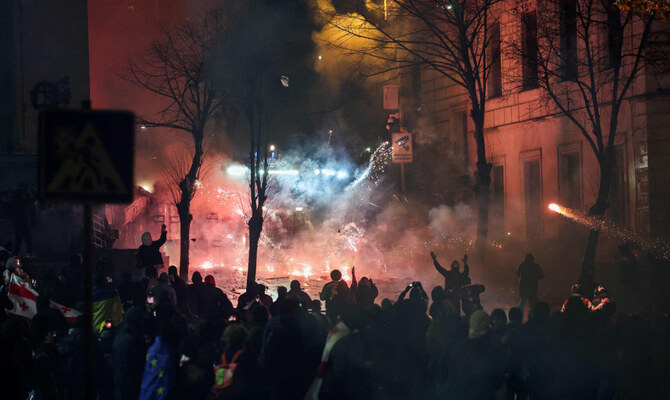
Waving European and Georgian flags, tens of thousands rallied outside parliament on Sunday evening, AFP reporters saw.
Some demonstrators tossed fireworks and stones at riot police, while others banged on the metal door blocking parliament’s entrance.
Police later deployed water cannons, but were unable to disperse the crowds.
The leader of the opposition United National Movement party, Levan Khabeishvili, told journalists that he was attacked by around 15 masked police officers attempting to detain him, but he had managed to escape with the help of protesters.
“Georgian Dream... is a (pro) Russian government, and they must go,” said demonstrator Alexandre Diasamidze, a 32-year-old bartender.
Another protest took place outside the offices of Georgia’s Public Broadcaster (GPB), widely accused of acting as a propaganda tool for the ruling party.
The broadcaster conceded to the protesters’ demand to grant Zurabishvili airtime, which it had previously denied her.
Simultaneous protests took place in cities across Georgia.
Fuelling popular anger, Kobakhidze ruled out new parliamentary elections, saying that “the formation of the new government based on the October 26 parliamentary elections has been completed.”
Earlier this week, the party nominated far-right former football international Mikheil Kavelashvili for the largely ceremonial post of president.
But Zurabishvili told AFP in an exclusive interview on Saturday that she would not step down until last month’s contested parliamentary elections are re-run.
Brussels has not recognized the outcome of the October elections and demanded an investigation into “serious electoral irregularities.”
The European Parliament has called for a re-run and for sanctions against top Georgian officials, including Kobakhidze.
Zurabishvili on Saturday said that she was “the only legitimate institution in the country,” and that “as long as there are no new elections... my mandate continues.”
Constitutional law experts, including one author of Georgia’s constitution, Vakhtang Khmaladze, told AFP that any decisions made by the new parliament — including the nomination of Kobakhidze as prime minister and the coming presidential election — would be invalid.
That is because parliament had approved its own credentials in violation of a legal requirement to await a court ruling on Zurabishvili’s bid to annul the election results, they said.
Hundreds of public servants, including from the ministries of foreign affairs, defense and education, as well as a number of judges, issued joint statements protesting Kobakhidze’s decision to postpone EU accession talks.
More than 200 Georgian diplomats criticized the move as contradicting the constitution and leading the country “into international isolation.”
A number of Georgia’s ambassadors resigned, while around 100 schools and universities suspended academic activities in protest.
The crackdown on protests has provoked international condemnation.
Estonia, Latvia, and Lithuania jointly agreed to impose sanctions “against those who suppressed legitimate protests in Georgia,” Lithuanian Foreign Minister Gabrielius Landsbergis said on social media.
US State Department spokesman Matthew Miller on Saturday condemned “excessive force used against Georgians exercising their freedom to protest.”


![]()

Tens of thousands rally in Georgia as PM rebuffs calls for new election
Short Url
https://arab.news/wzq2x
Tens of thousands rally in Georgia as PM rebuffs calls for new election
- On Thursday, Prime Minister Irakli Kobakhidze announced Georgia would not seek accession talks with the European Union until 2028, sparking a wave of protests in the capital Tbilisi and other cities


Latest updates


© 2026 SAUDI RESEARCH & PUBLISHING COMPANY, All Rights Reserved And subject to Terms of Use Agreement.