


BEIRUT: Israel was criticized on Friday for provocative actions in Lebanon, despite the ceasefire agreement currently in force.
The Israeli military said Lebanese residents were prohibited from moving south to a line of villages and their surroundings until further notice.
The army continued its operations in the border area it had advanced into and where it is still present, continuing actions which included uprooting olive trees, damaging structures, and even firing on mourners at a funeral.
On the third day of the ceasefire, security reports — primarily from the Iran-backed Hezbollah — highlighted what were described as “provocative Israeli violations.”
FASTFACT
Hezbollah chief Naim Qassem pledged on Friday to coordinate closely with the Lebanese army to implement a ceasefire deal with Israel.
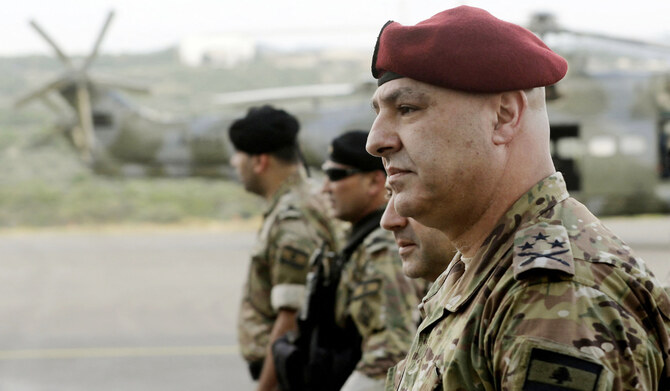
The US general tasked with leading the ceasefire monitoring committee and its members began meetings in Beirut on Friday with the commander of the Lebanese Armed Forces Gen. Joseph Aoun to discuss the implementation of the agreement.
Meanwhile, Al-Manar TV reported that Israeli forces “advanced into the town square of Markaba … and began bulldozing operations and blocking roads.”
The Israeli army also opened fire on residents in Khiam, who said that they had obtained permission from the Lebanese military, in coordination with the UN Interim Force in Lebanon, to enter the town for a funeral.
Footage captured by the mourners, who numbered no more than five or six, showed two of them injured in their legs by Israeli gunfire.
The mourners said that they left a woman’s body on the ground after an artillery shell struck nearby. The incident forced them to flee.
They also reported that the Israeli army seized the vehicles they had traveled in.
Israelis fired machine guns toward Aitaroun and demolished a playground in Kfarkela.
The army claimed on Thursday that the areas it had moved into in southern Lebanon were not included in the ceasefire agreement.
The deal, which was approved by both Lebanon and Israel on Tuesday, went into effect on Wednesday morning.
The Israeli army called on the Lebanese “not to cross into a line of towns specified by name to enter the border area, extending from Shebaa through Habbariyeh, Arnoun, Yohmor, Qantara, Shaqra, Baraashit, Yater, and Mansouri,” as anyone crossing these towns would endanger themselves.
The Israeli army said that it had 60 days to accomplish a “complete withdrawal from these areas” under the agreement.
The Israeli army has advanced into settlements extending 3 km from the border, an area which includes about 20 villages and Bint Jbeil.
Israeli forces have also prohibited Lebanese residents in the restricted area from moving around between 5 p.m. and 7 a.m.
Eyewitnesses spoke of attacks on “olive groves in Kfarkela, where bulldozers are uprooting olive trees near the Al-Abbara area.”
Meanwhile, four Israeli tanks ventured into the western neighborhood of the town of Khiam. An artillery shell fell on the town and the Israeli army conducted occasional sweeping operations with machine guns.
Israeli artillery shelling also targeted the outskirts of the towns of Markaba and Tallousa in the Marjayoun district while Israeli drones continued to fly over the western and central sectors.
The Lebanese army, which continues to deploy in the areas south of the Litani River and away from the Israeli incursion, blocked the roads leading to the restricted area.
Samir Geagea, head of the Lebanese Forces Party, said that “Hezbollah’s war in support of Gaza destroyed both Gaza and Lebanon,” and criticized the “unity of battlefields that Hezbollah called for.”
He was speaking after a meeting held by the Lebanese Forces’ parliamentary bloc and executive body.
Geagea added: “Hezbollah usurped the Lebanese people by starting this war and took Lebanon to war while the majority of the people were against it.
“Hezbollah committed a great crime against the Lebanese people. We could have avoided the martyrdom of 4,000 people and all the displacement and destruction.
“(But) despite all these disasters, Hezbollah MPs are still claiming victory, which is a strange and completely unrealistic logic.”
Geagea said that the ceasefire approved by Hezbollah “is the biggest proof of the illegitimacy of the party’s weapons,” and called on Hezbollah to “meet with the army command and develop a plan to dismantle its military presence north of the Litani River.
Meanwhile, the municipality of Mays Al-Jabal has warned residents returning to their town of the presence of “landmines, explosives and unexploded shells.”
It confirmed that it “is following up with the Lebanese army and relevant authorities to facilitate the safe return of people on time.”
The municipality warned that “entering the town at present is dangerous as the enemy is firing and launching artillery shells into the town’s neighborhoods and streets to target any civilian movement in the area.”
It added: “Due to the presence of landmines, explosives, and unexploded shells in homes and neighborhoods, and given that some houses are still rigged with explosives and might detonate at any moment, as well as the town’s streets being blocked with rubble and obstacles, we urge you and rely on your awareness to refrain from heading to our town at this time, and await further instructions.”
The Israeli army published a summary and data on Friday about the military operations carried out in the last two months against Hezbollah on the northern front.
It added that “orders preventing the return of residents to open areas north of Western Galilee and Upper Galilee remain in effect."
The Israeli army claimed that more than 12,500 targets were attacked, including more than 1,600 military headquarters and more than 1,000 ammunition depots.
The Israeli operations included “more than 14,000 flight hours for fighter jets and about 11,000 targets for attacks.”
The army’s statement claimed that “more than 1,500 offensive infrastructures, about 160 military headquarters, and about 150 ammunition depots were destroyed in the operation against the Radwan Force.
“About 2,500 high-ranking fighters were eliminated, causing significant damage to Hezbollah’s force.”
The Israeli army added that it estimated that Hezbollah had less than 30 percent of the drones it had possessed on the eve of the conflict.


