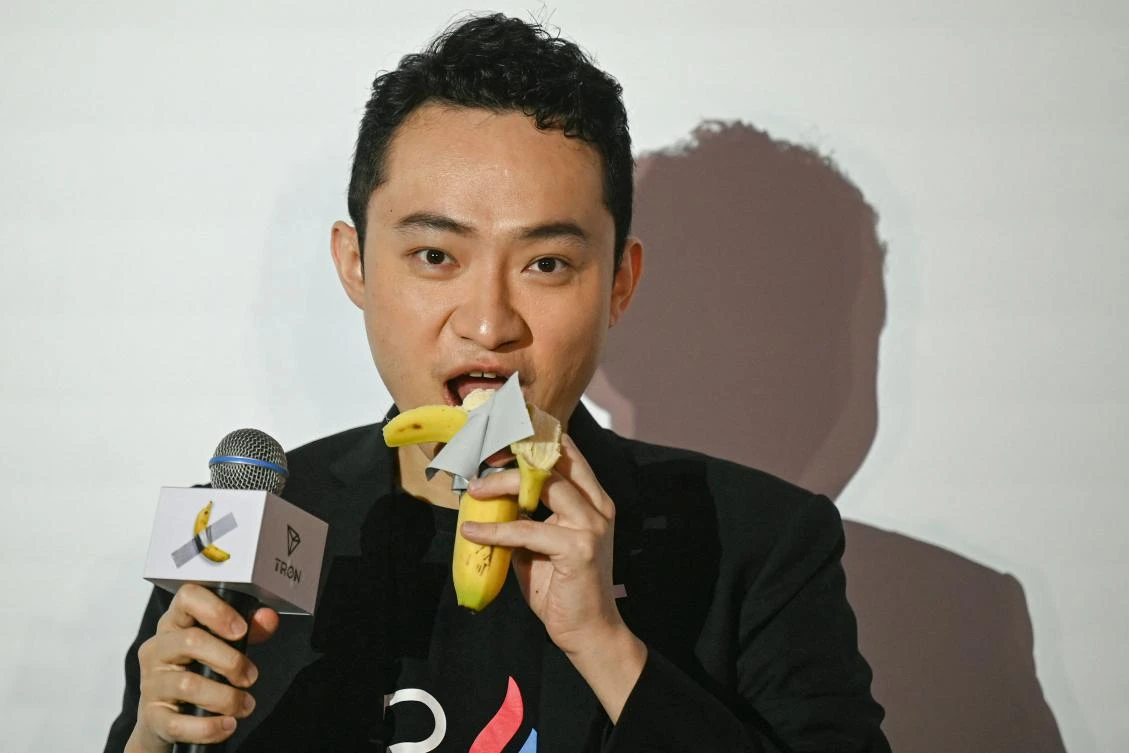
HONG KONG: Crypto entrepreneur Justin Sun on Friday fulfilled a promise he made after spending $6.2 million on an artwork featuring a banana duct-taped to a wall — by eating the fruit.
At one of Hong Kong’s priciest hotels, Sun chomped down on a banana in front of dozens of journalists and influencers after giving a speech hailing the work as “iconic” and drew parallels between conceptual art and cryptocurrency.
“It’s much better than other bananas,” Sun said after getting his first taste.
“It’s really quite good.”
Titled “Comedian,” the conceptual work created by Italian artist Maurizio Cattelan was sold at a Sotheby’s auction in New York last week, with Sun among seven bidders.
Sun said he felt “disbelief” in the first 10 seconds after he won the bid, before realizing “this could become something big.”
In the 10 seconds after that, he decided he would eat the banana.
“Eating it at a press conference can also become a part of the artwork’s history,” he said Friday.
The debut of the edible creation at the 2019 Art Basel show in Miami Beach sparked controversy and raised questions about whether it should be considered art — Cattelan’s stated aim.
And Sun on Friday compared conceptual art like “Comedian” to NFT art and decentralized blockchain technology.
“Most of its objects and ideas exist as (intellectual property) and on the Internet, as opposed to something physical,” he said.
Sun also this week disclosed a $30 million investment in World Liberty Financial, a crypto project backed by US president-elect Donald Trump.
The crypto businessman was last year charged by the US Securities and Exchange Commission with offering and selling unregistered securities in relation to his crypto project Tron. The case is ongoing.
At a function room at the Peninsula hotel in Hong Kong, two men dressed as auction house staff stood in front of a featureless wall with the yellow banana offering the only splash of color.
Sun said he only recently decided to bid for the artwork, adding he had “dumb questions” such as whether the banana had decayed and how to value the work.
The artwork owner is given a certificate of authenticity that the work was created by Cattelan as well as instructions about how to replace the fruit when it goes bad.
Event attendees on Friday each received a roll of duct tape and a banana as a souvenir.
“Everyone has a banana to eat,” he said.

Crypto boss eats banana art he bought for $6.2 million
https://arab.news/8jnnb
Crypto boss eats banana art he bought for $6.2 million
- Crypto entrepreneur Justin Sun on Friday fulfilled a promise he made after spending $6.2 million on an artwork featuring a banana duct-taped to a wall
Cambodia takes back looted historic artifacts handled by British art dealer
- The objects were returned under a 2020 agreement between the Ministry of Culture and Fine Arts and the family of the late Douglas Latchford, a British art collector and dealer who allegedly had the items smuggled out of Cambodia
PHNOM PENH, Cambodia: Cambodian officials on Friday received more than six dozen historic artifacts described as part of the country’s cultural heritage that had been looted during decades of war and instability.
At a ceremony attended by Deputy Prime Minister Hun Many, the 74 items were unveiled at the National Museum in Phnom Penh after their repatriation from the United Kingdom.
The objects were returned under a 2020 agreement between the Ministry of Culture and Fine Arts and the family of the late Douglas Latchford, a British art collector and dealer who allegedly had the items smuggled out of Cambodia.
“This substantial restitution represents one of the most important returns of Khmer cultural heritage in recent years, following major repatriations in 2021 and 2023 from the same collection,” the Culture Ministry said in a statement. “It marks a significant step forward in Cambodia’s continued efforts to recover, preserve, and restore its ancestral legacy for future generations.”
The artifacts were described as dating from the pre-Angkorian period through the height of the Angkor Empire, including “monumental sandstone sculptures, refined bronze works, and significant ritual objects.” The Angkor Empire, which extended from the ninth to the 15th century, is best known for the Angkor Wat archaeological site, the nation’s biggest tourist attraction.
Latchford was a prominent antiquities dealer who allegedly orchestrated an operation to sell looted Cambodian sculptures on the international market.
From 1970 to the 1980s, during Cambodia’s civil wars and the communist Khmer Rouge ‘s brutal reign, organized looting networks sent artifacts to Latchford, who then sold them to Western collectors, dealers, and institutions. These pieces were often physically damaged, having been pried off temple walls or other structures by the looters.
Latchford was indicted in a New York federal court in 2019 on charges including wire fraud and conspiracy. He died in 2020, aged 88, before he could be extradited to face charges.
Cambodia, like neighboring Thailand, has benefited from a trend in recent decades involving the repatriation of art and archaeological treasures. These include ancient Asian artworks as well as pieces lost or stolen during turmoil in places such as Syria, Iraq and Nazi-occupied Europe. New York’s Metropolitan Museum of Art is one of the prominent institutions that has been returning illegally smuggled art, including to Cambodia.
“The ancient artifacts created and preserved by our ancestors are now being returned to Cambodia, bringing warmth and joy, following the country’s return to peace,” said Hun Many, who is the younger brother of Prime Minister Hun Manet.