UN plastic treaty talks push for breakthrough as deadline looms

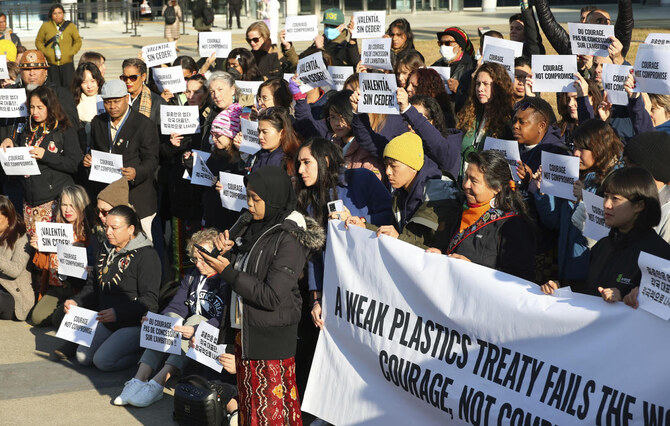
Environment activists call for a strong global plastics treaty outside of the venue for the fifth session of the Intergovernmental Negotiating Committee on Plastic Pollution in Busan, South Korea on Nov. 29, 2024. (Yonhap via AP)
Short Url
Updated 29 November 2024
Follow

UN plastic treaty talks push for breakthrough as deadline looms

  • South Korea is hosting the fifth and final UN Intergovernmental Negotiating Committee meeting to agree globally binding rules on plastics this week

BUSAN, South Korea: Negotiators at the fifth round of talks aimed at securing an international treaty to curb plastic pollution were striving on Friday to speed up sluggish proceedings and reach a deal by a Dec. 1 deadline.
South Korea is hosting the fifth and final UN Intergovernmental Negotiating Committee (INC-5) meeting to agree globally binding rules on plastics this week.
Until Thursday, several delegates from around 175 countries participating had expressed frustration about the slow pace of the talks amid disagreements over procedure, multiple proposals and some negotiations even returning to ground covered in the past.
In an attempt to speed up the process, INC Chair Luis Vayas Valdivieso is holding informal meetings on Friday to try and tackle the most divisive issues.
These issues include curbing plastic products and chemicals of concern, managing the supply of primary polymers, and a financial mechanism to help developing countries implement the treaty.
Petrochemical-producing nations such as Saudi Arabia strongly oppose efforts to target a cap on plastic production, over the protests of countries that bear the brunt of plastic pollution such as low- and middle-income nations.
While supporting an international treaty, the petrochemical industry has also been vocal in urging governments to avoid setting mandatory plastic production caps, and focus instead on solutions to reduce plastic waste, like recycling.
The INC plans an open a plenary session at 7 p.m. (1000 GMT) on Friday that will provide an indication of how close the talks have moved toward a treaty.


Ethiopia’s prime minister accuses Eritrea of mass killings during Tigray war

Updated 03 February 2026
Follow

Ethiopia’s prime minister accuses Eritrea of mass killings during Tigray war

  • Landlocked Ethiopia says that Eritrea is arming rebel groups, while Eritrea says Ethiopia’s aspiration is to gain access to a seaport
  • Ethiopia lost sovereign access to the Red Sea when Eritrea seceded in 1993 after decades of guerrilla warfare

ADDIS ABABA: Ethiopia’s government Tuesday for the first time acknowledged the involvement of troops from neighboring Eritrea in the war in the Tigray region that ended in 2022, accusing them of mass killings, amid reports of renewed fighting in the region.
Ethiopian Prime Minister Abiy Ahmed, while addressing parliament Tuesday, accused Eritrean troops fighting alongside Ethiopian forces of mass killings in the war, during which more than 400,000 people are estimated to have died.
Eritrean and Ethiopian troops fought against regional forces in the northern Tigray region in a war that ended in 2022 with the signing of a peace agreement.
Eritrea’s Information Minister Yemane Gebremeskel told The Associated Press that Ahmed’s comments were “cheap and despicable lies” and did not merit a response.
Both nations have been accusing each other of provoking a potential civil war, with landlocked Ethiopia saying that Eritrea is arming and funding rebel groups, while Eritrea says Ethiopia’s aspiration is to gain access to a seaport.
“The rift did not begin with the Red Sea issue, as many people think,” Ahmed told parliamentarians. “It started in the first round of the war in Tigray, when the Eritrean army followed us into Shire and began demolishing houses, massacred our youth in Axum, looted factories in Adwa, and uprooted our factories.”
“The Red Sea and Ethiopia cannot remain separated forever,” he added.
Ethiopia lost sovereign access to the Red Sea when Eritrea seceded in 1993 after decades of guerrilla warfare.
Gebremeskel said the prime minister has only recently changed his tune in his push for access to the Red Sea.
Ahmed “and his top military brass were profusely showering praises and State Medals on the Eritrea army and its senior officers. … But when he later developed the delusional malaise of ‘sovereignty access to the sea’ and an agenda of war against Eritrea, he began to sing to a different chorus,” he said.
Eritrea and Ethiopia initially made peace after Abiy came to power in 2018, with Abiy winning a Nobel Peace Prize for his efforts toward reconciliation.
In June, Eritrea accused Ethiopia of having a “long-brewing war agenda” aimed at seizing its Red Sea ports. Ethiopia recently said that Eritrea was “actively preparing to wage war against it.”
Analysts say an alliance between Eritrea and regional forces in the troubled Tigray region may be forming, as fighting has been reported in recent weeks. Flights by the national carrier to the region were canceled last week over the renewed clashes.