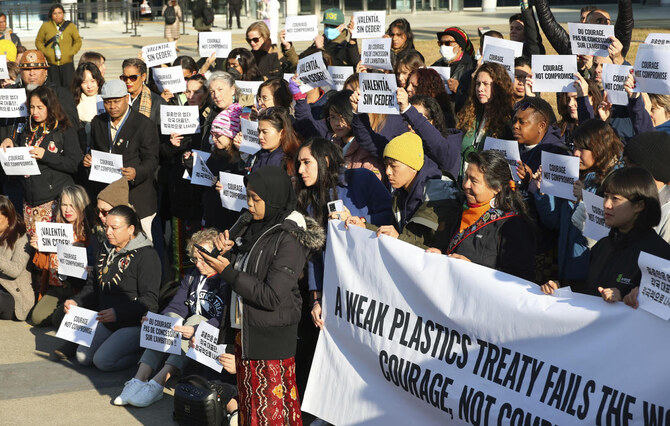
UN plastic treaty talks push for breakthrough as deadline looms

Environment activists call for a strong global plastics treaty outside of the venue for the fifth session of the Intergovernmental Negotiating Committee on Plastic Pollution in Busan, South Korea on Nov. 29, 2024. (Yonhap via AP)
Short Url
Updated 29 November 2024
Follow

UN plastic treaty talks push for breakthrough as deadline looms

  • South Korea is hosting the fifth and final UN Intergovernmental Negotiating Committee meeting to agree globally binding rules on plastics this week

BUSAN, South Korea: Negotiators at the fifth round of talks aimed at securing an international treaty to curb plastic pollution were striving on Friday to speed up sluggish proceedings and reach a deal by a Dec. 1 deadline.
South Korea is hosting the fifth and final UN Intergovernmental Negotiating Committee (INC-5) meeting to agree globally binding rules on plastics this week.
Until Thursday, several delegates from around 175 countries participating had expressed frustration about the slow pace of the talks amid disagreements over procedure, multiple proposals and some negotiations even returning to ground covered in the past.
In an attempt to speed up the process, INC Chair Luis Vayas Valdivieso is holding informal meetings on Friday to try and tackle the most divisive issues.
These issues include curbing plastic products and chemicals of concern, managing the supply of primary polymers, and a financial mechanism to help developing countries implement the treaty.
Petrochemical-producing nations such as Saudi Arabia strongly oppose efforts to target a cap on plastic production, over the protests of countries that bear the brunt of plastic pollution such as low- and middle-income nations.
While supporting an international treaty, the petrochemical industry has also been vocal in urging governments to avoid setting mandatory plastic production caps, and focus instead on solutions to reduce plastic waste, like recycling.
The INC plans an open a plenary session at 7 p.m. (1000 GMT) on Friday that will provide an indication of how close the talks have moved toward a treaty.


Uganda partially restores internet after president wins 7th term

Supporters of President Yoweri Museveni celebrate his winning the polls. (AFP)
Updated 58 min 18 sec ago
Follow

Uganda partially restores internet after president wins 7th term

  • “The internet shutdown implemented two days before the elections limited access to information, freedom ‌of association, curtailed economic activities ... it also created suspicion and mistrust on the ‍electoral process,” the team said in ‍their report

KAMPALA: Ugandan authorities have partially restored internet services late after 81-year-old President Yoweri Museveni won a seventh term to extend his rule into a fifth decade with a landslide ​victory rejected by the opposition.
Users reported being able to reconnect to the internet and some internet service providers sent out a message to customers saying the regulator had ordered them to restore services excluding social media.
“We have restored internet so that businesses that rely on internet can resume work,” David Birungi, spokesperson for Airtel Uganda, one of the country’s biggest telecom companies said. He added that the state communications regulator had ordered that social media remain shut down.
The state-run Uganda Communications Commission said it had cut off internet to ‌curb “misinformation, disinformation, ‌electoral fraud and related risks.” The opposition, however, criticized the move saying ‌it was ​to ‌cement control over the electoral process and guarantee a win for the incumbent.
The electoral body in the East African country on Saturday declared Museveni the winner of Thursday’s poll with 71.6 percent of the vote, while his rival pop star-turned-politician Bobi Wine was credited with 24 percent of the vote.
A joint report from an election observer team from the African Union and other regional blocs criticized the involvement of the military in the election and the authorities’ decision to cut off internet.
“The internet shutdown implemented two days before the elections limited access to information, freedom ‌of association, curtailed economic activities ... it also created suspicion and mistrust on the ‍electoral process,” the team said in ‍their report.

In power since 1986 and currently Africa’s third longest-ruling head of state, ‍Museveni’s latest win means he will have been in power for nearly half a century when his new term ends in 2031.

He is widely thought to be preparing his son, Muhoozi Kainerugaba, to take over from him. Kainerugaba is currently head of the military and has expressed presidential ambitions.
Wine, who was taking on ​Museveni for a second time, has rejected the results of the latest vote and alleged mass fraud during the election.
Scattered opposition protests broke out late on Saturday after results were announced, according to a witness and police.
In Magere, a suburb in Kampala’s north where Wine lives, a group of youths burned tires and erected barricades in the road prompting police to respond with tear gas.
Police spokesperson Racheal Kawala said the protests had been quashed and that arrests were made but said the number of those detained would be released later.
Wine’s whereabouts were unknown early on Sunday after he said in a post on X he had escaped a raid by the military on his home. People close to him said he remained at an undisclosed location in Uganda. Wine was briefly held under house arrest following the previous election in 2021.
Wine has said hundreds of his supporters were detained during the months leading up ‌to the vote and that others have been tortured.
Government officials have denied those allegations and say those who have been detained have violated the law and will be put through due process.