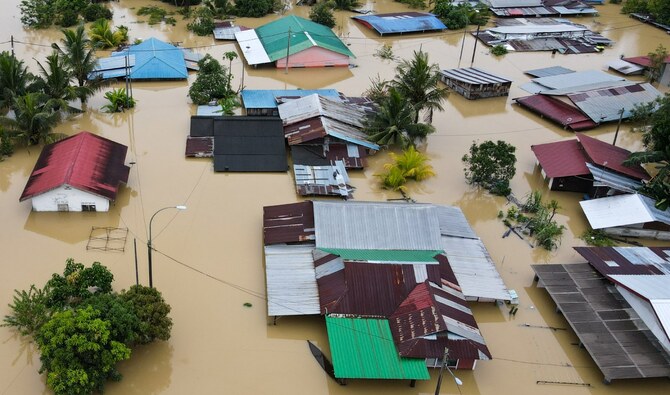
ISLAMABAD: Prime Minister Shehbaz Sharif on Thursday expressed sorrow over the devastating floods in Malaysia, which have displaced over 37,000 people, and highlighted the urgent need for global action to address climate change.
In a message to the Malaysian authorities and people, Sharif expressed solidarity, pledging support for the flood-hit nation.
His statement comes as Pakistan continues to grapple with its own vulnerability to climate change, which has triggered erratic weather patterns, including catastrophic floods, glacial melts, heatwaves and droughts.
Two years ago, floods in Pakistan killed about 1,700 people, caused estimated losses of $35 billion and underscored the country’s exposure to environmental shocks.
“The adverse effects of climate change are engulfing the entire world,” the prime minister said. “The global community must unite to take collective action to mitigate these impacts.”
At the recent COP29 summit in Baku, Azerbaijan, Pakistan reiterated its call for increased climate finance and justice-based solutions to support vulnerable nations.
It emphasized that developed countries must provide grants and concessional financing rather than burdening climate-affected nations with debt.
Pakistani authorities could relate with the situation in Malaysia where Prime Minister Anwar Ibrahim told parliament that torrential rains have affected six Malaysian states, with 322 temporary shelters housing those displaced.
Sharif extended condolences to the victims and assured assistance to Malaysia, noting the long-standing friendship between the two nations.
“Pakistan will do whatever it can to help our brothers and sisters in distress in Malaysia,” he said. “In this difficult hour, Pakistan will not leave Malaysia alone.”

Pakistan calls for global climate action as floods in Malaysia displace over 37,000
https://arab.news/j4abr
Pakistan calls for global climate action as floods in Malaysia displace over 37,000
- PM Sharif says climate change is impacting the whole world, necessitating global community to unite
- Pakistan recently reiterated its call for increased climate finance and justice-based solutions in Baku
IMF mission begins talks in Islamabad as Pakistan seeks next program review
- Finance ministry confirms ‘kick-off meeting’ with visiting IMF delegation
- Review critical for next tranche under $7 billion bailout program
Karachi: Pakistan began formal talks with a visiting International Monetary Fund (IMF) delegation on Monday as the country prepares for the next review of its $7 billion bailout program.
The IMF team is in Pakistan to conduct a review under the Extended Fund Facility (EFF) approved in September 2024, a multi-year program aimed at stabilizing the economy after a balance-of-payments crisis, high inflation and dwindling foreign exchange reserves.
Pakistan has so far received roughly $3 billion of the EFF. Successful completion of the latest review could pave the way for the release of the next tranche of funds, subject to IMF board approval.
Separately in 2024, Pakistan also secured about $1.3 billion under the IMF’s Resilience and Sustainability Facility, a climate-focused funding window aimed at strengthening the country’s capacity to manage environmental and disaster-related risks.
“Kick-off meeting with IMF Mission held today,” the finance ministry said on Monday as it shared visuals of Finance Minister Muhammad Aurangzeb and senior officials meeting the delegation in Islamabad.
IMF country representative in Pakistan, Mahir Binici, told Arab News in an emailed statement;
“An IMF mission led by Ms. Iva Petrova has started discussions with the authorities in Karachi and Islamabad on the third review of Pakistan’s Extended Fund Facility (EFF) arrangement and the second review of the Resilience and Sustainability Facility (RSF).”
The discussions are expected to focus on Pakistan’s fiscal performance, revenue collection targets, structural reform implementation and broader macroeconomic stability measures agreed under the program.
The review comes at a sensitive time for Pakistan’s economy, with rising global oil prices and regional instability adding pressure to inflation and external accounts. Analysts say continued IMF engagement remains crucial for maintaining investor confidence and securing external financing.
Pakistan entered the IMF program to restore macroeconomic stability, strengthen public finances and rebuild foreign exchange reserves. Authorities have repeatedly described the reform agenda as necessary to ensure long-term economic resilience.
Further meetings between technical teams are expected over the coming days.