

Winter rain piles misery on Gaza’s displaced

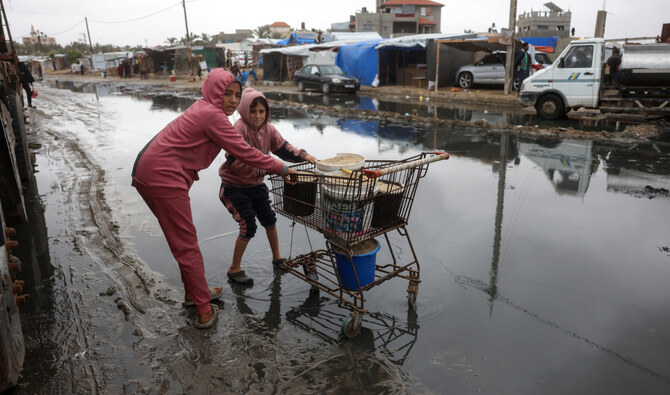
Displaced Palestinian children transport sand from the nearby beach to be used for making sand bags for protecting tents from the rain, following heavy rainfall north of Deir El-Balah in the central Gaza Strip on November 24, 2024. (AFP)
Short Url
Updated 26 November 2024
Follow

Winter rain piles misery on Gaza’s displaced

GAZA CITY: At a crowded camp in Gaza for those displaced by the war between Israel and Hamas, Ayman Siam laid concrete blocks around his tent to keep his family dry as rain threatened more misery.

“I’m trying to protect my tent from the rainwater because we are expecting heavy rain. Three days ago when it rained, we were drenched,” Siam said, seeking to shield his children and grandchildren from more wet weather.

Siam is among thousands sheltering at Gaza City’s Yarmouk sports stadium in the north after being uprooted by the Israel-Hamas war.

He lives in one of many flimsy tents set up at the stadium, where the pitch has become a muddy field dotted with puddles left by rainfall that washed away belongings and shelters.

People in the stadium dug small trenches around their tents, covered them with plastic sheets, and did whatever they could to stop the water from entering their makeshift homes.

Others used spades to direct the water into drains, as grey skies threatened more rain.

The majority of Gaza’s 2.4 million people have been displaced, often multiple times.

With many displaced living in tent camps, the coming winter is raising serious concerns.

Mahmud Bassal, spokesman for Gaza’s civil defense agency, said that “tens of thousands of displaced people, especially in the central and south of Gaza Strip, are suffering from flooded tents due to the rains,” and called on the international community to provide tents and aid.

International aid organizations have sounded the alarm about the deteriorating situation as winter approaches.

“It’s going to be catastrophic,” warned Louise Wateridge, an emergency officer for the UN agency for Palestinian refugees currently in Gaza.

The rainy period in Gaza lasts between late October and April, with January being the wettest month, averaging 30 to 40 millimeters of rain. Winter temperatures can drop as low as 6 degrees Celsius. Recent rain has flooded hundreds of tents.

“The rain and seawater flooded all the tents. We are helpless. The water took everything from the tent, including the mattresses, blankets and a water jug. We were only able to get a mattress and blankets for the children,” said Auni Al-Sabea, a displaced person.


Israel police to deploy around Al-Aqsa for Ramadan, Palestinians report curbs

Updated 57 min 38 sec ago
Follow

Israel police to deploy around Al-Aqsa for Ramadan, Palestinians report curbs

  • The Al-Aqsa compound is a central symbol of Palestinian identity and also a frequent flashpoint

JERUSALEM: Israeli police said Monday that they would deploy in force around the Al-Aqsa Mosque during the Muslim holy month of Ramadan, which begins this week, as Palestinian officials accused Israel of imposing restrictions at the compound.
Over the course of the month of fasting and prayer, hundreds of thousands of Palestinians traditionally attend prayers at Al-Aqsa — Islam’s third-holiest site, located in east Jerusalem, which Israel captured in 1967 and later annexed.
Arad Braverman, a senior Jerusalem police officer, said forces would be deployed “day and night” across the compound, known to Jews as the Temple Mount, and in the surrounding area.
He said thousands of police would also be on duty for Friday prayers, which draw the largest crowds of Muslim worshippers.
Braverman said police had recommended issuing 10,000 permits for Palestinians from the occupied West Bank, who require special permission to enter Jerusalem.
He did not say whether age limits would apply, adding that the final number of people would be decided by the government.
The Palestinian Jerusalem Governorate said in a separate statement it had been informed that permits would again be restricted to men over 55 and women over 50, mirroring last year’s criteria.
It said Israeli authorities had blocked the Islamic Waqf — the Jordanian?run body administering the site — from carrying out routine preparations, including installing shade structures and setting up temporary medical clinics.
A Waqf source confirmed the restrictions and said 33 of its employees had been barred from entering the compound in the week before Ramadan.
The Al-Aqsa compound is a central symbol of Palestinian identity and also a frequent flashpoint.
Under long?standing arrangements, Jews may visit the compound — which they revere as the site of their second temple, destroyed by the Romans in 70 AD — but they are not permitted to pray there.
Israel says it is committed to maintaining this status quo, though Palestinians fear it is being eroded.
Braverman reiterated Monday that no changes were planned.
In recent years, a growing number of Jewish ultranationalists have challenged the prayer ban, including far?right politician Itamar Ben-Gvir, who prayed at the site while serving as national security minister in 2024 and 2025.