

NEOM giga-project a ‘generational investment,’ Saudi minister says

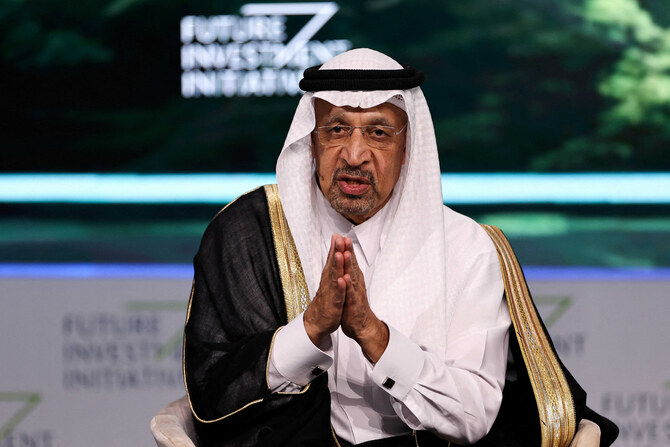
Saudi Arabia's Minister of Investment, Khalid-al-Falih. Reuters/File
Short Url
Updated 27 November 2024
Follow

NEOM giga-project a ‘generational investment,’ Saudi minister says

  • Foreign investors starting to come to NEOM, minister says
  • On recent departure of NEOM’s CEO, minister says there is a time to pass baton
  • Risk-return ‘very fair’ for outside investors, Al-Falih says

RIYADH: Saudi Arabia’s NEOM gigaproject, a futuristic region being built in the desert, is a “generational investment” with a long timeline, the country’s investment minister told Reuters on Monday, adding that foreign investment will pick up pace.

“NEOM was not meant to be a two-year investable opportunity. If anybody expected NEOM to be foreign investment in two, three or five years, then they have gotten (it) wrong — it’s a generational investment,” Minister Khalid Al-Falih said on the sidelines of the World Investment Conference in Riyadh.

“The flywheel is starting and it will gain speed as we go forward, as some of the foundational assets come to the market,” he said.

The world’s top oil exporter has poured hundreds of billions of dollars into development projects through the Kingdom’s $925 billion sovereign fund, the Public Investment Fund, as it undergoes an economic agenda dubbed Vision 2030 to cut dependence on fossil fuels.

NEOM, a Red Sea urban and industrial development nearly the size of Belgium that is meant to eventually house 9 million people, is central to Vision 2030.

NEOM announced this month its long-time chief executive, Nadhmi Al-Nasr, had stepped down, without giving further details.

Asked what effect the departure would have on investors, the minister said the executive had done “a respectable job” but that “there is a time for everybody to pass on the baton.”

Asked if PIF will continue to do much of the spending on NEOM until more foreign funds come in, Al-Falih said it was not binary.

“I think foreign investors are starting to come to NEOM, they’re starting to channel capital. Some of the projects that the PIF will be doing will be financed through global capital pools, through some alternative and private capital. That’s taking place as we speak,” he said.

“So I urge you not to look at NEOM as being 100 percent PIF and then suddenly there will be a cliff and it will go private.”

Saudi Arabia, which is racing to attract $100 billion in annual foreign direct investment by the turn of the decade — reaching about a quarter of that in 2023 — has recently seen more co-investment deals between state entities and foreign investors.

“It’s always been the intent,” Al-Falih said of foreign inflows alongside state funds.

He noted that foreign investors were at times “still looking, still examining, still sometimes questioning,” but that now there was confidence in the profitability of investment opportunities and that “the risk-return trade-offs are very, very fair and positive to them.” 


Jordan, Lebanon sign 21 cooperation agreements across various fields

Updated 5 sec ago
Follow

Jordan, Lebanon sign 21 cooperation agreements across various fields

RIYADH: Jordan and Lebanon have sealed 21 cooperation agreements across various fields, including energy, electrical interconnection, and industry.

Jordanian Prime Minister Jafar Hassan and his Lebanese counterpart, Nawaf Salam, witnessed the signing of the deals between the two countries, following their chairing of the eighth session of the Jordanian-Lebanese Joint Higher Committee in Beirut, the Jordan News Agency, or Petra, reported.

Additional areas of cooperation included trade, investment, and tourism, as well as transport and several service sectors.

This reflects the ongoing trade relationship between the two countries. In 2023, Jordan exported $101 million worth of goods to Lebanon, while Lebanon exported $111 million to Jordan, according to data from the Observatory of Economic Complexity.

Petra stated: “In joint press statements after the signing of the agreements, Hassan said that Jordan will continue, as it always has, to support Lebanon and to stand by its security, stability and sovereignty.”

It added: “He stressed that supporting Lebanon is a firm Jordanian position under the continuous guidance of His Majesty King Abdullah II, who tasked him with working intensively to translate the historic relations between the two countries into comprehensive cooperation across all fields.”

The prime minister noted that despite the absence of a shared border between Jordan and Lebanon, the two nations are closely connected through long-standing ties of communication, cooperation, and integration at both official and public levels, extending across economic and cultural spheres.

He further stated that both countries are committed to reinforcing these ties and advancing their relationship, with the next phase expected to see broader institutional cooperation that serves the interests of Jordan and Lebanon.

Hassan underlined that the Joint Jordanian-Lebanese Higher Committee convened again, highlighting the two sides’ commitment to maintaining and regularly holding these meetings in line with the strong fraternal ties.

The prime minister added that both sides agreed to maintain ongoing communication and coordination among ministers, officials, and technical teams to ensure the implementation of the agreed accords and to explore future areas of cooperation in ways that serve the interests of both countries and their peoples.