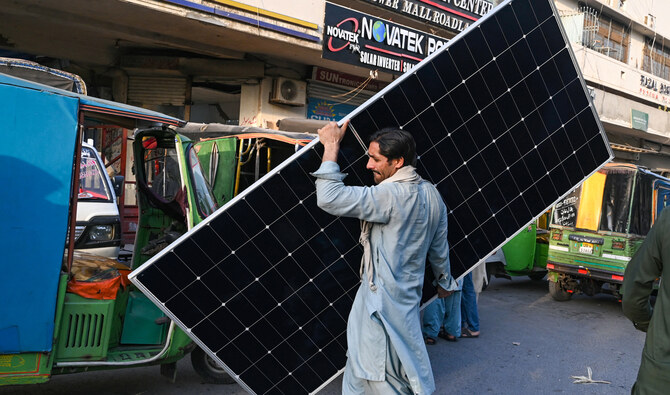
ISLAMABAD: Pakistan is now the sixth-largest solar market in the world and its “rapid adoption” of solar energy provides valuable lessons for emerging markets, a World Economic Forum report said this week as Islamabad tries to dodge rising fuel prices through renewable energy resources.
Pakistan’s energy sector has long struggled with financial strain due to circular debt, power theft and transmission losses, leading to blackouts and high electricity costs.
Experts say Pakistan has ideal climatic conditions for solar power generation, with over nine hours of sunlight in most parts of the country. According to the World Bank, utilizing just 0.071 percent of the country’s area for solar photovoltaic (solar PV) power generation would meet Pakistan’s electricity demand.
According to the National Electric Power Regulatory Authority, currently, only 5.4 percent of Pakistan’s installed power generation capacity of 39,772 megawatts comes from renewables like wind, solar and biomass, while fossil fuels still make up 63 percent of the fuel mix, followed by hydropower at 25 percent.
“The country is now the world’s sixth-largest solar market,” WEF said in its report published on Monday. “Declining solar panel prices, coupled with skyrocketing grid electricity tariffs that have increased by 155 percent over three years, are fueling a rush in renewable energy adoption in Pakistan, with solar power leading the way.”
The report highlighted that Pakistan’s move to adopt solar energy was driven by external factors such as China’s overproduction of solar panels, which had lowered the costs for Pakistan, making the country the third-largest destination for Chinese solar exports.
“Industrial, agricultural and residential sectors have embraced solar, with imported Chinese modules totaling 13 gigawatts (GW) in the first half of the year, and forecasts reaching 22GW by year-end,” the report said.
The WEF said the inability of state-owned energy providers to provide a stable supply and the government’s inconsistent energy policy characterized by ” inefficiencies in production, pricing and regulations” has deepened Pakistan’s energy crisis, aiding in the usage of solar energy.
“Grid electricity demand dropped by more than 10 percent in the past fiscal year as inflated tariffs burden consumers with covering inefficiencies,” the report added. “This trend has sparked a wave of solar adoption among industrial, commercial and private users who can afford self-generation.”
Supportive policies like offering credit for solar in off-grid areas and unbundling customer categories can also boost renewable energy adoption, it said.
“Pakistan’s journey underscores the importance of balancing policy innovation with market adaptation to drive sustainable and equitable energy solutions,” the WEF report concluded.


World Economic Forum says Pakistan now world’s sixth-largest solar market
https://arab.news/v4fp3
World Economic Forum says Pakistan now world’s sixth-largest solar market

- Pakistan’s “rapid adoption” of solar energy provides valuable lessons for emerging markets, says WEF
- Says declining solar panel prices, skyrocketing electricity tariffs reasons for Pakistan pursuing solar energy

US freezes visa processing for 75 countries, media reports Pakistan included
- State Department announces indefinite pause on immigrant visas starting Jan 21
- Move underscores Trump’s hard-line immigration push despite close Pakistan-US ties
ISLAMABAD: The United States will pause immigrant visa processing for applicants from 75 countries starting Jan. 21, the State Department said on Wednesday, with Fox News and other media outlets reporting that Pakistan is among the countries affected by the indefinite suspension.
The move comes as the Trump administration presses ahead with a broad immigration crackdown, with Pakistan included among the affected countries despite strong ongoing diplomatic engagement between Islamabad and Washington on economic cooperation, regional diplomacy and security matters.
Fox News, citing an internal State Department memo, said US embassies had been instructed to refuse immigrant visas under existing law while Washington reassesses screening and vetting procedures. The report said the pause would apply indefinitely and covers countries across Asia, Africa, the Middle East, Europe and Latin America.
“The State Department will pause immigrant visa processing from 75 countries whose migrants take welfare from the American people at unacceptable rates. The freeze will remain active until the US can ensure that new immigrants will not extract wealth from the American people,” the Department of State said in a post on X.
According to Fox News and Pakistan news outlets like Dawn, the list of affected countries includes Pakistan, Afghanistan, Bangladesh, Iran, Iraq, Egypt, Nigeria, Russia, Somalia, Brazil and Thailand, among others.
“The suspension could delay travel, study, and work plans for thousands of Pakistanis who annually seek US visas. Pakistani consulates in the US are expected to provide guidance to affected applicants in the coming days,” Dawn reported.
A State Department spokesman declined comment when Arab News reached out via email to confirm if Pakistan was on the list.
The Department has not publicly released the full list of countries or clarified which visa categories would be affected, nor has it provided a timeline for when processing could resume.
Trump has made immigration enforcement a central pillar of his agenda since returning to office last year, reviving and expanding the use of the “public charge” provision of US immigration law to restrict entry by migrants deemed likely to rely on public benefits.
During his previous term as president, Trump imposed sweeping travel restrictions on several Muslim-majority countries, a policy widely referred to as a “Muslim ban,” which was challenged in US courts before a revised version was upheld by the Supreme Court. That policy was later rescinded under the President Joe Biden administration.
The latest visa freeze marks a renewed hardening of US immigration policy, raising uncertainty for migrants from affected countries as Washington reassesses its screening and vetting procedures.
The freeze on visas comes amid an intensifying crackdown on immigration enforcement by the Trump administration. In Minneapolis last week, a US Immigration and Customs Enforcement (ICE) agent shot and killed 37-year-old Renee Good, a US citizen, during a federal operation, an incident that has drawn nationwide protests and scrutiny of ICE tactics. Family members and local officials have challenged the federal account of the shooting, even as Department of Homeland Security officials defended the agent’s actions. The case has prompted resignations by federal prosecutors and heightened debate over the conduct of immigration enforcement under the current administration.


