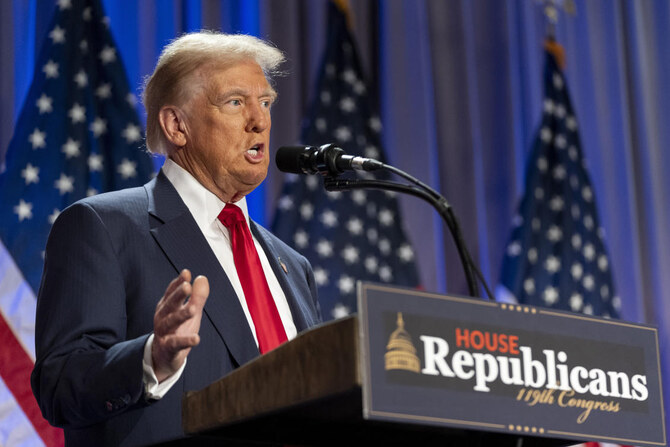
NEW YORK: President-elect Donald Trump is threatening to impose sweeping new tariffs on Mexico, Canada and China as soon as he takes office as part of his efforts to crack down on illegal immigration and drugs.
The tariffs, if implemented, could dramatically raise prices on everything from gas to automobiles. The US is the largest importer of goods in the world, with Mexico, China and Canada its top three suppliers, according to the most recent Census data.
Trump made the threats in a pair of posts on his Truth Social site Monday evening in which he railed against an influx of illegal migrants, even though southern border crossings have been hovering at a four-year low.
“On January 20th, as one of my many first Executive Orders, I will sign all necessary documents to charge Mexico and Canada a 25 percent Tariff on ALL products coming into the United States, and its ridiculous Open Borders,” he wrote, complaining that “thousands of people are pouring through Mexico and Canada, bringing Crime and Drugs at levels never seen before,” even though violent crime is down from pandemic highs.
He said the new tariffs would remain in place “until such time as Drugs, in particular Fentanyl, and all Illegal Aliens stop this Invasion of our Country! ”
Trump also turned his ire to China, saying he has “had many talks with China about the massive amounts of drugs, in particular Fentanyl, being sent into the United States – But to no avail.”
“Until such time as they stop, we will be charging China an additional 10 percent Tariff, above any additional Tariffs, on all of their many products coming into the United States of America,” he wrote.
It is unclear whether Trump will actually go through with the threats or if he is using them as a negotiating tactic before he takes office in the new year.
Arrests for illegally crossing the border from Mexico have been falling and remained around four-year lows in October, according to the most recent US numbers
The Border Patrol made 56,530 arrests in October, less than one third of the tally from last October.
Much of America’s fentanyl is smuggled from Mexico. Border seizures of the drug rose sharply under President Joe Biden, and US officials tallied about 21,900 pounds (12,247 kilograms) of fentanyl seized in the 2024 government budget year, compared with 2,545 pounds (1,154 kilograms) in 2019, when Trump was president.
Trump’s nominee for treasury secretary, Scott Bessent, if confirmed, would be one of several officials responsible for imposing tariffs on other nations. He has on several occasions said tariffs are a means of negotiation with other countries.
He wrote in a Fox News op-ed last week, before his nomination, that tariffs are “a useful tool for achieving the president’s foreign policy objectives. Whether it is getting allies to spend more on their own defense, opening foreign markets to US exports, securing cooperation on ending illegal immigration and interdicting fentanyl trafficking, or deterring military aggression, tariffs can play a central role.”
If Trump were to move forward with the threatened tariffs, the new taxes would pose an enormous challenge for the economies of Canada and Mexico, in particular.
They would also throw into doubt the reliability of the 2020 trade deal brokered in large part by Trump, which is up for review in 2026.
Spokespeople for Canada’s ambassador to Washington and its deputy prime minister, Chrystia Freeland, who chairs a special Cabinet committee on Canada-US relations to address concerns about another Trump presidency, did not immediately provide comment.
Trump’s promise to launch a mass deportation effort is a top focus for the Cabinet committee, Freeland has said.
A senior Canadian official had said before Trump’s posts that Canadian officials are expecting Trump to issue executive orders on trade and the border as soon as he assumes office. The official was not authorized to speak publicly and spoke on condition of anonymity.
Mexico’s Foreign Relations Department and Economy Department also had no immediate reaction to Trump’s statements. Normally such weighty issues are handled by the president at her morning press briefings.


![]()


Trump threatens to impose sweeping new tariffs on Mexico, Canada and China on first day in office
Short Url
https://arab.news/w73qa
Trump threatens to impose sweeping new tariffs on Mexico, Canada and China on first day in office
Deadly militant offensive sweeps northern and eastern Burkina Faso
- Burkina Faso, ruled by a military junta since September 2022, has faced more than 10 years of raids by groups linked to Al-Qaeda and the Daesh
ABIDJAN: Al-Qaeda-affiliated JNIM has in recent days claimed to have inflicted heavy losses in Burkina Faso as a surge in deadly militant attacks sweeps across the Sahelian state.
Burkina Faso, ruled by a military junta since September 2022, has faced more than 10 years of raids by groups linked to Al-Qaeda and the Daesh, including the Group for the Support of Islam and Muslims (JNIM).
A February UN Security Council report noted that the “pace of JNIM attacks” had slowed in September as fighters were diverted to Mali to back an attempted fuel blockade.
“The group’s efforts in Mali have been the primary focus since early September last year,” said Heni Nsaibia, analyst at conflict monitor ACLED.
But attacks never fully stopped, and JNIM has launched a string of large-scale assaults in northern and eastern Burkina Faso since mid-February, killing dozens, including civilians.
“Since February 14, JNIM has claimed responsibility for 10 attacks across different regions of Burkina Faso,” said Hasret Kargin, an Africa studies researcher at intelligence firm Mintel World.
Deadly assaults
The deadliest incidents targeted Titao’s military base on February 15 in the northwest, where the group says it killed dozens of soldiers.
A separate ambush on the same day left around 50 forestry officers dead in Tandjari in the east.
Around 10 civilians were also killed in Titao, including seven Ghanaian traders.
“This latest round demonstrated a high degree of coordination, given the number of large-scale attacks that occurred between 12 and 22 February,” Nsaibia said.
“Over 130 people” — Burkinabe soldiers, civilian auxiliaries and JNIM fighters — “were killed in this series of battles.”
Kargin noted that JNIM has issued no formal statement explaining the recent uptick after several months of reduced activity.
But militant groups often strike “right before and during” the Muslim holy month of Ramadan, he said, adding current dry-season conditions had helped them on the ground.
‘Smuggling zones’
Recent attacks have gripped the country’s north and east, areas seen as financial hubs for Al-Qaeda’s Sahel branch.
“These are zones with numerous gold sites and key routes that fuel the group’s smuggling activities,” a Burkinabe security analyst said, requesting anonymity.
The north “acts as a bridge” to JNIM’s “main central command” in Mali, Kargin said, while he east — home to a vast nature reserve straddling Niger, Benin and Burkina Faso — allows the group to push into neighboring countries.
The forests, he added, both shield fighters from airstrikes and generate income through illegal timber sales and control of artisanal gold mining.
The Tandjari attack near regional capital Fada N’Gourma highlights JNIM’s growing freedom of movement after having “gained a lot of ground in recent years,” Nsaibia said.
“The question is not the frequency of attacks — they never stopped — but how these groups are able to inflict such heavy losses” when the army claims to be better equipped and better organized, said a Burkinabe political scientist.
The army, which rarely comments on attacks, said in mid-February it now controls 74 percent of national territory, with some “600 villages retaken.”
According to the UN report, JNIM recently appointed a senior leader in eastern Burkina Faso tasked with expanding into Benin, Ivory Coast, Ghana, Niger and Togo.
Burkina Faso, ruled by a military junta since September 2022, has faced more than 10 years of raids by groups linked to Al-Qaeda and the Daesh, including the Group for the Support of Islam and Muslims (JNIM).
A February UN Security Council report noted that the “pace of JNIM attacks” had slowed in September as fighters were diverted to Mali to back an attempted fuel blockade.
“The group’s efforts in Mali have been the primary focus since early September last year,” said Heni Nsaibia, analyst at conflict monitor ACLED.
But attacks never fully stopped, and JNIM has launched a string of large-scale assaults in northern and eastern Burkina Faso since mid-February, killing dozens, including civilians.
“Since February 14, JNIM has claimed responsibility for 10 attacks across different regions of Burkina Faso,” said Hasret Kargin, an Africa studies researcher at intelligence firm Mintel World.
Deadly assaults
The deadliest incidents targeted Titao’s military base on February 15 in the northwest, where the group says it killed dozens of soldiers.
A separate ambush on the same day left around 50 forestry officers dead in Tandjari in the east.
Around 10 civilians were also killed in Titao, including seven Ghanaian traders.
“This latest round demonstrated a high degree of coordination, given the number of large-scale attacks that occurred between 12 and 22 February,” Nsaibia said.
“Over 130 people” — Burkinabe soldiers, civilian auxiliaries and JNIM fighters — “were killed in this series of battles.”
Kargin noted that JNIM has issued no formal statement explaining the recent uptick after several months of reduced activity.
But militant groups often strike “right before and during” the Muslim holy month of Ramadan, he said, adding current dry-season conditions had helped them on the ground.
‘Smuggling zones’
Recent attacks have gripped the country’s north and east, areas seen as financial hubs for Al-Qaeda’s Sahel branch.
“These are zones with numerous gold sites and key routes that fuel the group’s smuggling activities,” a Burkinabe security analyst said, requesting anonymity.
The north “acts as a bridge” to JNIM’s “main central command” in Mali, Kargin said, while he east — home to a vast nature reserve straddling Niger, Benin and Burkina Faso — allows the group to push into neighboring countries.
The forests, he added, both shield fighters from airstrikes and generate income through illegal timber sales and control of artisanal gold mining.
The Tandjari attack near regional capital Fada N’Gourma highlights JNIM’s growing freedom of movement after having “gained a lot of ground in recent years,” Nsaibia said.
“The question is not the frequency of attacks — they never stopped — but how these groups are able to inflict such heavy losses” when the army claims to be better equipped and better organized, said a Burkinabe political scientist.
The army, which rarely comments on attacks, said in mid-February it now controls 74 percent of national territory, with some “600 villages retaken.”
According to the UN report, JNIM recently appointed a senior leader in eastern Burkina Faso tasked with expanding into Benin, Ivory Coast, Ghana, Niger and Togo.
Latest updates


© 2026 SAUDI RESEARCH & PUBLISHING COMPANY, All Rights Reserved And subject to Terms of Use Agreement.