

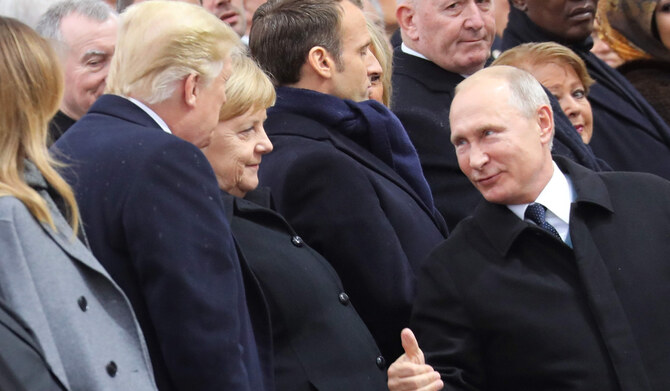

BERLIN: Germany’s former chancellor Angela Merkel gives a spirited defense of her 16 years at the helm of Europe’s top economy in her memoir “Freedom,” released in 30 languages on Tuesday.
Since she stepped down in 2021, Merkel has been accused of having been too soft on Russia, leaving Germany dangerously reliant on cheap Russian gas and sparking turmoil and the rise of the far right with her open-door migrant policy.
Her autobiography is released as wars rage in Ukraine and the Middle East, Donald Trump is headed back to the White House and Germany faces snap elections after its ruling coalition collapsed this month.
Merkel, 70, remembered for her calm and unflappable leadership style, rejects blame for any of the current turmoil, in the 736-page autobiography co-written with longtime adviser Beate Baumann.
After years out of the public eye, she has given multiple media interviews, reflecting on her childhood under East German communism and tense encounters with Russian President Vladimir Putin and Trump, who she felt “was captivated by politicians with autocratic and dictatorial tendencies.”
In the full memoir, she gives further insights into her thoughts and actions — including during the 2015 mass refugee influx, which came to define the final years of her leadership.
Critics have charged that Merkel’s refusal to push back large numbers of asylum-seekers at the Austrian border led to more than one million arrivals and fueled the rise of the far-right Alternative for Germany (AfD).
Merkel, who at the time posed for a selfie with one Syrian refugee, says she “still does not understand ... how anyone could have assumed that a friendly face in a photo would be enough to encourage entire legions to flee their homeland.”
While affirming that “Europe must always protect its external borders,” she stresses that “prosperity and the rule of law will always make Germany and Europe ... places where people want to go.”
In addition, she writes in the French edition of the book, fast-aging Germany’s “lack of manpower makes legal migration essential.”
Her bold declaration at the time — “wir schaffen das” in German or “we can do this” — was a “banal” statement with the message that “where there are obstacles, we must work to overcome them,” she argues.
And on the AfD, she cautions Germany’s mainstream parties against adopting their rhetoric “without proposing concrete solutions to existing problems,” warning that with such an approach mainstream movements “will fail.”
Merkel, who speaks Russian, also defends her engagement over the years with Putin, who speaks German — despite her misgivings about the former KGB agent who once allowed a labrador into a meeting between them, apparently playing on her fear of dogs.
She describes the Russian leader as “a man perpetually on the lookout, afraid of being mistreated and always ready to strike, including by playing at exercising his power with a dog and making others wait.”
Nevertheless, she says that “despite all the difficulties” she was right “not to let contacts with Russia be broken off ... and to also preserve ties through trade relations.”
The reality is, she argues, that “Russia is, with the United States, one of the two main nuclear powers in the world.”
She also defends her opposition to Ukraine joining NATO at a 2008 Bucharest summit, considering it illusory to think that candidate status would have protected it from Putin’s aggression.
After the summit, she remembers flying home with the feeling that “we in NATO had no common strategy for dealing with Russia.”
Russia’s full-scale attack on Ukraine in February 2022, and the sabotage of the Nord Stream pipelines, cut Germany off from cheap Russian gas, with the taps’ closure a key driver of its ongoing economic malaise.
But Merkel rejects criticism for having allowed the Baltic Sea pipelines in the first place, pointing out that Nord Stream 1 was signed off on by her predecessor, the Social Democrat Gerhard Schroeder, long a friend of Putin.
On Nord Stream 2, which she approved after Russia’s 2014 annexation of Crimea, she argues that at the time it would have been “difficult to get companies and gas users in Germany and in many EU member states to accept” having to import more expensive liquefied natural gas from other sources.
Merkel says the gas was needed as a transitional energy source as Germany was pursuing both a switch to renewable energy and the phase-out of nuclear power following Japan’s 2011 Fukushima disaster.
On nuclear power itself, she argues that “we do not need it to meet our climate goals” and that the German phase-out can “inspire courage in other countries” to follow suit.


