Russia security chief meets Taliban officials in Kabul

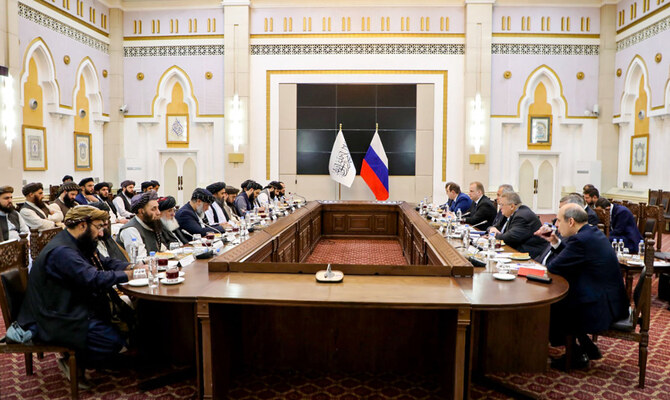
This handout photograph taken on November 25, 2024 and released by the Taliban deputy prime minister for economic affairs office shows Afghanistan's delegation (L) headed by their deputy prime minister for Economic Affairs Abdul Ghani Baradar attending a bilateral meeting with the Russian delegation headed by the secretary of Russia's Security Council Sergei Shoigu at the Chahar Chinar Palace in Kabul. (AFP)
Short Url
Updated 26 November 2024
Follow

Russia security chief meets Taliban officials in Kabul

  • Shoigu, the secretary of Russia’s Security Council, met an Afghan cohort in Kabul headed by Deputy Prime Minister for Economic Affairs Abdul Ghani Baradar

KABUL: Top Russian security official Sergei Shoigu visited Afghan government officials on Monday, assuring them Moscow will soon remove the Taliban from its list of banned organizations, Kabul said.
Since the Taliban surged back to power in 2021 visits by foreign officials have been infrequent because no nation has yet formally recognized the government of the former insurgent group.
Taliban government curbs on women have made them pariahs in many Western nations but Kabul is making increasing diplomatic overtures to its regional neighbors, emphasising economic and security cooperation.
Shoigu, the secretary of Russia’s Security Council, met an Afghan cohort in Kabul headed by Deputy Prime Minister for Economic Affairs Abdul Ghani Baradar.
He “expressed Russia’s interest in increasing the level of bilateral cooperation with Afghanistan,” Baradar’s office said in a statement released on social media site X.
“He also announced that, to expand political and economic relations between the two countries, the Islamic Emirate’s name would soon be removed from Russia’s blacklist.”
The Islamic Emirate is the name the Taliban government uses to refer to itself.
Russian news agencies quoted Shoigu as saying he wanted “constructive” ties with Kabul, without saying if he had floated Moscow removing the Taliban from its list of banned groups.
“I confirm the readiness to build a constructive political dialogue between our countries, including in order to give momentum to the process of the internal Afghan settlement,” Shoigu said, according to the RIA Novosti news agency.
He also said Russian companies plan to take part in projects in Afghanistan on extracting natural resources.
Analysts say Moscow may be eying cooperation with Kabul to counter the threat from Islamic State Khorasan (IS-K) — the Afghan-based branch of the Sunni militant group.
In March, more than 140 people were killed when IS-K gunmen attacked a Moscow concert hall.
Taliban authorities have repeatedly said security is their top domestic priority and have pledged militants staging foreign attacks will be ousted from Afghanistan.
“The Taliban certainly are our allies in the fight against terrorism,” Russia’s ambassador to Afghanistan, Dmitry Zhirnov, said in July.
“They are working to eradicate terrorist cells.”


Starvation fears as flood toll passes 900 in Indonesia

Updated 9 sec ago
Follow

Starvation fears as flood toll passes 900 in Indonesia

  • More than 1,790 people have been killed in natural disasters unfolding across Southeast Asia over the past week
  • Floods have swept away roads, smothered houses in silt, and cut off supplies in Indonesia's provinces of Aceh and North Sumatra

More than 1,790 people have been killed in natural disasters unfolding across Southeast Asia over the past week

Floods have swept away roads, smothered houses in silt, and cut off supplies in Indonesia's provinces of Aceh and North Sumatra

BANDA ACEH, Indonesia: Ruinous floods and landslides have killed more than 900 people on Indonesia’s island of Sumatra, the country’s disaster management agency said Saturday, with fears that starvation could send the toll even higher.
A chain of tropical storms and monsoonal rains has pummelled Southeast and South Asia, triggering landslides and flash floods from the Sumatran rainforest to the highland plantations of Sri Lanka.
More than 1,790 people have been killed in natural disasters unfolding across Indonesia, Sri Lanka, Malaysia, Thailand and Vietnam over the past week.
In Indonesia’s provinces of Aceh and North Sumatra, floods have swept away roads, smothered houses in silt, and cut off supplies.
Aceh governor Muzakir Manaf said response teams were still searching for bodies in “waist-deep” mud.
However, starvation was one of the gravest threats now hanging over remote and inaccessible villages.
“Many people need basic necessities. Many areas remain untouched in the remote areas of Aceh,” he told reporters.
“People are not dying from the flood, but from starvation. That’s how it is.”
Entire villages had been washed away in the rainforest-cloaked Aceh Tamiang region, Muzakir said.
“The Aceh Tamiang region is completely destroyed, from the top to the bottom, down to the roads and down to the sea.
“Many villages and sub-districts are now just names,” he said.
Aceh Tamiang flood victim Fachrul Rozi said he had spent the past week crammed into an old shop building with others who had fled the rising waters.
“We ate whatever was available, helping each other with the little supplies each resident had brought,” he told AFP.
“We slept crammed together.”
Aceh resident Munawar Liza Zainal said he felt “betrayed” by the Indonesian government, which has so far shrugged off pressure to declare a national disaster.
“This is an extraordinary disaster that must be faced with extraordinary measures,” he told AFP, echoing frustrations voiced by other flood victims.
“If national disaster status is only declared later, what’s the point?“
Declaring a national disaster would free up resources and help government agencies coordinate their response.
Analysts have suggested Indonesia could be reluctant to declare a disaster — and seek additional foreign aid — because it would show it was not up to the task.
Indonesia’s government this week insisted it could handle the fallout.

Climate calamity

The scale of devastation has only just become clear in other parts of Sumatra as engorged rivers shrink and floodwaters recede.
AFP photos showed muddy villagers salvaging silt-encrusted furniture from flooded houses in Aek Ngadol, North Sumatra.
Humanitarian groups worry that the scale of the calamity could be unprecedented, even for a nation prone to natural disasters.
Indonesia’s death toll rose to 908 on Saturday, according to the disaster management agency, with 410 people missing.
Sri Lanka’s death toll jumped on Friday to 607, as the government warned that fresh rains raised the risk of new landslides.
Thailand has reported 276 deaths and Malaysia two, while at least two people were killed in Vietnam after heavy rains triggered a series of landslides.
Seasonal monsoon rains are a feature of life in Southeast Asia, flooding rice fields and nourishing the growth of other key crops.
However, climate change is making the phenomenon more erratic, unpredictable and deadly throughout the region.
Environmentalists and Indonesia’s government have also suggested that logging and deforestation exacerbated landslides and flooding in Sumatra.