



QUETTA: A wheel-jam strike paralyzed highways in Pakistan’s southwestern Balochistan province on Monday as protests over the kidnapping of an 11-year-old schoolboy entered their 11th consecutive day in Quetta.
Muhammad Musawir Khan, a third-grade student, was kidnapped from a school van by unknown armed men while on his way to school on November 15.
The family has not received any ransom call from the kidnappers in all these days since his abduction. They have also categorically said they will not pay a single penny to the kidnappers.
“Today, all national highways connecting Balochistan with the rest of the country are closed against the kidnapping of my son,” Raz Muhammad, the boy’s father, told Arab News. “We will continue our protest until he safely returns home.”
Muhammad urged Prime Minister Shahbaz Sharif and Army Chief General Asim Munir to consider Khan as their own child and play a role in his recovery.
Other family members echoed the sentiment, saying it was the state’s responsibility to ensure the boy’s recovery and improve the general environment of insecurity.
“We have been sitting here for the last 11 days to seek protection for all children like Muhammad Musawir Khan from these kidnappers,” Hajji Malang, the boy’s uncle, told Arab News. “Whoever kidnapped our child, we will not bargain with them for his release.”
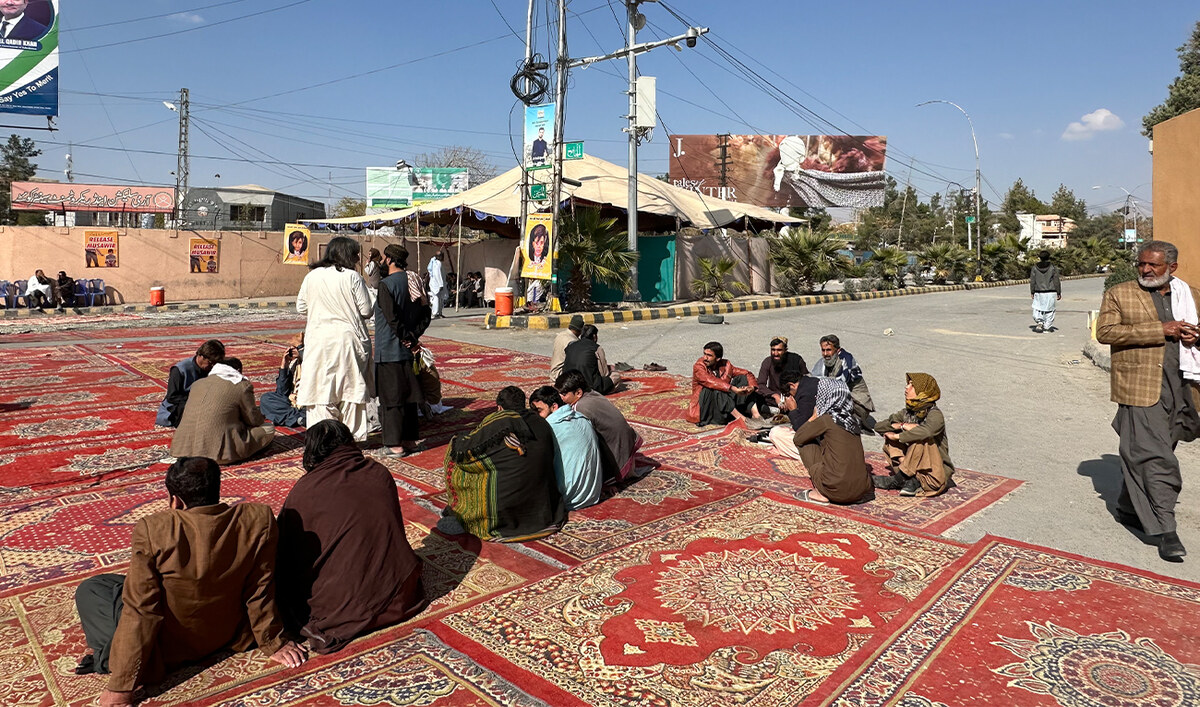
Demonstrators are protesting over the kidnapping of an 11-year-old schoolboy in Quetta, Pakistan, on November 25, 2024. (AN photo)
The kidnapped boy belongs to a prominent tribal family involved in the gold trading business in Balochistan for decades. According to the family, he was abducted from Patel Bagh, a busy neighborhood in Quetta.
Political and religious parties, traders, transporters, lawyers and civil society members have all been visiting the protest camp to express solidarity with the family and demand the immediate and safe recovery of the boy.
Speaking to the media outside the provincial assembly, Chief Minister Mir Sarfraz Bugti said he thought of the kidnapped child like his own son.
“We are utilizing our full capacity and the government is making serious efforts to ensure his safe recovery,” he said.
Commissioner of Quetta Division Hamza Shafqaat shared the same update while speaking to Arab News.
“The government, along with all law enforcement agencies, is working diligently for the recovery of Muhammad Musawir Khan,” he said.
“We have shared our report on the progress in the recovery of the kidnapped boy to with the Balochistan High Court, chief minister and the provincial assembly, and they have all expressed satisfaction that the investigation is heading in the right direction,” he added.
However, Shafqaat declined to divulge details of the ongoing investigation.
Malik Muhammad Sadiq Kakar, senior member of Pashtoonkhwa Milli Awami Party, said that highways in Balochistan’s Quetta, Mastung, Khuzdar, Killa Abdullah, Chaman, Zhob, Killa Saifullah and Loralai districts were closed to protest the kidnapping of the child.
“We are sitting with the family of the kidnapped boy to express solidarity because we want peace in Balochistan,” he told Arab News.
Pakistan’s restive Balochistan province, which shares borders with Afghanistan and Iran, has been the site of a low-level insurgency by separatist militants for over two decades.
Other extremist factions, including Tehreek-e-Taliban Pakistan and Daesh’s Khorasan chapter, also have a presence in the region and frequently attack security forces and civilians.
Last week, Pakistan approved a “comprehensive military operation” in the province, targeting ethnic Baloch separatist groups attacking security forces and Chinese nationals working on the multibillion-dollar China-Pakistan Economic Corridor (CPEC).


