

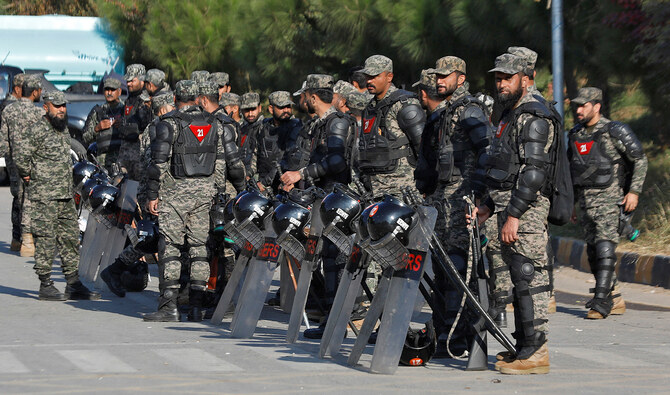

PESHAWAR/ISLAMABAD: A march by thousands of supporters to demand the release of jailed former Prime Minister Imran Khan reached the edges of the Pakistani federal capital of Islamabad on Monday, with his wife Bushara Khan saying the demonstration would not be called off until the ex-premier was released from prison.
The Pakistan Tehreek-e-Insaf (PTI) party is leading a “long march” to the Pakistani capital from cities around the country to call for the release of political prisoners, including Khan, among other demands. The protesters plan to camp at D-Chowk, a high-security area in the capital’s Red Zone that houses key government buildings and is a popular site for protests, but the government has sealed all entry and exit points to the city with shipping containers and heavy contingents of police and other security forces have been stationed across Islamabad.
Khan has been in jail since August last year and faces a slew of charges he says are politically motivated.
“Until Khan does not return to us, we will not end this march,” Bushra said to supporters as the PTI edged closer to Islamabad. “I will stand there till my last breath, you people have to stand by me. I will keep standing even if nobody does because this does not concern just my husband but the country and its leader.”
The largest PTI protest caravan began its journey from Peshawar, led by Khyber Pakhtunkhwa (KP) Chief Minister Ali Amin Gandapur and accompanied by Bushra, who was released on bail in October after nearly nine months in detention. KP is ruled by Khan’s party, which is in opposition in the national parliament, and Gandapur is a key PTI leader and a close aide of Khan’s.
The PTI march started on Sunday but could not reach Islamabad as shipping containers placed by the government on key points on major highways slowed the pace of the caravans.
“We wouldn’t let them storm the capital,” provincial Information Minister Uzma Bukhari told a news conference, adding that several police officials were injured in clashes and rioting at some places in the province.
Ahead of Khan’s protest, the government had imposed a two-month ban on public gatherings in the capital, citing security challenges and inconvenience to the public. Earlier this year, parliament also passed a new law to regulate public assembly in Islamabad, which said, among other rules, that any party or group wanting to hold a protest can only do so at a venue designated by the administration and during set timings.
Authorities have closed all schools in Islamabad and the adjacent garrison city of Rawalpindi, while the Internet and WhatsApp messaging services also slowed.
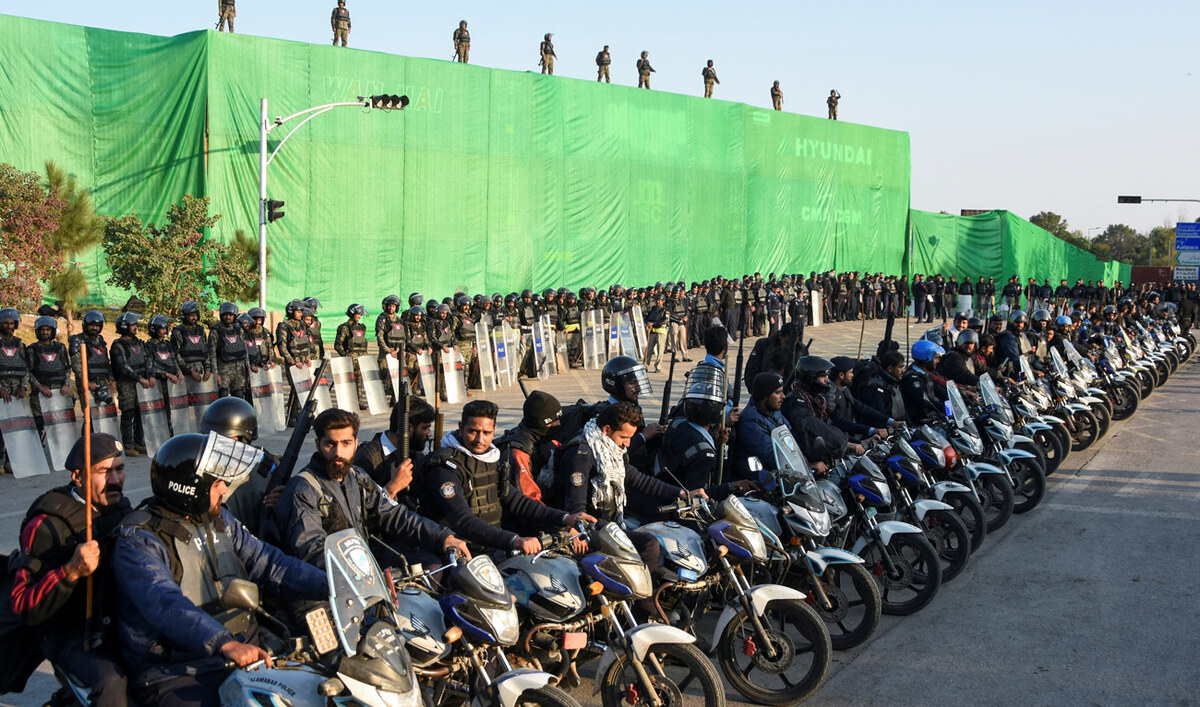
Police officers sit on motorbikes with shipping containers in the background, used to prevent an anti-government rally by supporters of the former Pakistani Prime Minister Imran Khan’s party Pakistan Tehreek-e-Insaf (PTI), in Islamabad on November 24, 2024. (REUTERS)
ARRESTS AND CLASHES
On Monday afternoon, the caravan crossed barriers at Ghazi Barotha and the Hazara toll plaza before entering Punjab’s Attock district. Clashes between protesters and police were reported as the march reached the Kati Pahari area, with PTI workers struggling to clear the motorway under tear gas shelling.
Islamabad police confirmed over 400 arrests related to the protest in the past few days, saying the detainees were being held in different police stations. The PTI said over 3,500 of its leaders and supporters had been arrested in connection to the protests.
“So far, no major clashes have been reported today within Islamabad’s jurisdiction,” Jawad Taqi, the police spokesperson, told Arab News. “Police remain vigilant and prepared to uphold law and order in the capital.”
Another police official in the nearby city of Rawalpindi also reported a “calmer situation,” following minor clashes on Saturday near the peripheries of the federal capital.
“Several individuals have been arrested, but the exact number will be confirmed later,” Sajjad Ali, Punjab Police spokesperson in Rawalpindi, said. “Some police officials were injured yesterday, and further details will be shared soon.”
PTI leader Shaukat Yousafzai, who is part of the caravan, told Arab News over the phone the march would carry on until it reached D-Chowk.
“We will only return from D-Chowk when Imran Khan and other innocent party workers are released from Pakistani prisons,” he said.
The PTI’s march has coincided with a visit to Islamabad by Belarusian President Aleksandr Lukashenko and a 68-member delegation to discuss investment deals. The government has accused the PTI of trying to sabotage the foreign visit in a bid to destabilize its economic recovery efforts.
Yousafzai rejected this criticism, saying his party had called the protest well before the Belarusian delegation’s arrival was announced.
“We have not blocked the roads,” he added. “The government has blocked the roads, creating a situation like this. The government should have held talks with the PTI instead of blocking the roads.”
KP government spokesperson Muhammad Ali Saif also said the PTI planned to hold a “protracted protest.”
“We are advancing according to our plan and are not in a hurry,” he said. “The government should prepare food supplies for the police for several days because we won’t stop until our demands are met.”
A report prepared by Pakistan’s Ministry of Finance estimated economic losses of Rs190 billion ($684 million) per day due to political protests.


