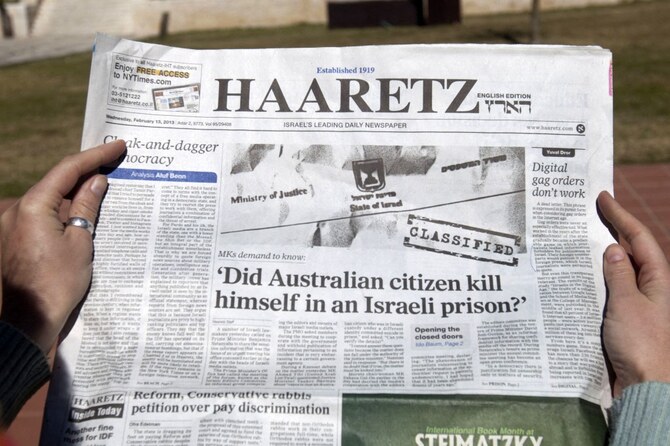

LONDON: Israel’s government on Sunday announced plans to boycott the country’s leading left-leaning newspaper, Haaretz.
The move, confirmed by Communications Minister Shlomo Karhi, follows a unanimous decision by Israeli ministers to order a halt to government advertising in its pages. Officials and employees of government-funded organizations are also prohibited from engaging with the publication.
“We will not allow a reality in which the publisher of an official newspaper in the State of Israel will call for the imposition of sanctions against it and will support the enemies of the state in the midst of a war and will be financed by it,” said a statement from Karhi’s office.
“We advocate a free press and freedom of expression, but also the freedom of the government to decide not to fund incitement against the state of Israel.”
Haaretz is known for its critical stance on Prime Minister Benjamin Netanyahu’s right-wing coalition. It has recently drawn anger from the government for vocal support of a ceasefire to secure the release of hostages held by Hamas since Oct. 7 last year.
In response to Karhi’s decision, Haaretz issued a scathing statement accusing Netanyahu of undermining Israel’s democratic principles.
“Like his friends Putin, Erdogan and Orban, Netanyahu is trying to silence a critical, independent newspaper. Haaretz will not balk and will not morph into a government pamphlet that publishes messages approved by the government and its leader,” the statement read.
The government’s justification for the boycott centers on remarks by Amos Schocken, Haaretz’s publisher, during a recent conference in London. Schocken described the Israeli government as “imposing a cruel apartheid regime on the Palestinian population” and accused it of targeting “freedom fighters” among Palestinians, a statement he later clarified was not intended to refer to Hamas.
The boycott has drawn condemnation from international press freedom advocates, reported The Guardian.
The International Federation of Journalists said it was concerned the Israeli government’s actions represented a broader effort to restrict press freedom and public access to independent reporting.
In May, Israeli authorities shut down the local offices of Al Jazeera, citing national security concerns. The government’s decision to close the satellite news network was met with widespread criticism, with opponents calling it a “dark day for the media.”
As tensions between the government and independent media continue to rise, critics have argued the actions represent a troubling erosion of democratic values in Israel.